Writing a narrative (a short story)
Be the author of your own story: a strong start, events in order, feelings and details, and an ending that wraps it up
About four lessons of 40 to 50 minutes
You are the author of your own story
Every book on the shelf started as an idea in an author's head. Someone decided who the story was about, what happened to them, and how it ended, then wrote it down one sentence at a time. Today that author is you.
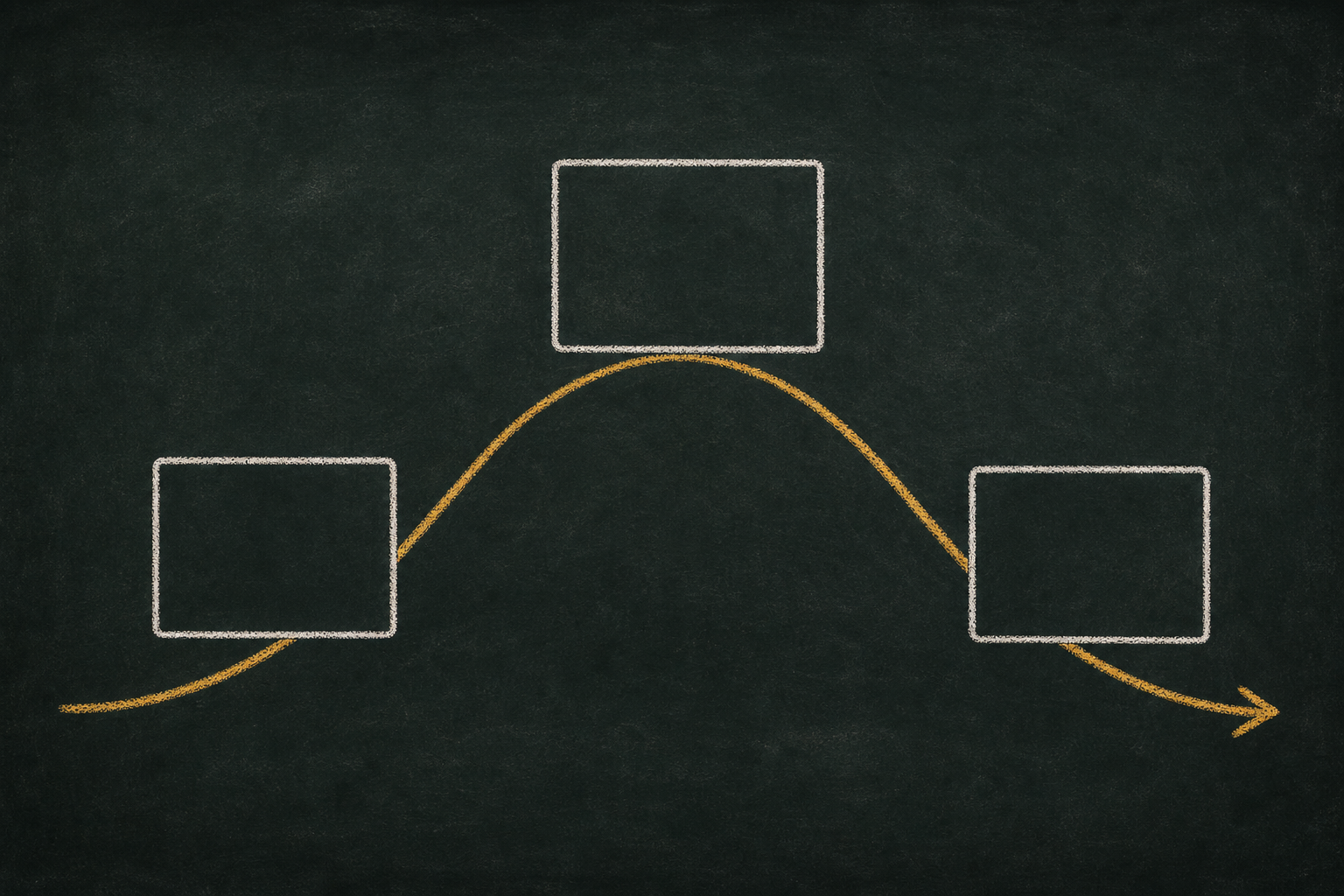
A narrative is just a story you write: it has a beginning where we meet someone, a middle where something happens, and an end that wraps it up. Learn the parts of a story and you can turn any idea, a lost dog, a birthday surprise, a monster under the bed, into a narrative a reader wants to finish.
- A beginning, a middle and an endevery narrative has these three parts, in that order
- 'The moment Tia opened the box, something jumped out'a strong start hooks the reader so they want to read on
- First, next, then, after that, finallyorder words keep your events happening in the right sequence
- 'Her heart raced as she peeked inside'details about actions and feelings make a story come alive
What students will be able to do
Students will write a short narrative that has a clear beginning, middle and end, starts in a way that hooks the reader, tells its events in order using temporal words, includes details about characters' actions, thoughts and feelings, and finishes with an ending that gives a sense of closure.
- I can plan a story with a beginning, a middle and an end.
- I can start my story in a way that makes the reader want to read on.
- I can put my events in order using words like first, next and finally.
- I can add details about what my characters do, think and feel.
- I can end my story so the reader knows it is finished.
Standards this unit teaches
- W.2.3Common Core (US)Write a narrative with details and closure
Write narratives in which they recount a well-elaborated event or short sequence of events, include details to describe actions, thoughts, and feelings, use temporal words to signal event order, and provide a sense of closure.
- W.2.5Common Core (US)Strengthen writing by revising and editing
With guidance and support from adults and peers, focus on a topic and strengthen writing as needed by revising and editing.
- AC9E2LE05Australian Curriculum v9 (ACARA)Create literary texts by adapting familiar stories
Create and edit literary texts, including stories, by adapting the structure and language features of familiar literary texts through drawing, writing, performance or digital tools.
Prior knowledge
This unit builds on skills students should already have met. Revisit any that are shaky first.
- Nouns, verbs and sentencesa story is built from complete sentences, so sentence writing comes first
- Retelling a storyretelling a story in order out loud is the spoken version of the sequence a narrative needs
- Story structureknowing beginning, middle and end as a reader helps you build them as a writer; this reading unit runs a year ahead, so use it as a model to read together
- Sight wordsquick spelling of common words keeps the writing flowing so ideas do not stall
Words to teach and display
- Narrative
- a story you write, with a beginning, a middle and an end
- Character
- a person or animal the story is about
- Setting
- where and when the story happens
- Beginning, middle, end
- the three parts of a narrative, in that order
- Order words
- words like first, next, then and finally that show the order events happen; also called temporal words
- Ending
- the last part, where the story wraps up and the reader knows it is finished
Teach it: model, guided practice, independent
The lesson moves from a teacher writing a story aloud, to building sentences together, to students writing their own narrative. Every example is a real sentence or short story, so writing is practised on the page rather than learned as a rule. Model your own thinking and write in front of the class before asking students to try.
1. A narrative has a beginning, a middle and an end
Open with the shape of every story. A narrative has three parts in order: a beginning where we meet a character in a place, a middle where a problem or event happens, and an end where it is sorted out. Model this by telling a tiny story aloud and naming each part as you go.
Keep the three parts on the board all unit. Beginning: who and where. Middle: what happens, usually a problem. End: how it wraps up.
Plan before writing. Have students say their beginning, middle and end out loud, or draw three quick boxes, before they write a single sentence.
Name the beginning, middle and end. 'Ben found a stray kitten in the rain. He fed it and made a warm bed in a box. By morning the kitten was purring on his lap.'
- Beginning: who and where. Ben found a kitten in the rain.
- Middle: what happened. He fed it and made a warm bed.
- End: how it wrapped up. The kitten was happy on his lap.
Answer: Beginning: Ben found a stray kitten in the rain. Middle: he fed it and made a bed. End: the kitten purred on his lap. Three parts, in order.
- What are the three parts of a narrative?
- What do you tell the reader in the beginning?
- Why is it smart to plan the three parts before you write?
2. A strong start
Teach the hook. A strong start makes the reader want to keep going, and it quickly tells us who the story is about and where they are. Model a boring start next to an exciting one so students hear the difference.
Ways to hook a reader: start with something happening, a surprise, a question, or a sound. 'Bang! The door flew open.' is stronger than 'One day I woke up.'
In the first sentence or two, slip in the character and the setting, so the reader knows who we are following and where they are.
Turn this dull start into a strong one. 'One day a girl went to the park.'
- Add something happening or a surprise to hook the reader.
- Name the character and the setting so we know who and where.
- Read both starts aloud and pick the one that makes you want to read on.
Answer: 'The second Mia reached the park, she spotted a puppy tangled in the swing.' It hooks the reader with a problem and tells us the character (Mia) and the setting (the park).
- What should a strong start make the reader want to do?
- Which two things should the reader learn near the start?
- Name one way to hook a reader in the first sentence.
3. Events in order
Move to the middle, where the events happen. The key skill is order: telling what happened step by step so the reader never gets lost. Model using order words to signal each new step.
Teach the order words: first, next, then, after that, later, finally. They act like signposts that carry the reader from one event to the next.
Warn against jumping around. Tell events in the order they happened, one step at a time, so the story stays clear.
Put these events in order with order words. 'She won the race. She trained hard. She lined up at the start.'
- Work out what happened first: she trained hard.
- Then what came next: she lined up at the start.
- Add order words to signal each step and end with the last event.
Answer: First, she trained hard for weeks. Next, she lined up at the start. Finally, she raced her fastest and won. The order words keep the events in sequence.
- Why do the events need to be in order?
- Name three order words you can use.
- What can go wrong if you jump around instead of telling events in order?
4. Feelings and details
Now bring the story to life. A bare list of events is dull. Details about what characters do, think and feel make a reader care. Model turning a plain sentence into a vivid one.
Add details in three ways: what the character does (actions), what they think, and what they feel. 'She was scared' becomes stronger as 'Her hands shook as she reached for the handle.'
Use describing words and strong verbs, but do not overload every sentence. One good detail per event is plenty for a Grade 2 story.
Add a feeling or a detail to this plain sentence. 'Sam opened the present.'
- Ask how Sam felt or what he did as he opened it.
- Show the feeling through an action or a thought instead of just naming it.
- Keep it to one clear detail so the sentence stays simple.
Answer: 'Sam tore off the paper, grinning, and gasped when he saw the skateboard.' The actions (tore, grinning, gasped) show his excitement instead of just saying he was happy.
- What three kinds of details bring a character to life?
- Why is 'her hands shook' stronger than 'she was scared'?
- How many good details does each event need in a short story?
5. An ending that wraps it up
Finish with the ending. A good ending gives a sense of closure: the reader knows the story is finished and how things turned out. Model an abrupt stop next to a proper ending so students feel the difference.
An ending sorts out the problem from the middle and often shows how the character feels now. 'The dog was safe, and Mia hugged him tight.' tells us it is over and how it ended.
Avoid the two weak endings: stopping in the middle of the action, and writing 'The End' with nothing wrapped up. Give the reader a real finish.
Write a proper ending for this story. 'Leo searched everywhere for his lost puppy. At last he heard a bark behind the shed.'
- Sort out the problem from the middle: does he find the puppy?
- Show how the character feels now that it is resolved.
- Give the reader a sense that the story is finished.
Answer: 'There was his puppy, muddy but wagging its tail. Leo scooped it up and carried it home, happy and relieved.' The problem is solved and we know how Leo feels, so the story feels finished.
- What does a good ending give the reader?
- What should the ending do with the problem from the middle?
- Why is stopping in the middle of the action a weak ending?
Common misconceptions and how to address them
MisconceptionA narrative is just a list of everything that happened in my day.
Why it happens: Students recount events with no shape, so the writing becomes 'and then, and then, and then'.
How to address it: Anchor every story to a beginning, a middle with a problem, and an end. Plan the three parts before writing so the story has a shape, not just a list.
MisconceptionYou should start a story with 'One day' or 'Once upon a time' every time.
Why it happens: These openers are familiar and safe, so students default to them.
How to address it: Model hooks that start with action, a sound or a surprise. Show a dull opener beside a strong one and let students hear which pulls them in.
MisconceptionDetails slow the story down, so it is better to just say what happened.
Why it happens: Students think a story is only its events, so they strip out feelings and description.
How to address it: Show a bare sentence and a vivid one side by side. Teach showing a feeling through an action, and keep it to one good detail per event.
MisconceptionThe order of events does not really matter as long as they are all there.
Why it happens: Students write events as they remember them, jumping back and forth.
How to address it: Teach order words as signposts and have students number their events before writing, so the sequence stays clear.
MisconceptionWriting 'The End' is the same as ending the story.
Why it happens: Students learn that stories say 'The End' and think the words alone finish it.
How to address it: Teach that an ending resolves the problem and shows how the character feels now. The words 'The End' are optional; a real wrap-up is not.
Guided practice (with answers)
1. Name the beginning, middle and end. 'Ava planted a tiny seed. She watered it every day and waited. In spring, a bright sunflower bloomed.'
Answer: Beginning: Ava planted a seed. Middle: she watered it and waited. End: a sunflower bloomed. Three parts, in order.
2. Turn this dull start into a strong one. 'One day a boy found a box.'
Answer: 'Something rattled inside the old box the moment Kai picked it up.' It hooks the reader with a mystery and names the character (Kai).
3. Add order words to these events. 'He crossed the finish line. He tied his laces. He started to run.'
Answer: First, he tied his laces. Next, he started to run. Finally, he crossed the finish line. The order words keep the events in sequence.
4. Add one detail or feeling. 'The dog barked.'
Answer: 'The dog barked and pressed its nose to the window, its tail thumping with joy.' The actions show the dog is excited, not just that it barked.
5. Write a proper ending. 'Mia looked everywhere for her lost ticket. Then she felt something in her back pocket.'
Answer: 'It was the ticket all along! Mia laughed with relief and raced inside before the show began.' The problem is solved and we know how she feels.
6. What are the three parts of a narrative, and what goes in each?
Answer: Beginning: who and where. Middle: what happens, usually a problem. End: how it wraps up. Always in that order.
Independent practice worksheets
Have students plan a short story in three parts, then write it with a strong start, events in order, some feelings and details, and a proper ending. Let them pick their own idea or use a prompt, and write the final draft on lined paper.
Differentiation
- Let the student draw the beginning, middle and end in three boxes, then write one sentence under each.
- Provide a start frame: 'The moment ___, something happened.' so the hook is scaffolded.
- Give an order-word bank (first, next, then, finally) on a strip to keep on the desk.
- Accept a three-sentence story at first, one sentence per part, and grow it from there.
- Add a second problem in the middle before the ending resolves everything.
- Include a line of dialogue where a character speaks, punctuated correctly.
- Write the same story from a different character's point of view.
- Revise a finished draft to make the start stronger and add one vivid detail to each event.
Assessment: exit ticket
A short check done in the last few minutes, or across a finished piece. It samples naming the story parts, fixing a weak start, and writing an ending with closure.
1. Name the beginning, middle and end. 'Tom lost his hat in the wind. He chased it down the street. A kind man caught it and handed it back.'
Answer: Beginning: Tom lost his hat in the wind. Middle: he chased it down the street. End: a man caught it and gave it back.
2. Turn this dull start into a strong one. 'One day I went outside.'
Answer: 'The second I stepped outside, a giant dog bounded straight toward me.' It hooks the reader with action and a surprise.
3. Write a proper ending. 'Nia baked a cake for the fair but dropped it on the floor. Then she had an idea.'
Answer: 'She quickly baked a batch of cupcakes instead, and they sold out first. Nia beamed with pride.' The problem is solved and we know how she feels.
Teacher notes and timings
- Rough timing across four lessons: Lesson 1 the three parts and planning (section 1), Lesson 2 a strong start and events in order (sections 2 and 3), Lesson 3 feelings, details and an ending (sections 4 and 5), Lesson 4 write, revise and share the final draft.
- Language to keep saying: beginning, middle, end; hook the reader; in order; show the feeling; wrap it up. These phrases pre-empt most of the misconceptions.
- Modelled writing is the heart of this unit. Write your own short story in front of the class, thinking aloud, before students write theirs. They copy the shape, not a definition.
- Reading and writing stories reinforce each other, so this unit pairs naturally with the story-structure and retelling units. Read a story, name its parts, then write one with the same shape.
- Curriculum note: US Grade 2 sets out the narrative parts directly (W.2.3, with revising and editing in W.2.5). In ACARA v9, writing stories sits within creating imaginative texts (AC9E2LE05), and the beginning, middle and end structure is developed through the literature and literacy strands. This unit maps to US Grade 2 and supports the ACARA text-creation expectations across the early primary years.
- Use Student view to project this lesson. Print saves the full teacher unit, including answers and teacher notes; use the linked independent-practice worksheets for student handouts.