Retelling a story and key details
Tell a story back in your own words: who, what, where and when, with the beginning, the middle and the end in the right order
About three short lessons of 25 to 35 minutes
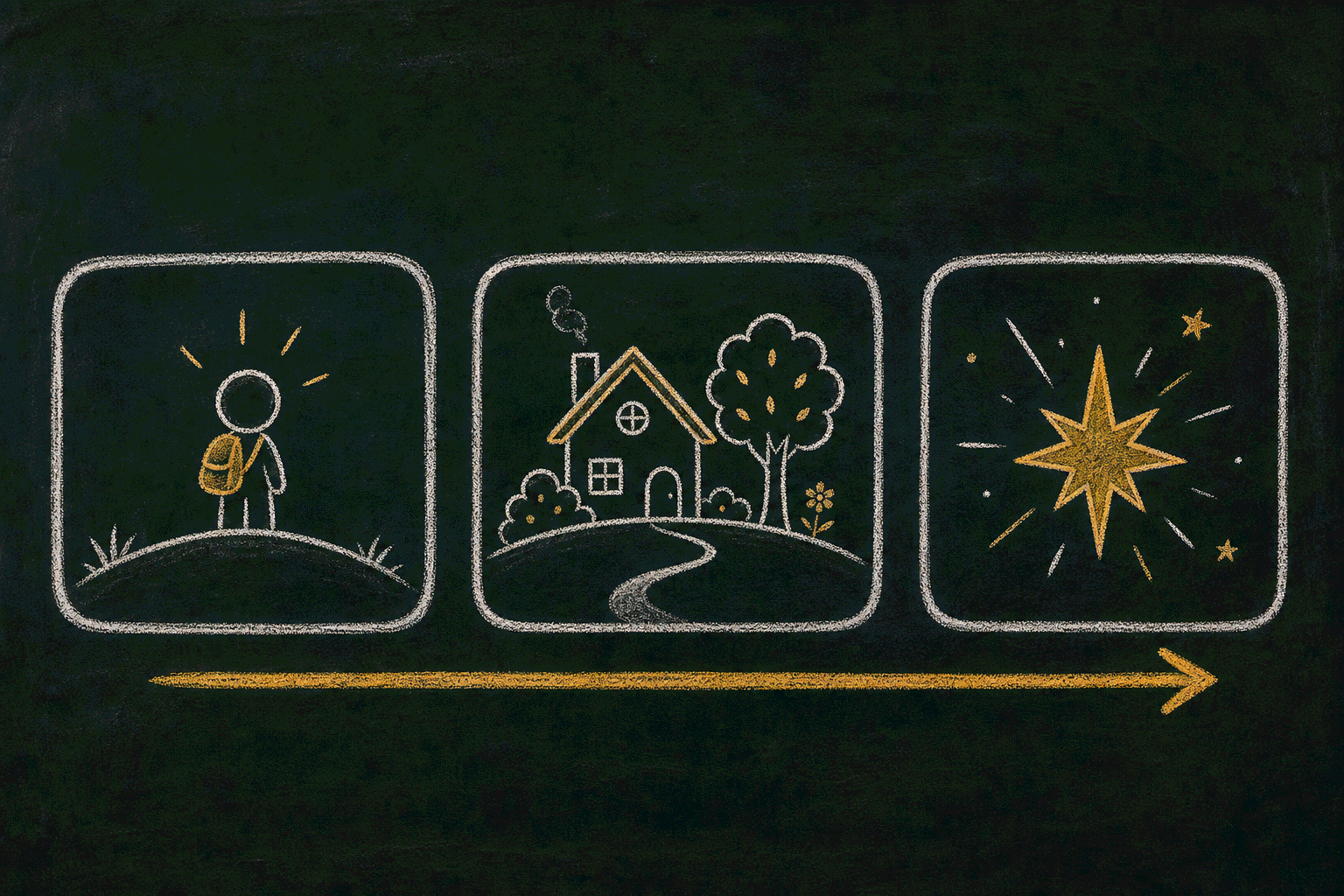
Tell the story back to a friend
You know how it feels to watch a great show and then run to tell a friend all about it. You do not repeat every single word. You tell them who it was about, where it happened, and what happened, from the start to the finish. That is retelling, and you already do it every day.
Retelling a story means telling it back in your own words, in the right order, with the important bits kept in. Today you will learn to catch the who, the where and the what, and to tell a story back from beginning to middle to end so a friend who never heard it would understand.
- Whothe characters: the people or animals in the story
- Where and whenthe setting: the place and time the story happens
- What happenedthe key events, the important things that happen
- In orderbeginning first, then the middle, then the end
What students will be able to do
Students will understand that retelling means telling a story back in their own words with the important parts in order, will name the characters and the setting, will pick out the key events, will retell the beginning, middle and end in the right order using time words, and will say what the story teaches or is mostly about.
- I can say who the story is about and where it happens.
- I can pick out the key details, the important parts of the story.
- I can tell the beginning, the middle and the end in the right order.
- I can use time words like first, then, next and last to keep the order.
- I can say in one sentence what the story teaches or is mostly about.
Standards this unit teaches
- RL.1.2Common Core (US)Retell stories including key details
Retell stories, including key details, and demonstrate understanding of their central message or lesson.
- RL.1.1Common Core (US)Ask and answer questions about key details
Ask and answer questions about key details in a text.
- RL.1.3Common Core (US)Describe characters, settings and major events
Describe characters, settings, and major events in a story, using key details.
- AC9E1LY05Australian Curriculum v9 (ACARA)Comprehension strategies to retell and build meaning
Use comprehension strategies such as visualising, predicting, connecting, summarising, monitoring and questioning to build literal and inferred meanings of texts, and to retell events and describe characters and settings.
Printable anchor chart
Print a wall poster to go with this unit, a code-drawn diagram students can point to during and after the lesson.
Prior knowledge
This unit builds on skills students should already have met. Revisit any that are shaky first.
- Using decodable readerschildren retell stories they hear or read, so confident decoding of the simplest readers helps them hold the story
- Sight wordsinstant recognition of common words keeps reading smooth enough to follow the story
- Building reading fluencysmooth reading frees up the attention a child needs to remember what happened
- Main idea and detailspicking the important parts out of a story is the same sorting habit as finding the main idea and its details
Words to teach and display
- Retell
- to tell a story again in your own words, with the important parts in order
- Character
- a person or animal in the story
- Setting
- where and when the story happens
- Key detail
- an important part of the story that a listener needs to understand it
- Beginning, middle and end
- the three parts of a story in order: how it starts, what happens, and how it finishes
- Lesson or main idea
- what the story teaches or is mostly about
Teach it: model, guided practice, independent
The lesson moves from listening to a story, to naming who and where, to retelling the beginning, middle and end in order. Every example is a short story children hear and retell, so retelling is practised on real stories rather than learned as a rule. Read each story aloud twice, then model the retell out loud before children try.
1. What retelling means
Open with something children already do. When they tell a friend about a show or a trip, they do not repeat every word, they tell the important parts in order. Retelling a story is the same: telling it back in your own words, keeping the important parts, and putting them in the right order. Say the goal simply: could a friend who never heard the story understand it from your retell?
Give the class the four questions and keep them on the board all unit: who, where, what happened, and in what order. A good retell answers all four.
Retelling is not reading the story out word for word. It is putting the story into your own words while keeping the parts that matter.
- What does it mean to retell a story?
- What four things does a good retell tell a listener?
- Is retelling the same as reading every word? Why not?
2. Who and where: characters and setting
Start every retell by naming the characters and the setting. The characters are the who: the people or animals in the story. The setting is the where and when: the place and time it happens. Model catching both from a short story read aloud, because a listener is lost without them.
Ask 'who is this story about?' to find the characters, and 'where and when does it happen?' to find the setting.
A retell that starts with who and where sets the scene for the listener, just like the opening of the story did.
Name the characters and the setting. 'One frosty morning, Nell the fox trotted across the snowy field to look for her lost red mitten.'
- Ask who the story is about: Nell the fox.
- Ask where it happens: a snowy field.
- Ask when it happens: a frosty morning.
Answer: The character is Nell the fox. The setting is a snowy field on a frosty morning. Now a listener knows who the story is about and where it happens.
- Who is the character in the story?
- What is the setting, the where and the when?
3. What happened: the key events
Next find the key events: the important things that happen. A story has small moments and big ones, and a retell keeps the big ones. Teach children to ask 'what is the most important thing that happens here?' rather than trying to remember every tiny detail.
Model sorting the important from the unimportant. Whether the fox's mitten was red or blue may not matter, but the fact that she lost it and then found it does.
Aim for a small number of key events, usually one for the beginning, one or two for the middle, and one for the end.
Pick the key events. 'Nell lost her red mitten in the snow. She searched by the pond and under the big oak but could not find it. At last she spotted it hanging on a branch, blown there by the wind, and pulled it back on with a happy squeak.'
- Find the important thing at the start: Nell lost her mitten.
- Find the important thing in the middle: she searched in several places but could not find it.
- Find the important thing at the end: she found it on a branch and put it back on.
Answer: The key events are: Nell lost her mitten, she searched but could not find it, and she found it on a branch and put it back on. The small details, like the pond or the squeak, can be left out of a short retell.
- What is one key event from the middle of the story?
- How do you decide if an event is important enough to keep?
4. Retell in order: beginning, middle and end
Now put it together in order. Every story has a beginning, a middle and an end, and a retell keeps them in that order. Teach children to use time words like first, then, next and last to hold the order, because a jumbled retell confuses a listener.
The beginning tells who and where and how things start. The middle tells what happens, often a problem. The end tells how it finishes.
Model a full retell using the time words: 'First ... Then ... Next ... Last ...'. The time words are the glue that keeps the order.
Retell the whole story in order using time words. Use the mitten story from before.
- Beginning: start with who and where, then the first key event. First, Nell the fox lost her red mitten in the snowy field.
- Middle: the next key events. Then she searched by the pond and under the oak, but she could not find it.
- End: the last key event. Last, she spotted it on a branch and pulled it back on.
Answer: First, Nell the fox lost her red mitten in the snowy field. Then she searched by the pond and under the oak but could not find it. Last, she spotted it on a branch and put it back on. The time words keep the beginning, middle and end in order.
- Which time words help you keep the order?
- What belongs in the beginning of a retell?
5. What the story teaches
Finish by stepping back from the events to the point. Many stories teach a lesson or have a main idea, what the story is mostly about. Teach children to ask 'what is the story trying to tell me?' after the retell, because understanding the point shows they truly followed the story.
The lesson is not an event, it is the message. In the mitten story, the message might be that patience and looking carefully pay off.
Keep it to one sentence. If a child can retell the events and then say the point in a sentence, they have understood the whole story.
- What is the difference between an event and the lesson of a story?
- In one sentence, what might the mitten story be trying to teach us?
Common misconceptions and how to address them
MisconceptionRetelling means reading the whole story out word for word.
Why it happens: Children think a good retell has to include everything, so they try to reproduce the text exactly.
How to address it: Show that a retell uses your own words and keeps only the important parts. Model retelling a story in far fewer sentences than the original.
MisconceptionYou only need to tell the exciting part.
Why it happens: Children remember the most dramatic moment and skip the rest.
How to address it: Use the four questions: who, where, what happened and in what order. A retell that is only the exciting bit leaves a listener confused about how the story got there.
MisconceptionYou can skip who the story is about and where it happens.
Why it happens: The characters and setting feel obvious to a child who just heard the story, so they leave them out.
How to address it: Remind children the listener did not hear the story. Always start a retell with who and where, so a friend can follow it.
MisconceptionThe order of events does not matter in a retell.
Why it happens: Children recall events as they pop into mind, not as they happened.
How to address it: Teach the time words first, then, next and last, and the beginning, middle and end shape. Practise ordering mixed-up events back into the right sequence.
MisconceptionA retell can start with the ending.
Why it happens: A child who remembers the happy ending best wants to lead with it.
How to address it: Anchor the beginning, middle and end order. The retell starts where the story starts, and the end comes last, so it makes sense to a listener.
Guided practice (with answers)
1. Listen: 'Sam the dog chased his ball into the pond, could not climb out, and barked until Mia came and lifted him out.' Who is the story about, and where does it happen?
Answer: The character is Sam the dog. The setting is a pond. That is the who and the where a retell should start with.
2. Using the Sam story, what is the key event in the middle?
Answer: Sam could not climb out of the pond. That is the important problem in the middle, before the ending where Mia helps him.
3. Retell the Sam story in order using time words.
Answer: First, Sam the dog chased his ball into the pond. Then he could not climb out. Last, he barked until Mia came and lifted him out.
4. Here are three events in the wrong order: 'She blew out the candles. Grandma baked a cake. Everyone sang.' Put them in the right order for a retell.
Answer: First, Grandma baked a cake. Then everyone sang. Last, she blew out the candles. The order follows the beginning, middle and end.
5. In a retell, why do you have to say who the story is about, even if you already know?
Answer: Because the listener did not hear the story. Naming the character at the start lets a friend follow the retell.
6. A story tells how a small ant helped a big lion, who later helped the ant back. In one sentence, what might the story teach?
Answer: That even someone small can help, and kindness is returned. Any sensible one-sentence lesson about helping each other is fine.
Independent practice worksheets
Set the matching ChalkBee reading worksheets for independent work: first a story-elements page to catch who, where and what, then a sequencing page to order the events, then a short passage to retell. Narrative passages work best for retelling, so start with a story.
Differentiation
- Retell using picture cards for the beginning, middle and end, so the child orders images before words.
- Give a retelling frame to fill in: 'This story is about ___. It happens ___. First ___. Then ___. Last ___.'
- Read the story aloud more than twice, and retell one part at a time before joining them.
- Use a hand with five fingers as a prompt: who, where, beginning, middle, end.
- Retell a longer story with more than three key events, keeping only the important ones.
- Retell a story from a character's point of view, using I instead of the character's name.
- Add the lesson or main idea in one sentence at the end of the retell.
- Retell a simple nonfiction text by pulling out the key facts in the order they are given.
Assessment: exit ticket
A short three-part check done with the teacher or as a spoken retell in the last few minutes. It samples naming who and where, ordering the events, and giving the point.
1. Read or listen to a short story, then say who it is about and where it happens.
Answer: Any accurate answer that names the character (the who) and the setting (the where and when) from the story.
2. Retell the same story in order, using the words first, then and last.
Answer: A retell that keeps the beginning, middle and end in order and covers the key events, in the child's own words.
3. In one sentence, what was the story mostly about, or what did it teach?
Answer: Any sensible one-sentence statement of the main idea or lesson that fits the events of the story.
Teacher notes and timings
- Rough timing across three short lessons: Lesson 1 what retelling is plus who and where (sections 1 and 2), Lesson 2 the key events plus retelling in order (sections 3 and 4), Lesson 3 the lesson plus the spoken retell check (section 5 and assessment).
- Language to keep saying: who, where, what happened, in what order; first, then, next, last. These phrases pre-empt most of the misconceptions.
- Model the retell out loud yourself before children try. A first grader learns retelling by hearing a short, clear retell and copying its shape, not from a definition.
- Read each story at least twice. The first read is to enjoy it, the second is to catch the who, where and key events for the retell.
- In ACARA v9, retelling events and describing characters and settings sits within comprehension strategies and responding to literature (AC9E1LY05 and the Year 1 literature content). This unit maps to US Grade 1 retelling and supports the ACARA expectations for retelling and discussing stories in the early years.
- Use Student view to project this lesson. Print saves the full teacher unit, including answers and teacher notes; use the linked independent-practice worksheets for student handouts.