Nouns, verbs and building a sentence
Naming words and doing words, and how to join them into a complete sentence with a capital letter and a full stop
About four lessons of 30 to 40 minutes
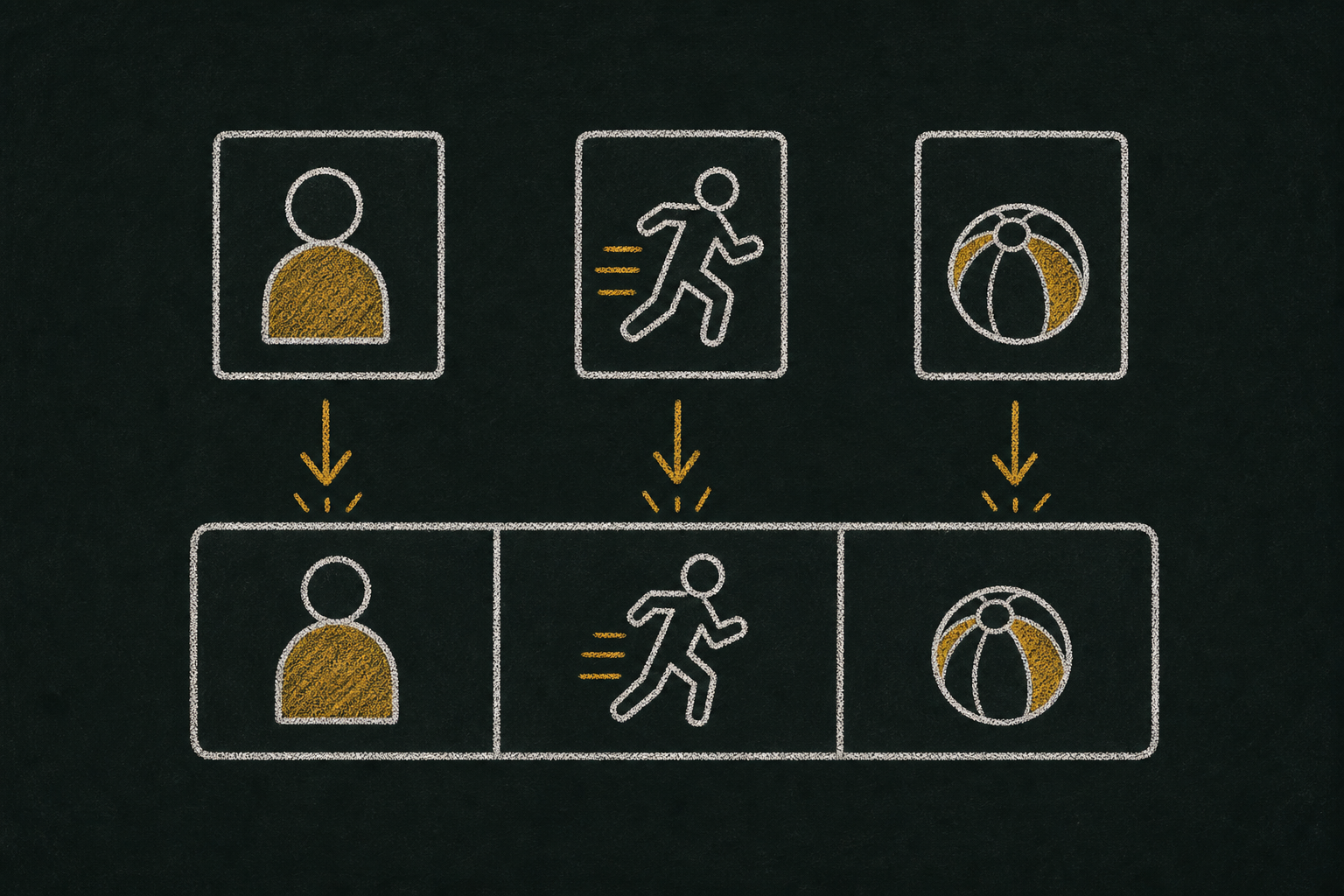
Build a sentence like building with blocks
Think of a sentence as something you build out of blocks. You need a naming block, a word that says who or what the sentence is about, and a doing block, a word that says what happens. Snap the two together and you have a sentence.
Take the naming block dog and the doing block barked. Click them together and you get 'The dog barked.' Today you will learn the two kinds of blocks, naming words and doing words, and how to build a complete sentence and then make it even better.
- Naming block: doga noun, a naming word for a person, place, thing or idea
- Doing block: barkeda verb, a doing or being word
- Snap them together: The dog barked.a naming part plus a doing part makes a complete sentence
- Add detail: The big dog barked loudly.expand a plain sentence so it paints a picture
What students will be able to do
Students will identify nouns and verbs in a sentence, understand that a complete sentence needs both a naming part and a doing part and must express a complete thought, will punctuate a sentence with a capital letter at the start and a full stop at the end, and will expand a simple sentence by adding detail about who, what, when or where.
- I can find the nouns (naming words) in a sentence.
- I can find the verbs (doing words) in a sentence.
- I can tell whether a group of words is a complete sentence that makes sense.
- I can start a sentence with a capital letter and end it with a full stop.
- I can expand a short sentence by adding detail about who, what, when or where.
Standards this unit teaches
- L.2.1Common Core (US)Command of standard English grammar and usage
Demonstrate command of the conventions of standard English grammar and usage when writing or speaking.
- L.2.1.fCommon Core (US)Produce and expand complete sentences
Produce, expand, and rearrange complete simple and compound sentences.
- L.2.2Common Core (US)Capitalization and end punctuation
Demonstrate command of the conventions of standard English capitalization, punctuation, and spelling when writing, including capitalizing the first word in a sentence and using end punctuation.
- AC9E2LA07Australian Curriculum v9 (ACARA)Building noun groups and verb groups
Understand how nouns can be expanded into noun groups with articles and adjectives, and verbs built into verb groups, to make sentences clearer.
Prior knowledge
This unit builds on skills students should already have met. Revisit any that are shaky first.
- Verb tensesverbs are the doing words at the heart of a sentence, and they change with time
- Sight wordsinstant recognition of common words so students can read and build sentences smoothly
- Building reading fluencyreading whole sentences smoothly helps students hear when one is complete
- Synonymschoosing a stronger word helps when expanding a plain sentence
Words to teach and display
- Noun
- a naming word for a person, place, thing or idea
- Verb
- a doing or being word; every complete sentence needs one
- Adjective
- a describing word that tells you more about a noun, used when expanding a sentence
- Sentence
- a group of words that expresses a complete thought, with a naming part and a doing part
- Capital letter
- the big letter that begins every sentence, and every name
- Full stop
- the dot that ends a telling sentence, also called a period
Teach it: model, guided practice, independent
The lesson moves from naming words and doing words, to joining them into a complete sentence, to expanding that sentence with detail. Every example is a real sentence students read, fix and build, so the grammar is practised in writing rather than only labelled. Build sentences together on the board before students try their own.
1. Naming words: nouns
Begin with the building block students meet first: the naming word, or noun. A noun names a person (teacher), a place (park), a thing (pencil) or an idea (happiness). Gather nouns from around the room so students see that anything you can name is a noun, not just objects.
Sort nouns into the four kinds out loud: person, place, thing, idea. The idea kind (fun, love, courage) is the one students forget, so give a couple of clear examples.
Point out proper nouns: a noun that names one particular person or place, such as Sarah or London, and always begins with a capital letter. This links straight to the punctuation section later.
- Name a noun that is a person, one that is a place, and one that is a thing.
- Is happiness a noun? What kind?
- Why does the name Sarah start with a capital letter?
2. Doing words: verbs
Next comes the doing word, or verb. Most verbs show an action you can act out: run, jump, eat, write. Have students perform a few so the idea of a doing word sticks. Then widen it: some verbs show a state of being, like is, are and seem, even though nothing moves.
Play a quick game: you say a noun and a verb (the dog barks), and students point out which word is the doing word. The verb is what the naming thing does or is.
Note that verbs change with time, which students may know from the tenses guide: walk, walked, will walk. The important idea here is simply that every complete sentence has to have a verb.
- Find the verb: 'The bird sings.'
- Is the word is a verb? What kind of verb is it?
- Act out a verb for the class to name.
3. A sentence needs both, and it must make sense
Now put the blocks together. A complete sentence needs a naming part (who or what it is about) and a doing part (the verb), and together they must express a complete thought. Build one on the board: take the noun dog and the verb barked and join them into 'The dog barked.' A naming block plus a doing block makes a sentence.
Test groups of words against the rule. 'The big dog.' has a naming part but no verb, so it is not a sentence yet. 'Ran to the park.' has a verb but no naming part, so we do not know who ran. Each is missing a block.
Fixing a non-sentence means adding the missing block until it makes complete sense on its own.
Turn each group of words into a complete sentence by adding the missing part. 'The big dog.' and 'Ran to the park.'
- 'The big dog.' has a naming part but no doing part, so add a verb: what did the dog do?
- 'Ran to the park.' has a doing part but no naming part, so add who or what: who ran?
- Read each new sentence back to check it expresses a complete thought.
Answer: 'The big dog barked.' and 'The children ran to the park.' Each now has both a naming part and a doing part and makes complete sense.
- Is 'The happy cat.' a complete sentence? What is it missing?
- What two parts does every complete sentence need?
4. Capital letter and full stop
A complete sentence also has to be dressed properly. It begins with a capital letter and ends with an end mark, most often a full stop. The capital letter signals 'a sentence starts here' and the full stop signals 'the thought ends here'. Model fixing a sentence that has neither.
Teach the two-part check for every sentence students write: capital at the start, full stop at the end. Names inside the sentence keep their capital letters too, because they are proper nouns.
Mention that a question ends with a question mark and an excited sentence can end with an exclamation mark, but a plain telling sentence ends with a full stop.
Fix the punctuation of this sentence: 'the cat sat on the mat'
- Check the start: the first word needs a capital letter, so 'the' becomes 'The'.
- Check the end: a telling sentence needs a full stop after 'mat'.
- Read it back to confirm it is now correctly dressed.
Answer: The cat sat on the mat. A capital letter at the start and a full stop at the end.
- What two things does every telling sentence need at its start and end?
- In 'my friend Ben ran home', which words need capital letters?
5. Expanding a simple sentence
Finish by making a plain sentence richer. A simple sentence like 'The dog barked.' is complete, but we can expand it by adding detail that answers who, what kind, when or where. Adding an adjective, or a where, or a when, turns a bare sentence into one that paints a picture, while it still makes sense.
Expand a little at a time, one question at a time: what kind of dog? (a big brown dog), how did it bark? (loudly), where? (at the gate). Each answer adds a detail without breaking the sentence.
Keep the rule in view: expanding means adding meaningful detail, not just piling on words. The longer sentence still needs a naming part, a verb and a complete thought.
Expand the simple sentence 'The dog barked.' by adding detail.
- Add what kind, using an adjective: 'The big brown dog barked.'
- Add how or where: 'The big brown dog barked loudly at the gate.'
- Read it back to check it still makes complete sense and keeps its capital and full stop.
Answer: 'The big brown dog barked loudly at the gate.' The sentence now tells us what kind of dog, how it barked and where, and it is still one complete sentence.
- Add one detail to 'The girl ran.' to tell where.
- What must stay true even after we expand a sentence?
Common misconceptions and how to address them
MisconceptionOnly objects you can touch are nouns, so people, places and ideas do not count.
Why it happens: The first nouns children meet are usually things, so they overlook the other kinds.
How to address it: Sort nouns into person, place, thing and idea every time. Collect examples of each kind, and dwell on idea nouns like fun and love, which are the ones most often missed.
MisconceptionA verb has to be a visible action, so is and are are not verbs.
Why it happens: Verbs are taught as doing words, and being verbs do not look like actions.
How to address it: Show that every complete sentence has a verb, then point to 'The sky is blue.' The verb is is. Being verbs tell us how something is, not what it does, but they are still verbs.
MisconceptionAny group of words with a capital letter and a full stop is a sentence.
Why it happens: Students judge a sentence by its punctuation rather than by whether it is complete.
How to address it: Show 'The big dog.' and 'In the park.' with correct punctuation but no complete thought. Ask what is missing. A sentence is judged by its parts and its meaning, not just its dots.
MisconceptionA sentence just needs to be long, so a run of words strung together counts.
Why it happens: Students equate more words with a better sentence and lose the single complete thought.
How to address it: Read a rambling run-on aloud and ask where one thought ends and the next begins. Break it into complete sentences, each with its own capital and full stop.
MisconceptionOnly the very first word of a sentence ever gets a capital letter.
Why it happens: The 'capital at the start' rule is learned so firmly that names in the middle get missed.
How to address it: Point out that names (proper nouns) always keep their capital wherever they appear. In 'we saw Ben at school', Ben needs a capital even though it is not the first word.
MisconceptionExpanding a sentence means adding any extra words at all.
Why it happens: Students hear 'make it longer' and add words that do not add meaning or that break the sentence.
How to address it: Expand by answering a question: what kind, when or where. Each added detail must make sense and the sentence must still read as one complete thought.
Guided practice (with answers)
1. Find the two nouns in this sentence: 'The teacher opened the door.'
Answer: teacher and door. Teacher names a person, door names a thing.
2. Find the verb: 'The children played in the yard.'
Answer: played. It is the doing word, what the children did.
3. Is this a complete sentence? 'The small yellow bird.' If not, what is missing?
Answer: No. It has a naming part but no verb, so we do not know what the bird did. It needs a doing word, such as 'sang'.
4. Fix the punctuation: 'we went to the beach'
Answer: We went to the beach. Capital W at the start and a full stop at the end.
5. Which words need a capital letter? 'on monday my dog rex ran fast'
Answer: On (first word), Monday (a day is a proper noun) and Rex (a name). It becomes 'On Monday my dog Rex ran fast.'
6. Expand this simple sentence by adding where: 'The boy read.'
Answer: For example, 'The boy read quietly in the library.' The added detail tells where, and the sentence still makes complete sense.
Independent practice worksheets
Set the matching ChalkBee grammar worksheets for independent work. Start with naming and doing words on their own, then move to building and punctuating whole sentences.
Differentiation
- Colour-code the two blocks: one colour for the naming part, another for the doing part, so a complete sentence is visibly two colours.
- Give sentences with the noun or verb already underlined and ask students to find only the other one.
- Use short, familiar sentences for the punctuation check before moving to ones students write themselves.
- Offer a word bank of adjectives and where-phrases for the expanding step, rather than a blank page.
- Join two simple sentences into one compound sentence with and, but or so.
- Sort a mixed list of complete sentences and non-sentences (fragments), and fix the fragments.
- Expand a sentence in three different ways and discuss which version paints the clearest picture.
- Find every noun and verb in a sentence from a class reading book and label each one.
Assessment: exit ticket
A three-question exit ticket done on a slip in the last few minutes. It samples finding a noun and a verb, judging a complete sentence, and punctuating one correctly.
1. Write one noun and one verb from this sentence: 'The frog jumped into the pond.'
Answer: Noun: frog or pond. Verb: jumped.
2. Is this a complete sentence? 'Under the tall green tree.' Explain.
Answer: No. It has no naming part and no doing part, only a where-phrase, so it does not express a complete thought.
3. Rewrite this with correct capital and full stop: 'the bus was late today'
Answer: The bus was late today.
Teacher notes and timings
- Rough timing across four lessons: Lesson 1 nouns (section 1), Lesson 2 verbs (section 2), Lesson 3 building and punctuating a complete sentence (sections 3 and 4), Lesson 4 expanding a sentence plus the exit ticket (section 5 and assessment).
- Language to keep saying: naming part plus doing part, does it make complete sense, capital at the start and full stop at the end. These phrases pre-empt most of the misconceptions.
- Keep building sentences physically. Word cards or two-colour blocks for the naming part and the doing part make an abstract rule something students can move around with their hands.
- Being verbs (is, are, was) are the ones students miss. Include a couple in every set so the idea that a verb can show a state, not just an action, is normal from the start.
- Proper nouns tie the noun work to the capital-letter work. Reuse names from section 1 when you reach punctuation so students see why they keep their capitals.
- Use Student view to project this lesson. Print saves the full teacher unit, including answers and teacher notes; use the linked independent-practice worksheets for student handouts.