Understanding percentages
Percent as a rate per hundred, its fraction and decimal forms, finding a percent of a quantity, and the 10 percent building block
About four to five lessons of 45 to 60 minutes
How much do you really save in a sale?
A hoodie you want is $40, and the tag says 25% off. Your friend guesses you save $25. Are they right? Not even close. Percentages are the language of every sale, every test score, every phone battery and every news headline, and getting them right is the difference between a bargain and being fooled.
A percentage is just a fair way of saying how much out of every hundred. Once you see that 'per cent' literally means 'per hundred', you can turn any percentage into a fraction or a decimal, find a percentage of any amount in your head, and work out that a 25% discount on a $40 hoodie saves you exactly $10.
- 25% off a $40 hoodie25% of 40 is 10, so you save $10 and pay $30
- A phone battery at 50%50% is one half, so the battery is half full
- 18 out of 20 on a testthat is 90%, because 18 out of 20 is 90 out of 100
- 10% of a $60 pizza order tip10% is one tenth, so the tip is $6
What students will be able to do
Students will understand a percent as a rate per hundred, convert between percentages, fractions and decimals, find a percent of a quantity using fraction and per-hundred reasoning, use 10 percent as a building block, and apply this to discounts and to finding a whole from a part.
- I can explain that a percent means a number out of one hundred.
- I can write a percent as a fraction and as a decimal.
- I can find a percent of a quantity.
- I can use 10 percent to build other percentages such as 5, 20 and 30 percent.
- I can work out a sale price after a percentage discount.
Standards this unit teaches
- 6.RP.A.3cCommon Core (US)Find a percent of a quantity
Find a percent of a quantity as a rate per 100 (for example, 30% of a quantity means 30/100 times the quantity), and solve problems that involve finding the whole given a part and the percent. This is a lettered sub-standard of 6.RP.A.3, which does not have its own page in the library, so no direct link is given.
- 6.RP.A.3Common Core (US)Solve ratio, rate and percent problems
Use ratio and rate reasoning to solve real-world and mathematical problems, including percent problems such as finding a percent of a quantity and finding the whole from a part and percent.
- AC9M6N03Australian Curriculum v9 (ACARA)Percentages of a whole (Year 6)
Recognise that 100 per cent represents the whole, and use percentages to describe, compare and estimate the relative size of quantities, connecting familiar percentages to their equivalent fractions and decimals.
- AC9M5N07Australian Curriculum v9 (ACARA)Fractions, decimals and percentages of amounts (Year 5)
Find a familiar fraction, decimal or percentage of a quantity, including percentage discounts, by choosing efficient calculation strategies. Australia introduces finding a percentage of an amount at Year 5, so this US Grade 6 unit builds on that Year 5 descriptor.
Printable anchor chart
Print a wall poster to go with this unit, a code-drawn diagram students can point to during and after the lesson.
Prior knowledge
This unit builds on skills students should already have met. Revisit any that are shaky first.
- How to teach fractionsa percent is a fraction with a denominator of 100
- Grade 4 equivalent fractions teaching unitsimplifying, needed to turn 25/100 into 1/4
- Grade 5 decimals teaching unithundredths, which are exactly percents in decimal form
- How to teach decimals0.25 and 25% are the same amount written two ways
Words to teach and display
- Percent
- a number out of one hundred, written with the percent sign
- Per cent
- the meaning of the word: 'per hundred', so 25% is 25 for every 100
- Fraction
- a percent is a fraction whose denominator is 100, such as 25/100
- Decimal
- a percent divided by 100, so 25% is 0.25
- Discount
- an amount taken off a price, often given as a percentage
- The whole
- the full amount that a percentage is a part of, which is 100%
Teach it: concrete, pictorial, abstract
The lesson moves from things students can hold, to pictures and diagrams, to the written maths. The diagrams below are drawn from data, so they are accurate and print cleanly. Teach straight from them.
1. Per cent means per hundred
ConcreteBreak the word open: per cent means per hundred, the same 'cent' as in a century of 100 years or 100 cents in a dollar. So 25% means 25 out of every 100. Picture the whole as one bar worth 100 equal parts: shade 25 of them and you have shaded 25%.
The whole is always 100%. If 25% of the bar is shaded, the other 75% is not, and 25 plus 75 makes the full 100. Every percentage is measured against that whole of 100.
- What does the 'cent' in per cent mean?
- If 30% of a bar is shaded, what percent is not shaded?
2. Percent, fraction and decimal are three names for one amount
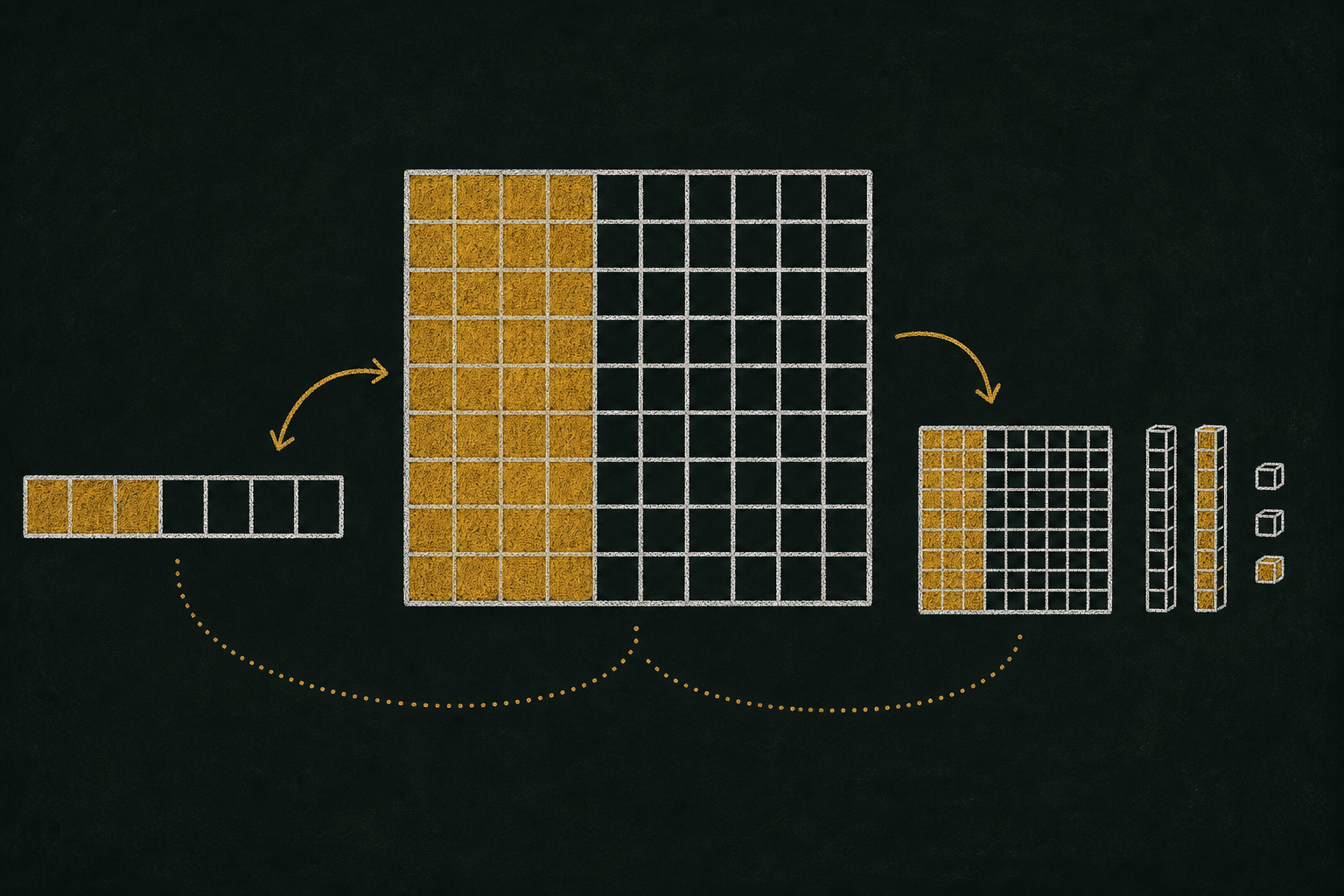
PictorialBecause a percent is a count out of 100, it is also a fraction over 100, and dividing by 100 gives a decimal. So 25% is 25/100, which simplifies to 1/4, and as a decimal is 0.25. The shaded quarter-bar below is the very same amount as 25 shaded out of 100.
Learn the everyday set by heart: 50% is 1/2 is 0.5, 25% is 1/4 is 0.25, 10% is 1/10 is 0.1, 75% is 3/4 is 0.75, and 100% is the whole, 1. To turn a percent into a decimal, divide by 100 (move the point two places left): 40% becomes 0.40.
Write 40% as a fraction in simplest form and as a decimal.
- Per cent means per hundred, so 40% is 40/100.
- Simplify by dividing top and bottom by 20: 40/100 = 2/5.
- Divide by 100 for the decimal: 40% = 0.40 = 0.4.
Answer: 40% = 2/5 = 0.4.
- What is 50% as a fraction and as a decimal?
- Turn 75% into a fraction and a decimal.
3. Finding a percent of a quantity
PictorialNow the useful skill: how much is 25% of 40? Because 25% is 1/4, finding 25% of 40 is the same as finding a quarter of 40. Split 40 into 4 equal parts of 10, and one of those parts, 25%, is 10.
The per-hundred method gives the same answer and works for any percent: 25% of 40 means 25/100 times 40, which is 40 divided by 100 (that is 0.4) times 25, giving 10. Use the friendly fraction when there is one, and the per-hundred method otherwise.
Find 25% of 40.
- Recognise 25% as the fraction 1/4.
- Split 40 into 4 equal parts: each part is 10.
- One of the four parts is 25%, so 25% of 40 is 10.
Answer: 25% of 40 is 10.
- What friendly fraction is 50%, and what is 50% of 18?
- What is 25% of 80?
4. The 10 percent building block
AbstractThe most useful percentage to find is 10%, because 10% of any number is just that number divided by 10. From 10% you can build almost any friendly percentage. Take 60: 10% of 60 is 6. Then 20% is two lots of that, 12, and 5% is half of it, 3.
Combine the blocks for percentages in between. 15% is 10% plus 5%, so 15% of 60 is 6 plus 3, which is 9. 30% is three lots of 10%, which is 18. This mental toolkit handles most tips, discounts and survey figures without a calculator.
Find 15% of 60 using the 10 percent building block.
- 10% of 60 is 60 divided by 10, which is 6.
- 5% is half of 10%, so 5% of 60 is half of 6, which is 3.
- 15% is 10% plus 5%, so add: 6 plus 3 is 9.
Answer: 15% of 60 is 9.
- How do you find 10% of a number quickly?
- Build 20% of 90 from 10% of 90.
5. Working out a sale discount
AbstractBack to the hook. A hoodie is $40 with 25% off. The discount is 25% of $40, which we found is $10. That is what you save. The price you actually pay is the whole minus the discount: $40 minus $10 is $30.
There are two fair ways to reach the sale price. Either find the discount (25% of 40 is 10) and subtract it from 40, or notice that paying after 25% off means paying the other 75%, and 75% of 40 is 30. Both give $30, which is a good way to check your work.
A $40 hoodie has 25% off. What is the sale price?
- Find the discount: 25% of 40 is 10, so you save $10.
- Subtract from the original price: 40 minus 10 is 30.
- Check the other way: after 25% off you pay 75%, and 75% of 40 is 30.
Answer: The sale price is $30.
- What two steps turn an original price and a percent off into a sale price?
- A $50 game is 20% off. What do you save, and what do you pay?
Common misconceptions and how to address them
Misconception25% always means 25 dollars, or 25 things.
Why it happens: Students treat the percent as a fixed amount rather than a rate that depends on the whole.
How to address it: A percent is per hundred of whatever the whole is. 25% of 40 is 10, but 25% of 200 is 50. The same percent gives different amounts because the wholes are different.
MisconceptionTo find 25% of 40 you subtract, so the answer is 40 minus 25, which is 15.
Why it happens: The percent and the amount look like two numbers to combine, and subtraction is the habit from discount problems.
How to address it: Finding a percent of a quantity is multiplying by a fraction, not subtracting. 25% of 40 is 1/4 of 40, which is 10. Subtracting only comes later, when you take a discount off a price.
Misconception25% and 0.25 are different sizes.
Why it happens: One has a percent sign and one has a decimal point, so they look like different numbers.
How to address it: A percent is per hundred, and dividing by 100 gives the decimal, so 25% is 25/100 is 0.25, exactly the same amount. Lay a shaded quarter-bar beside the label 0.25 to make it one picture.
MisconceptionA bigger percent is always a bigger amount.
Why it happens: Students compare the percents and ignore the whole each one is a part of.
How to address it: 10% of 1000 is 100, but 90% of 50 is only 45, so the smaller percent won. A percentage is only comparable when both are parts of the same whole.
Misconception50% off and then another 50% off is 100% off, so the item is free.
Why it happens: Students add the two discounts as if both were taken from the original price.
How to address it: The second discount is taken off the already reduced price. 50% off $40 is $20, and 50% off that $20 is $10, so you still pay $10, not nothing. Stacked discounts do not simply add.
Misconception5% written as a decimal is 0.5.
Why it happens: Students move the decimal point one place instead of two, treating percent like tenths.
How to address it: Per cent means per hundred, so divide by 100, moving two places: 5% is 5/100 is 0.05. Note that 0.5 would be 50%, ten times bigger.
Guided practice (with answers)
1. Write 60% as a fraction in simplest form and as a decimal.
Answer: 60% = 60/100 = 3/5 = 0.6.
2. Find 50% of 18.
Answer: 9, because 50% is one half and half of 18 is 9.
3. Find 25% of 80.
Answer: 20, because 25% is one quarter and 80 split into 4 is 20.
4. Find 10% of 90, then use it to find 30% of 90.
Answer: 10% of 90 is 9, so 30% is three lots of 9, which is 27.
5. A $50 game is 20% off. How much do you save, and what do you pay?
Answer: Save $10 (20% of 50), and pay $40 (50 minus 10).
6. 20% of a class are absent, and that is 5 children. How many children are in the class?
Answer: 25, because 20% is 1/5, so the whole class is 5 lots of 5.
Independent practice worksheets
ChalkBee does not yet have a dedicated percentages worksheet generator, so set the closely related fraction and decimal worksheets, whose answer keys are computed in code and never wrong. These rehearse the exact skills a percentage rests on: simplifying, finding a fraction of an amount, and hundredths as decimals.
Differentiation
- Keep the per-hundred bar in view so every percent is anchored to a whole of 100.
- Limit early work to the friendly percentages 50, 25 and 10, using their fractions 1/2, 1/4 and 1/10.
- Provide a percent, fraction, decimal matching card set so the three forms are connected by hand.
- Do discounts in two clearly separate steps: find the discount, then subtract it.
- Find awkward percentages such as 35% or 12.5% by combining 10%, 5% and 2.5% blocks.
- Work backwards to find the whole from a part and a percent (if 15% is 9, the whole is 60).
- Compare two offers, such as 25% off versus a third off, and justify which is the better deal.
- Find a percentage increase as well as a decrease, such as a 20% tip added to a bill.
Assessment: exit ticket
A three-question exit ticket for the last five minutes, sampling finding a percent of an amount, a discount, and converting between forms.
1. Find 25% of 60.
Answer: 15, because 25% is one quarter and 60 split into 4 is 15.
2. A $30 shirt is 10% off. What is the new price?
Answer: $27. The discount is 10% of 30, which is 3, and 30 minus 3 is 27.
3. Write 75% as a fraction in simplest form and as a decimal.
Answer: 3/4 and 0.75, because 75/100 simplifies to 3/4.
Teacher notes and timings
- Rough timing across four to five lessons: Lesson 1 per cent as per hundred (section 1), Lesson 2 the three forms (section 2), Lesson 3 finding a percent of a quantity (section 3), Lesson 4 the 10 percent building block (section 4), Lesson 5 discounts plus the exit ticket (section 5 and assessment).
- This unit assumes fractions and decimals, especially simplifying and hundredths. Revisit the Grade 4 equivalent-fractions and Grade 5 decimals units if either is shaky.
- Language to keep saying: per cent means per hundred, the whole is 100%, a percent of a quantity is multiplying by a fraction, 10% is dividing by 10. These pre-empt most of the misconceptions.
- The bar models split a whole into a shaded percent and the rest, so the per-hundred meaning stays visible. They show the proportion, not 100 separate hundredth squares, so describe them as a whole worth 100 parts.
- Curriculum note: US Grade 6 finds a percent of a quantity as a rate per 100 (6.RP.A.3c). ACARA introduces finding a percentage of an amount, including discounts, at Year 5 (AC9M5N07) and the meaning of percentages against the whole at Year 6 (AC9M6N03), so this unit spans Australian Years 5 and 6.
- Use Student view to project this lesson. Print saves the full teacher unit, including answers and teacher notes; use the linked independent-practice worksheets for student handouts.