Equivalent fractions and comparing
Building equivalent fractions, fractions on a number line, comparing unlike fractions, and simplest form
About four to five lessons of 45 to 60 minutes
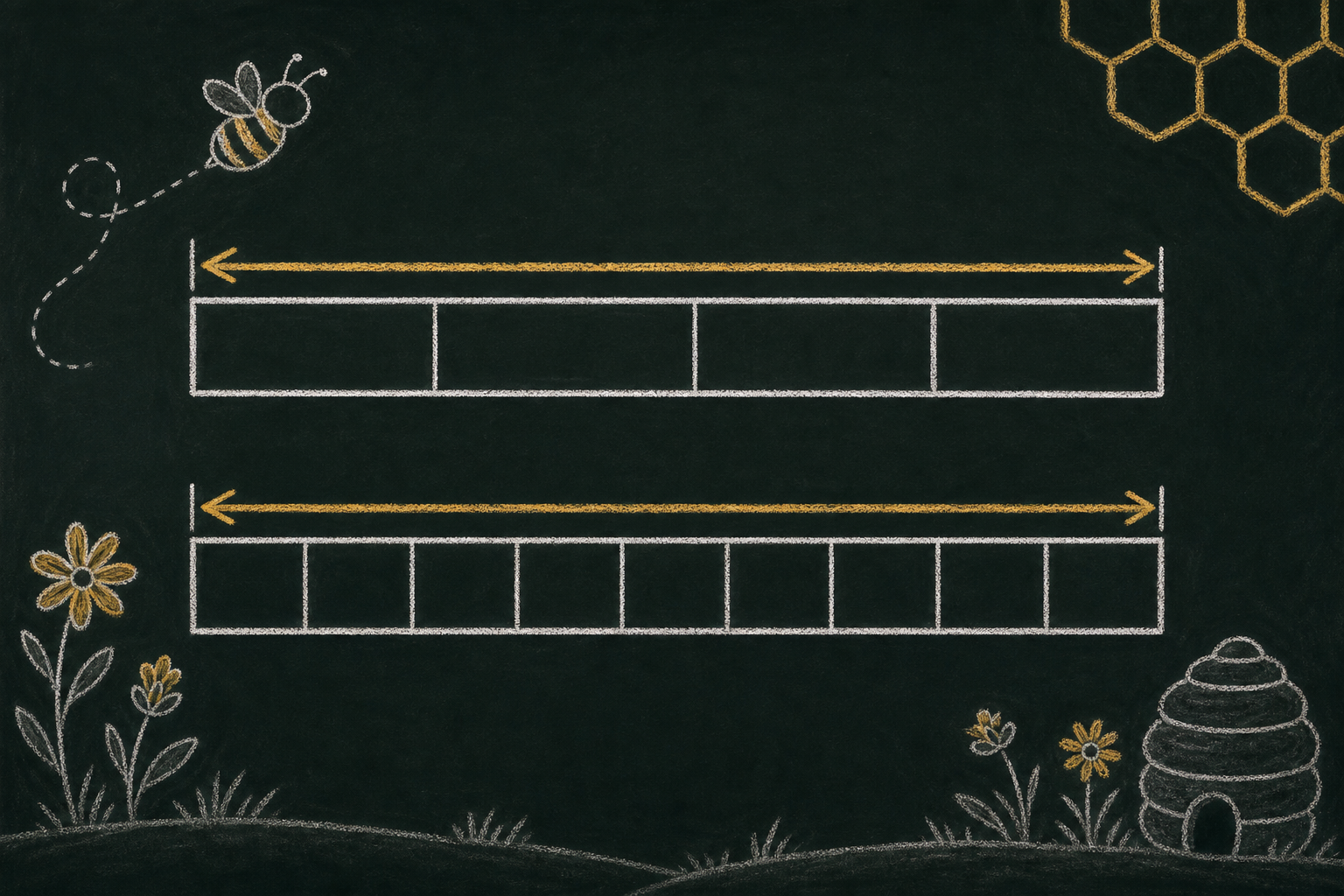
The same amount can wear a different fraction
Two friends order the same size pizza. One shop cuts it into 4 big slices and gives you 2 of them. The other cuts it into 8 smaller slices and gives you 4 of them. Do you get more pizza at one shop than the other? No, you get exactly the same amount of pizza, half of it, even though one plate says 2/4 and the other says 4/8. Same pizza, same half, different fraction.
In Grade 3 you learned to name fractions and place them on a number line. Now you will see that many different-looking fractions can name the very same amount, learn the quick rule for building them, and settle the everyday argument of which fraction is bigger, even when the tops and bottoms are all different.
- 2 of 4 big slices or 4 of 8 small slices2/4 and 4/8 are the same half of the same pizza
- Half a chocolate bar, or 3 of its 6 pieces1/2 and 3/6 cover the same amount
- A cup half full, marked 1/2 or 2/4the same line on the cup, two names for it
- Half a cup of flour or two quarter-cups1/2 cup and 2/4 cup pour the same amount
What students will be able to do
Students will build equivalent fractions with visual models and by multiplying the numerator and denominator by the same number, place equivalent fractions on a number line, compare two unlike fractions using a common denominator or a benchmark, and write a fraction in its simplest form.
- I can show with a model that two fractions such as 2/4 and 1/2 are equivalent.
- I can build an equivalent fraction by multiplying the top and bottom by the same number.
- I can place equivalent fractions on the same point of a number line.
- I can compare two fractions with different denominators and say which is greater.
- I can write a fraction in its simplest form.
Standards this unit teaches
- 4.NF.A.1Common Core (US)Generate equivalent fractions
Explain why a fraction a/b is equivalent to a fraction (n x a)/(n x b) by using visual fraction models, and use this principle to recognise and generate equivalent fractions.
- 4.NF.A.2Common Core (US)Compare two fractions
Compare two fractions with different numerators and denominators, e.g. by creating common denominators or numerators or comparing to a benchmark such as 1/2, recognising comparisons are valid only when the fractions refer to the same whole, and record with the symbols greater than, equal to, or less than.
- AC9M4N02Australian Curriculum v9 (ACARA)Represent unit fractions and their multiples
Recognise and represent unit fractions such as halves, thirds, quarters, fifths and tenths and their multiples in different ways, and combine same-denominator fractions to make a whole.
- AC9M5N03Australian Curriculum v9 (ACARA)Use equivalence to compare and order fractions (Year 5 bridge)
Use equivalence to compare, order and represent common fractions on the same number line and justify the order. ACARA places explicit equivalence-and-comparing at Year 5, so this US Grade 4 unit reaches toward that Year 5 descriptor.
Printable anchor chart
Print a wall poster to go with this unit, a code-drawn diagram students can point to during and after the lesson.
Prior knowledge
This unit builds on skills students should already have met. Revisit any that are shaky first.
Words to teach and display
- Fraction
- a number that names equal parts of one whole
- Numerator
- the top number, how many equal parts you have
- Denominator
- the bottom number, how many equal parts the whole is cut into
- Equivalent fractions
- different fractions that name the same amount, such as 2/4 and 1/2
- Common denominator
- the same bottom number given to two fractions so you can compare them
- Simplest form
- a fraction written with the smallest possible numbers, such as 1/2 instead of 4/8
Teach it: concrete, pictorial, abstract
The lesson moves from things students can hold, to pictures and diagrams, to the written maths. The diagrams below are drawn from data, so they are accurate and print cleanly. Teach straight from them.
1. The same amount, cut two ways
ConcreteFold two identical paper strips. Fold the first once and shade one half. Fold the second into four and shade two of the quarters. Lay them on top of each other: the shaded parts reach exactly the same distance. So 1/2 and 2/4 are the same amount of strip. Fractions that name the same amount are called equivalent fractions.
The parts got smaller and there are more of them, but the total shaded amount did not move. That is the picture of equivalence, and every rule to come is just a shortcut for what the strips already show.
- Did the amount of strip that is shaded change when we cut it into quarters?
- Name another fraction you think equals one half.
2. Building a family of equivalent fractions
PictorialOne amount has a whole family of equivalent fractions. Take one half and keep cutting each part into more equal pieces. Cut each half in two and you get 2/4. Cut each half in three and you get 3/6. Cut each into four and you get 4/8. Every one of them shades exactly half the circle.
The pattern to notice: as the pieces get smaller, both the numerator and the denominator grow, but always together and by the same factor. 1/2, 2/4, 3/6, 4/8 are one amount with many names.
- What happens to both numbers as the pieces get smaller?
- Write the next fraction in the family after 4/8 that still equals a half.
3. The rule: multiply top and bottom by the same number
AbstractThe pictures give the shortcut. To build an equivalent fraction, multiply the numerator and the denominator by the same number. You are cutting every part into that many smaller pieces, so the amount is unchanged. To turn 3/4 into eighths, each quarter splits into 2, so multiply top and bottom by 2.
The one warning, met head on in the misconceptions below, is that this only works with multiplying (or dividing), never adding. Adding the same number to the top and bottom changes the amount.
Write 3/4 as an equivalent fraction in eighths.
- Ask what turns 4 into 8: multiply by 2. Each quarter is cut into 2.
- Multiply the top by the same 2: 3 x 2 = 6.
- Multiply the bottom by 2: 4 x 2 = 8.
Answer: 3/4 = 6/8. They name the same amount.
- To change 2/3 into sixths, what do you multiply the top and bottom by?
- Why does multiplying both by the same number keep the value the same?
4. Equivalent fractions on a number line
PictorialEquivalent fractions are not just equal in area, they sit on the exact same point of the number line. Draw a line from 0 to 1 and split it into 2 to place 1/2. Draw a second line from 0 to 1 and split it into 4 to place 2/4. The two points land in the very same spot, because they are the same number.
This is the strongest proof that they are equal: a number has only one home on the number line, and 1/2 and 2/4 share it.
- How many quarter-jumps from 0 reach the same point as 1/2?
- If 3/6 were placed on a line from 0 to 1, where would it land?
5. Comparing fractions with different denominators
AbstractNow the everyday question with unlike fractions: which is more, 2/3 or 3/4? You cannot just compare the tops, because the parts are different sizes. The reliable move is to give both fractions the same denominator, then compare the numerators. A good bottom number for thirds and quarters is 12.
Rebuild each fraction in twelfths: 2/3 = 8/12 (multiply by 4) and 3/4 = 9/12 (multiply by 3). Now the parts match, so more parts wins: 9/12 is greater than 8/12, therefore 3/4 is greater than 2/3.
A faster check for many fractions is the benchmark 1/2. Since 5/8 is more than 4/8 (which is a half) and 2/5 is less than a half, 5/8 must be greater than 2/5 without any common denominator at all.
As always, a comparison is only fair when both fractions describe the same whole. Half of a small glass is not more than a quarter of a large jug.
Compare 3/4 and 5/8.
- Give both the same denominator. Eighths work: leave 5/8, and change 3/4 by multiplying top and bottom by 2 to get 6/8.
- Compare the numerators now the parts match: 6 eighths against 5 eighths.
- More eighth-parts is more.
Answer: 3/4 = 6/8, which is greater than 5/8. So 3/4 is greater than 5/8.
- What common denominator would you use for 1/3 and 1/4?
- Use the benchmark 1/2 to say which is greater, 5/8 or 3/8.
6. Writing a fraction in simplest form
AbstractEquivalence runs the other way too. If you can multiply top and bottom to build bigger numbers, you can divide top and bottom to shrink them. A fraction is in simplest form when the numerator and denominator share no common factor bigger than 1. Take 4/8: both divide by 4, giving 1/2. That is 4/8 in simplest form.
Simplifying does not change the amount, only the numbers used to write it. 6/8 divides top and bottom by 2 to give 3/4, the same amount in smaller numbers.
Write 6/8 in simplest form.
- Find a number that divides both 6 and 8. They share the factor 2.
- Divide the top by 2: 6 / 2 = 3.
- Divide the bottom by 2: 8 / 2 = 4. Check 3 and 4 share no factor bigger than 1.
Answer: 6/8 = 3/4 in simplest form.
- What do the top and bottom of 4/8 both divide by?
- Is 3/4 in simplest form? How do you know?
Common misconceptions and how to address them
MisconceptionTo make an equivalent fraction you add the same number to the top and the bottom, so 1/2 becomes 2/3.
Why it happens: It mirrors the correct multiplying rule, and adding feels like the natural move.
How to address it: Show with bars that 1/2 and 2/3 shade different amounts, so they are not equal. Multiplying both by 2 cuts each part into the same smaller pieces and keeps the amount, giving 2/4. Equivalence multiplies, it does not add.
MisconceptionThe fraction with the bigger numbers is bigger, so 5/8 is greater than 3/4.
Why it happens: Whole-number thinking says 5 and 8 beat 3 and 4, ignoring that the parts are different sizes.
How to address it: Give them the same denominator: 3/4 = 6/8, and 6/8 is greater than 5/8. Bigger digits do not mean a bigger fraction until the parts are made the same size.
MisconceptionCompare fractions by the numerators alone, so 3/8 is greater than 1/2 because 3 is greater than 1.
Why it happens: Students compare the tops and never look at the size of the parts.
How to address it: Eighths are smaller parts than halves. Rewrite the half as 4/8: now 3/8 against 4/8 shows 3/8 is less. Always compare with a shared denominator or a benchmark, never the tops alone.
MisconceptionSimplifying a fraction makes it smaller, so 1/2 is less than 4/8.
Why it happens: The numbers in 1/2 are smaller, so students assume the amount shrank too.
How to address it: Lay 4/8 and 1/2 bars side by side, they shade the same length. Simplifying changes only the numbers used to write the fraction, not the amount it names.
MisconceptionYou can compare two fractions no matter what whole each one refers to.
Why it happens: Students treat the fraction as a bare number and forget it always names part of a whole.
How to address it: Ask which is more, half of a cracker or a quarter of a birthday cake. The laughter makes the point: comparisons are only fair when both fractions are parts of the same whole.
Misconception3/6 must be smaller than 1/2 because its numbers are bigger.
Why it happens: The reverse of the bigger-numbers trap, students assume unfamiliar-looking fractions cannot be a tidy half.
How to address it: Show 3/6 on a bar: three of six equal parts is exactly half shaded. Divide top and bottom by 3 to reveal 1/2. So 3/6 equals a half, it is not smaller.
Guided practice (with answers)
1. Is 2/4 equivalent to 1/2? Show why.
Answer: Yes. Both shade the same amount, and 1/2 multiplied top and bottom by 2 gives 2/4.
2. Write 2/3 as an equivalent fraction in sixths.
Answer: 4/6. Multiply the top and bottom of 2/3 by 2.
3. Fill in the blank: 3/5 = _/10.
Answer: 6. Multiply top and bottom by 2, so 3/5 = 6/10.
4. Which is greater, 2/3 or 3/4?
Answer: 3/4. Rewrite as 8/12 and 9/12, and 9 twelfths is more than 8 twelfths.
5. Use the benchmark 1/2 to compare 5/8 and 3/8.
Answer: 5/8 is greater. 5/8 is more than 4/8 (a half), and 3/8 is less than a half.
6. Write 8/12 in simplest form.
Answer: 2/3. Divide the top and bottom by 4.
Independent practice worksheets
Set the matching ChalkBee worksheets for independent work. The answer keys are computed in code, so they are never wrong. Start with naming and equivalent fractions, then move to comparing once equivalence is secure.
Differentiation
- Stay concrete: keep folding and stacking paper strips to see equivalence before using the rule.
- Use a fraction wall or strips so equivalent fractions can be lined up and matched by eye.
- Limit comparing to fractions where one denominator is a multiple of the other (halves and quarters, thirds and sixths).
- Give the common denominator so the student only rebuilds the numerators and compares.
- Order three or four unlike fractions from least to greatest with a single common denominator.
- Simplify fractions that need dividing more than once, or spot the greatest common factor in one step.
- Place several equivalent fractions on one shared number line and justify the order.
- Bridge to Year 5 by comparing fractions with related denominators without drawing (AC9M5N03).
Assessment: exit ticket
A three-question exit ticket for the last five minutes. It samples building an equivalent fraction, comparing unlike fractions, and simplest form.
1. Fill in the blank: 3/4 = _/8.
Answer: 6. So 3/4 = 6/8.
2. Circle the greater fraction and say why: 2/3 or 3/4.
Answer: 3/4. As twelfths, 2/3 = 8/12 and 3/4 = 9/12, and 9/12 is greater.
3. Write 6/8 in simplest form.
Answer: 3/4, dividing top and bottom by 2.
Teacher notes and timings
- Rough timing across four to five lessons: Lesson 1 same amount and building equivalents (sections 1 to 2), Lesson 2 the multiplying rule (section 3), Lesson 3 the number line (section 4), Lesson 4 comparing (section 5), Lesson 5 simplest form plus the exit ticket (section 6 and assessment).
- This unit assumes the Grade 3 fractions unit: naming fractions, the number line, and that 1/2 = 2/4. Revisit it first if that is shaky.
- Language to keep saying: the same amount, multiply top and bottom by the same number, same denominator before you compare, the same whole. These pre-empt most of the misconceptions.
- The number-line diagrams label only the endpoints below the line and put the fraction above the marked point, so a class that has only just met decimals is not distracted by the tick values.
- Curriculum note: US Grade 4 teaches generating equivalents (4.NF.A.1) and comparing (4.NF.A.2). In ACARA, Year 4 covers representing fractions and their multiples (AC9M4N02), while the explicit use of equivalence to compare and order sits at Year 5 (AC9M5N03), so this unit spans Australian Years 4 and 5.
- Use Student view to project this lesson. Print saves the full teacher unit, including answers and teacher notes; use the linked independent-practice worksheets for student handouts.