Properties of multiplication
The commutative, associative and distributive properties as strategies to multiply, seen on arrays
About three to four lessons of 45 to 60 minutes
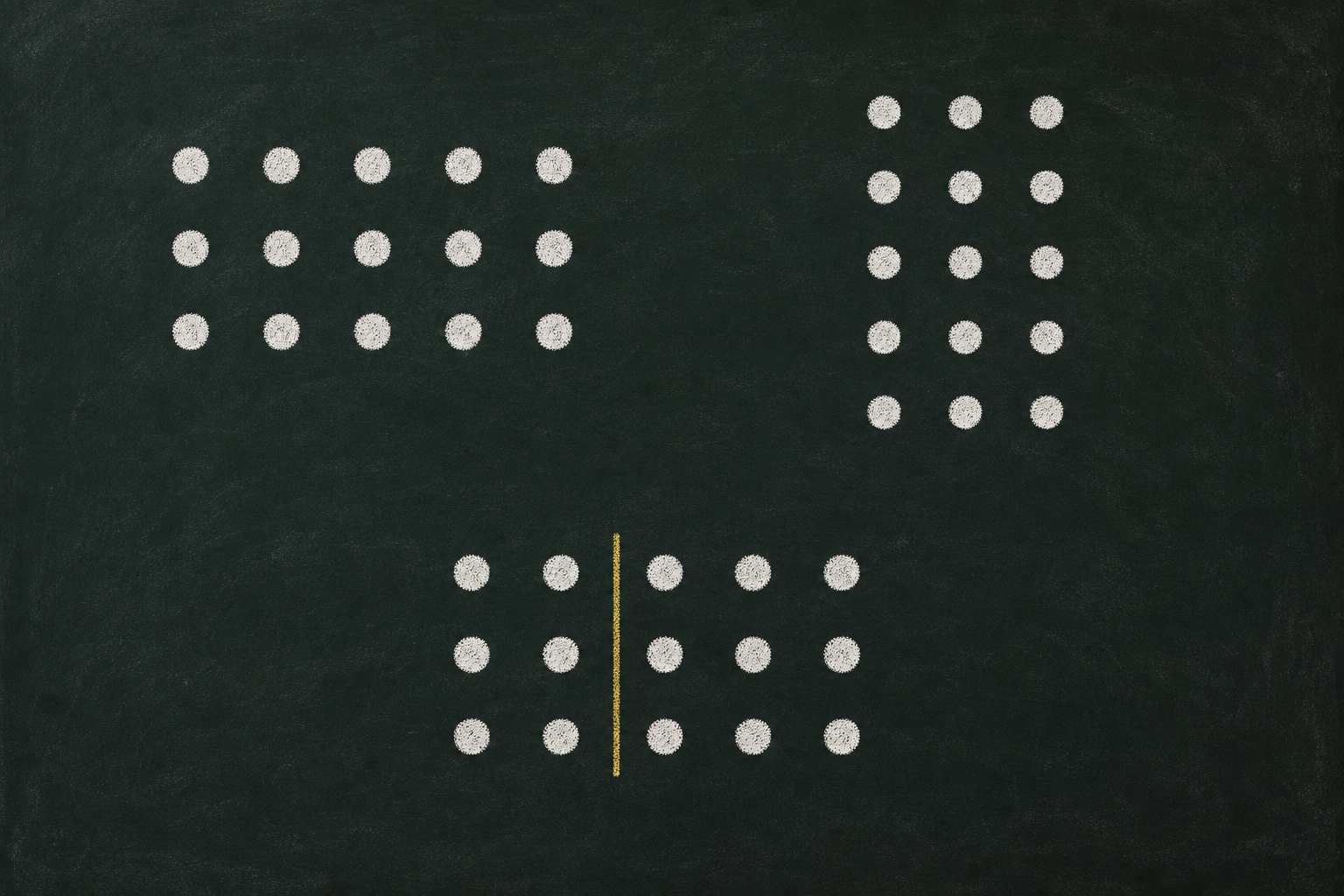
The chairs know they can be rearranged
A hall is set out for assembly with 3 rows of 4 chairs, 12 chairs in all. The caretaker turns the whole block a quarter turn to face the other wall, and now it reads as 4 rows of 3. Not one chair was carried in or out, so it is still 12. That quarter turn is a real mathematical law: 3 times 4 and 4 times 3 give the same product. You are allowed to rearrange.
Multiplication has a small set of these laws, and knowing them turns hard facts into easy ones. You can swap the order of the factors, you can regroup which pair you multiply first, and you can break one factor into friendlier chunks and multiply the chunks separately. Today you will see all three on arrays, where each law is just the same squares counted a smarter way, and use them to work out facts you have not memorised yet.
- 3 rows of 4 turned to 4 rows of 3still 12 chairs: 3 x 4 = 4 x 3 (commutative)
- 2 x 5 x 3 grouped two ways(2 x 5) x 3 = 2 x (5 x 3) = 30 (associative)
- 6 x 7 broken into 6 x 5 and 6 x 230 + 12 = 42 (distributive)
- You know 5 x 8 = 40so 8 x 5 is 40 too, for free
What students will be able to do
Students will apply the commutative, associative and distributive properties of multiplication as strategies to find products, showing each property on a rectangular array, and will use the properties to derive an unknown multiplication fact from facts they already know.
- I can show that a x b and b x a give the same product by turning an array.
- I can regroup three factors and multiply the easier pair first.
- I can break a factor into two parts and multiply each part, then add.
- I can split an array to show 6 x 7 = 6 x 5 + 6 x 2.
- I can use a fact I know to work out one I do not know yet.
Standards this unit teaches
- 3.OA.B.5Common Core (US)Properties of multiplication
Apply properties of operations as strategies to multiply and divide, including the commutative, associative and distributive properties.
- 3.OA.A.1Common Core (US)Interpret products (foundation)
Interpret products of whole numbers, for example interpret 5 x 7 as the total number of objects in 5 groups of 7 objects each. This meaning of multiplication as equal groups and arrays is what the properties in this unit rearrange.
- AC9M3N04Australian Curriculum v9 (ACARA)Multiply and divide with arrays (Year 3)
Multiply and divide one- and two-digit numbers, representing problems using number sentences, diagrams and arrays, and using a variety of calculation strategies. The properties here are exactly those calculation strategies, made visible on arrays.
- AC9M3A02Australian Curriculum v9 (ACARA)Fluency with multiplication facts (Year 3)
Build fluency with the multiplication facts for three, four, five and ten and the related division facts. The commutative and distributive properties are how students derive an unknown fact from the facts they already know.
Prior knowledge
This unit builds on skills students should already have met. Revisit any that are shaky first.
- Grade 2 arrays and repeated addition teaching unittotalling equal rows, the array picture the properties rearrange
- Grade 3 multiplication teaching unitreading a x b as a groups of b, the meaning of a product
- How to teach multiplicationequal groups, arrays and the times sign
- How to teach skip countingcounting equal rows to total an array
Words to teach and display
- Factor
- a number being multiplied, such as the 3 or the 4 in 3 x 4
- Product
- the result of a multiplication, the 12 in 3 x 4 = 12
- Array
- objects in equal rows and columns, a picture of a product
- Commutative property
- the order of the factors can be swapped without changing the product
- Associative property
- with three factors, you may regroup which pair to multiply first
- Distributive property
- a factor can be split into parts, multiplied separately, then added
Teach it: concrete, pictorial, abstract
The lesson moves from things students can hold, to pictures and diagrams, to the written maths. The diagrams below are drawn from data, so they are accurate and print cleanly. Teach straight from them.
1. The commutative property: order does not matter
ConcreteBuild a 3 by 4 array of counters: 3 rows with 4 in each, which is 3 x 4 = 12. Now turn the whole array a quarter turn. The rows become columns and you are looking at 4 rows of 3, which is 4 x 3 = 12. No counter was added or removed, so the product cannot change. Swapping the order of the two factors always gives the same product. That is the commutative property.
This is worth real money in the classroom: it halves how many facts you must memorise. If you know 8 x 5 = 40, then 5 x 8 = 40 comes free, because it is the same array turned.
Say it as a rule the class repeats: for any two factors, a x b = b x a. The two arrays look different on the page, taller versus wider, but they hold the same number of squares.
- You know 6 x 3 = 18. What is 3 x 6, and how do you know without counting?
- How does the array show that 3 x 4 and 4 x 3 must be equal?
2. The distributive property: break a factor apart
PictorialSuppose you have not learned 6 x 7 yet, but you are solid on your fives. Draw a 6 by 7 array, then slide a line down after the fifth column. You have split it into a 6 by 5 chunk and a 6 by 2 chunk. The whole array is the two chunks added: 6 x 7 = 6 x 5 + 6 x 2 = 30 + 12 = 42. Breaking one factor into friendly parts and multiplying each part is the distributive property.
The split never changes the total, it just counts the same squares in two easier pieces. You choose where to cut so both pieces land on facts you know: cutting 7 into 5 + 2 turns an unknown into two knowns.
You can split the other way too. A 6 by 4 array cut after the second column is 6 x 2 + 6 x 2 = 12 + 12 = 24, which is a neat way to see 6 x 4 as double 6 x 2.
Use the distributive property to work out 7 x 8 from facts you know.
- Split the 8 into 5 + 3, two friendly parts: 7 x 8 = 7 x (5 + 3).
- Multiply each part: 7 x 5 = 35 and 7 x 3 = 21.
- Add the two parts: 35 + 21 = 56.
Answer: 7 x 8 = 7 x 5 + 7 x 3 = 35 + 21 = 56.
- Where would you cut a 6 by 7 array so both pieces are facts you know?
- Show 8 x 6 as 8 x 5 + 8 x 1. What are the two products?
3. The associative property: regroup three factors
AbstractWhen you multiply three numbers, you can only multiply two at a time, so you must choose a pair to do first. The associative property says the choice does not change the answer. Take 2 x 5 x 3. Group it as (2 x 5) x 3 = 10 x 3 = 30, or as 2 x (5 x 3) = 2 x 15 = 30. Same product, so pick whichever pair is easier, here the 2 x 5 that makes a friendly 10.
This is the law that lets you rearrange for convenience. Faced with 4 x 7 x 25, no one wants 4 x 7 first. Regroup as 7 x (4 x 25) = 7 x 100 = 700 and it is almost instant.
Keep the associative and commutative laws separate in your mind: commutative changes the order of the factors, associative changes only which pair is bracketed first. Together they let you multiply a string of factors in whatever order is easiest.
Find 2 x 9 x 5 by grouping the easy pair first.
- The friendly pair is 2 x 5 = 10, so regroup: (2 x 5) x 9.
- Multiply: 10 x 9.
- That gives 90.
Answer: 2 x 9 x 5 = (2 x 5) x 9 = 10 x 9 = 90.
- Which pair would you multiply first in 5 x 8 x 2, and why?
- Does (3 x 2) x 4 equal 3 x (2 x 4)? Work out both.
4. Using the properties to multiply smarter
AbstractThe properties are not three facts to memorise, they are three moves you are allowed to make so a hard product becomes easy. Swap the order (commutative), regroup a pair (associative), or break a factor apart and add (distributive). Good mathematicians pick the move that lands on facts they already know.
A worked mix: to find 9 x 6, some prefer 6 x 9 (commutative) then 6 x 9 = 6 x 10 - 6 = 54 by thinking of nine as ten less one. Others split 9 into 5 + 4: 6 x 5 + 6 x 4 = 30 + 24 = 54 (distributive). Both are legal and both give 54.
The properties also explain a shortcut you already use: to multiply by 10 you often do the other factor first. All of this rests on the same idea from the arrays, rearranging the count never changes how many there are.
Find 4 x 25 x 3 using the properties.
- Commute and regroup so the friendly pair is together: (4 x 25) x 3.
- 4 x 25 = 100.
- 100 x 3 = 300.
Answer: 4 x 25 x 3 = 300. Choosing 4 x 25 = 100 first made it easy.
- Show two different ways to work out 8 x 7 using the properties.
- Why does rearranging the factors never change the product?
Common misconceptions and how to address them
Misconception3 x 4 and 4 x 3 are different problems, so they might have different answers.
Why it happens: The two arrays look different, one taller and one wider, so students expect different totals.
How to address it: Turn one array a quarter turn onto the other. The squares are identical, only the view changed, so both are 12. This is the commutative property: a x b = b x a.
MisconceptionWhen splitting 6 x 7 into 6 x 5 + 6 x 2, work out 6 x 5 = 30 and stop.
Why it happens: Students break the factor apart but forget the second piece still has to be added on.
How to address it: Point to the array: the cut makes two chunks and the whole is both chunks together. 6 x 5 = 30 is only the left piece, you must add the right piece 6 x 2 = 12 to reach 42.
MisconceptionSplitting 6 x 7 as 6 x 5 + 2, adding just the leftover columns instead of multiplying them.
Why it happens: Students split the factor but drop the shared factor from the second part.
How to address it: Every part keeps the same number of rows. The second chunk is 6 rows of 2, which is 6 x 2 = 12, not 2. Both parts are multiplied by the 6.
MisconceptionThe associative property lets you change the numbers, not just the grouping, so 2 x (5 x 3) could be done as 2 x 5 x 3 in any values.
Why it happens: Regrouping is confused with a licence to alter the factors themselves.
How to address it: Associativity moves only the brackets, which pair you multiply first. The three factors stay exactly the same. (2 x 5) x 3 and 2 x (5 x 3) both equal 30.
MisconceptionThe properties also work for division and subtraction, so 12 divided by 3 equals 3 divided by 12.
Why it happens: Students overgeneralise the swap-the-order rule to every operation.
How to address it: Commutativity and associativity are properties of multiplication (and addition), not of subtraction or division. 12 divided by 3 = 4 but 3 divided by 12 is not 4, so order matters there.
MisconceptionThe properties are extra facts to memorise separately from the times tables.
Why it happens: Named laws sound like more to learn, not less.
How to address it: They are moves that make the tables easier, not additions to them. Each one is just the same array counted a smarter way, so an unknown fact can be built from known ones.
Guided practice (with answers)
1. You know 7 x 5 = 35. What is 5 x 7, and which property tells you?
Answer: 5 x 7 = 35, by the commutative property. Swapping the factors does not change the product.
2. Use the array to write 6 x 4 as two smaller products that add to it.
6 by 4 cut after column 2: 6 x 2 + 6 x 2. Answer: 6 x 4 = 6 x 2 + 6 x 2 = 12 + 12 = 24.
3. Work out 7 x 6 by splitting the 6 into 5 + 1.
Answer: 7 x 5 + 7 x 1 = 35 + 7 = 42.
4. Find 2 x 7 x 5 by grouping the easy pair first.
Answer: (2 x 5) x 7 = 10 x 7 = 70.
5. Show 8 x 7 using the distributive property.
Answer: 8 x 5 + 8 x 2 = 40 + 16 = 56 (or 8 x 7 = 8 x 5 + 8 x 2, any friendly split).
6. Does (4 x 2) x 3 equal 4 x (2 x 3)? Show both.
Answer: Yes. (4 x 2) x 3 = 8 x 3 = 24 and 4 x (2 x 3) = 4 x 6 = 24.
Independent practice worksheets
Set the matching ChalkBee worksheets for independent work. The answer keys are computed in code, so they are never wrong. The multiplication sets give facts to practise the properties on, and the break-apart strategy shines on the larger facts.
Differentiation
- Keep counters and a grid mat so students physically turn an array to feel the commutative property before drawing it.
- Give a pre-drawn array with the split line already marked so the student only writes the two products and adds them.
- Start the break-apart with a cut at 5, since the fives are the facts most students know best.
- For the associative work, colour the friendly pair (such as 2 x 5) so it is obvious which to multiply first.
- Use the distributive property to work out a fact beyond the tables, such as 12 x 6 = 10 x 6 + 2 x 6.
- Explain why the commutative property halves the number of times-table facts you must learn.
- Find two genuinely different property-based routes to 9 x 8 and check they agree.
- Investigate whether subtraction is commutative by testing 8 minus 3 against 3 minus 8, and say what you find.
Assessment: exit ticket
A three-question exit ticket for the last five minutes. It samples the commutative swap, a break-apart, and naming a property.
1. You know 9 x 4 = 36. What is 4 x 9, and which property tells you?
Answer: 36, by the commutative property (order of factors does not change the product).
2. Work out 6 x 8 by splitting the 8 into 5 + 3.
Answer: 6 x 5 + 6 x 3 = 30 + 18 = 48.
3. Which property lets you do 2 x 7 x 5 as (2 x 5) x 7?
Answer: The associative property, regrouping which pair to multiply first. It gives 10 x 7 = 70.
Teacher notes and timings
- Rough timing across three to four lessons: Lesson 1 the commutative property on arrays (section 1), Lesson 2 the distributive break-apart (section 2), Lesson 3 the associative regrouping (section 3), Lesson 4 choosing a property to multiply smarter plus the exit ticket (section 4).
- The whole unit rests on one honest idea from the arrays: rearranging a count never changes how many there are. Keep returning to the squares so each named law stays concrete rather than a rule to memorise.
- The distributive property is the heavy lifter for the rest of primary maths: it is how the standard multiplication algorithm and mental strategies work. Time spent on the split array here pays off for years.
- Watch the two classic distributive slips: stopping after the first chunk (6 x 5 = 30, forgetting the 6 x 2), and dropping the shared factor from the second chunk (writing 6 x 5 + 2). The array defeats both.
- Do not let commutativity leak onto subtraction or division. A quick counterexample (8 minus 3 is not 3 minus 8) keeps the properties tied to multiplication and addition, where they hold.
- US and AU alignment: the US names this exactly at Grade 3 (3.OA.B.5), applying the commutative, associative and distributive properties as strategies. ACARA folds the same strategy work into Year 3 multiplying and dividing with arrays (AC9M3N04) and building fact fluency (AC9M3A02). The array method here serves both.
- Use Student view to project this lesson. Print saves the full teacher unit, including answers and teacher notes; use the linked independent-practice worksheets for student handouts.