Understanding multiplication
Equal groups, arrays, writing multiplication, and the commutative property
About four lessons of 45 to 60 minutes
You already multiply, you just call it counting the fast way
Open an egg carton. There are two rows of six eggs, and you know there are twelve without counting each one, because the rows are equal. Look at your two hands: five fingers on each, ten in all. Count the wheels on three cars, or the legs on four dogs. Every time something comes in equal groups, there is a quicker way than counting one by one.
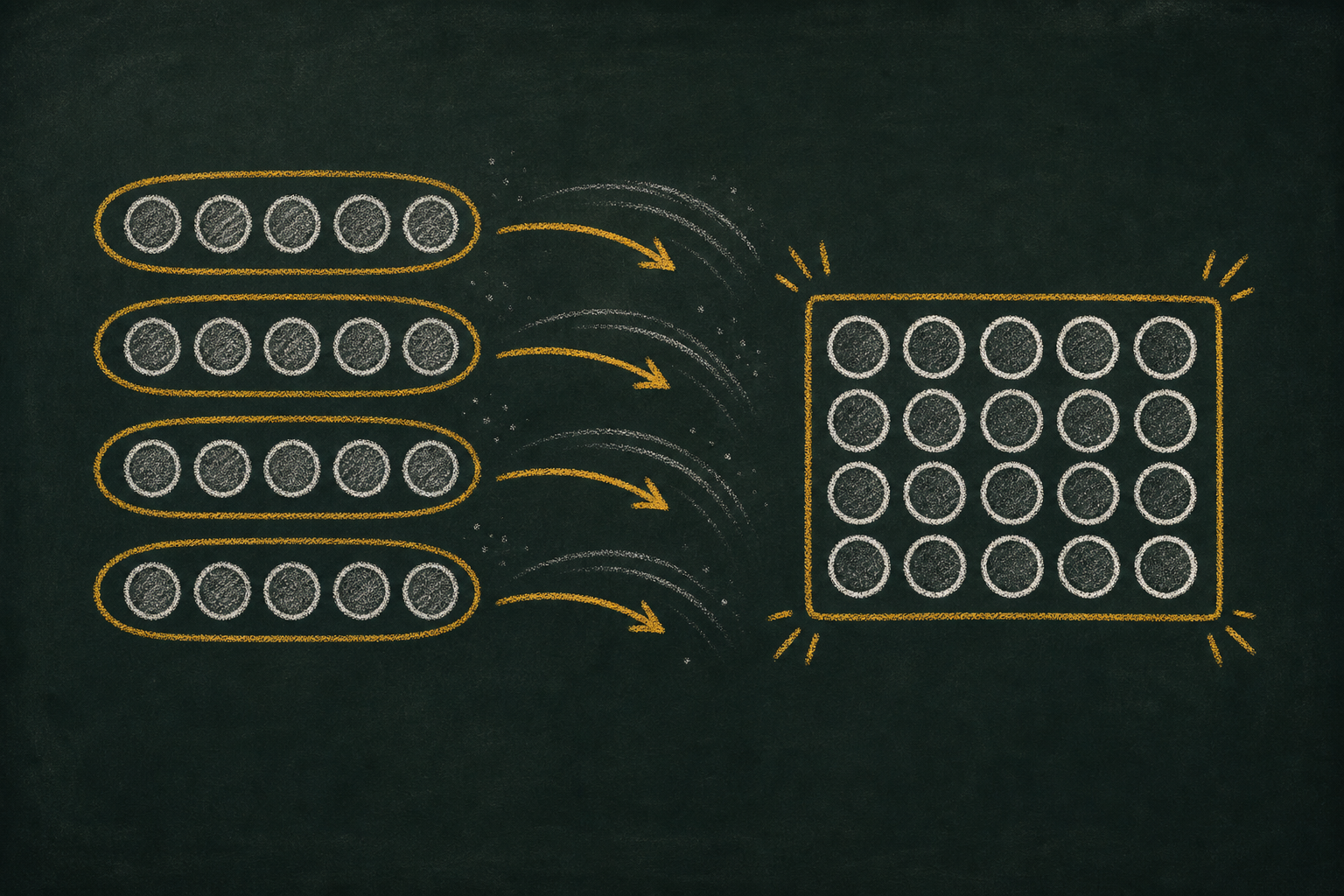
That quicker way is multiplication. It is adding the same number again and again, packed into one short statement. Today you will see that 3 groups of 4 and a 3 by 4 array and 3 x 4 are three ways of saying the same twelve. Once you can see the groups, the times tables stop being a list to memorise and start being something you can work out.
- An egg carton, 2 rows of 62 groups of 6 is 2 x 6 = 12 eggs, and you did not count them one at a time
- Two hands of fingers2 groups of 5 is 2 x 5 = 10 fingers
- Chairs set out in 4 rows of 54 rows of 5 is 4 x 5 = 20 seats, an array you can walk around
- A tray of cookies, 3 rows of 43 rows of 4 is 3 x 4 = 12 cookies
What students will be able to do
Students will understand multiplication as combining equal groups, model a product as an array of rows and columns, write the matching multiplication sentence with its factors and product, and use the commutative property to see that the order of the two factors does not change the product.
- I can make equal groups and find the total by multiplying.
- I can build an array and read it as rows times columns.
- I can write a multiplication sentence with two factors and a product.
- I can explain why 3 x 4 and 4 x 3 give the same answer.
- I can break a harder fact into two easier facts and add them.
Standards this unit teaches
- 3.OA.A.1Common Core (US)Interpret products as equal groups
Interpret products of whole numbers, e.g. interpret 5 x 7 as the total number of objects in 5 groups of 7 objects each.
- 3.OA.A.3Common Core (US)Multiplication word problems, arrays and equal groups
Use multiplication and division within 100 to solve word problems in situations involving equal groups, arrays and measurement quantities.
- 3.OA.C.7Common Core (US)Fluently multiply within 100
Fluently multiply and divide within 100, so that by the end of Grade 3 the single-digit products are known from memory. The array and skip-count work here is the route to that fluency.
- AC9M3N04Australian Curriculum v9 (ACARA)Multiply one- and two-digit numbers with arrays
Multiply and divide one- and two-digit numbers, showing problems with number sentences, diagrams and arrays.
- AC9M3A02Australian Curriculum v9 (ACARA)Facts for 3, 4, 5 and 10
Build fluency with the multiplication facts for three, four, five and ten and the related division facts. This unit builds the meaning those facts rest on.
Prior knowledge
This unit builds on skills students should already have met. Revisit any that are shaky first.
Words to teach and display
- Multiply
- to combine equal groups to find how many in all
- Factor
- one of the two numbers being multiplied
- Product
- the answer, the total you get when you multiply
- Array
- objects arranged in equal rows and columns
- Equal groups
- groups that each hold the same number
- Commutative
- the order of the factors can swap without changing the product
Teach it: concrete, pictorial, abstract
The lesson moves from things students can hold, to pictures and diagrams, to the written maths. The diagrams below are drawn from data, so they are accurate and print cleanly. Teach straight from them.
1. Equal groups and repeated addition
ConcreteStart with counters and cups. Put 3 counters into each of 4 cups so every cup holds the same amount. Say it in words the class repeats: 4 equal groups of 3. Now find the total two ways, first by adding, 3 + 3 + 3 + 3 = 12, then by naming it as multiplication, 4 x 3 = 12. The word 'of' is the giveaway: 4 groups of 3 is 4 x 3.
The whole idea rests on one word, equal. If the cups held 3, 3, 2 and 4 you could not multiply, because the groups are not the same size. Multiplication is the shortcut only when every group matches.
Read the first factor as the number of groups and the second as the size of each group. So 4 x 3 is 4 groups of 3. Adding the same number over and over is slow, and multiplication is the fast way to write and work it out.
- How many groups are there, and how many in each group?
- Write this as an addition and as a multiplication. Do they match?
- Why can we only multiply when the groups are equal?
2. Arrays: equal groups lined up
PictorialTidy the equal groups into straight rows and you get an array, the picture at the heart of multiplication. Draw 3 rows with 4 squares in each. Count the rows, count how many in a row, and read it as rows times columns: 3 rows of 4 is 3 x 4 = 12. An egg carton, a muffin tin and a chessboard are all arrays.
An array makes the total easy to see and hard to get wrong, because the rows are equal by the way it is drawn. You can find the total by skip counting a row at a time: 4, 8, 12.
Write the multiplication sentence for this array and find the product.
- Count the rows: 3. That is the first factor.
- Count how many squares are in one row: 4. That is the second factor.
- Multiply the factors, or skip count the rows: 4, 8, 12.
Answer: 3 x 4 = 12. The product is 12.
- How many squares are in each row, and how do you know they are equal?
- Skip count the rows aloud. What numbers do you say?
3. Writing multiplication: factors and product
AbstractNow name the parts of the written sentence. In 3 x 4 = 12, the two numbers being multiplied, 3 and 4, are the factors, and the answer, 12, is the product. The x sign is read as 'times' or 'multiplied by'. Every array and every set of equal groups can be captured in one clean sentence: factor times factor equals product.
Keep tying the symbol back to the picture. If a student writes 3 x 4 = 12, ask them to draw the array or the groups that prove it. The written fact and the picture must always agree.
There are 5 baskets with 3 apples in each. Write a multiplication sentence and solve it.
- Number of groups (baskets): 5. That is the first factor.
- Size of each group (apples): 3. That is the second factor.
- Multiply: 5 x 3. Skip count in 3s five times: 3, 6, 9, 12, 15.
Answer: 5 x 3 = 15. There are 15 apples. The factors are 5 and 3, the product is 15.
- Point to the factors. Point to the product.
- Say 6 x 2 two ways in words.
4. The commutative property: order does not matter
PictorialHere is a fact that saves half the memorising. Draw a 3 by 4 array, then turn the page a quarter turn so it becomes a 4 by 3 array. Same squares, same total. So 3 x 4 = 4 x 3 = 12. Swapping the two factors never changes the product. This is called the commutative property.
It means every fact you learn is really two facts. Know 2 x 6 and you already know 6 x 2. Point it out so students do not treat 7 x 8 and 8 x 7 as two separate things to learn.
- If you know 4 x 5 = 20, what other fact do you know for free?
- Does turning the array change how many squares there are? Why not?
5. Breaking a harder fact into two easier ones
AbstractWhen a fact feels hard, split one factor into a friendly pair and add the two smaller products. To find 3 x 7, cut the 7 into 5 and 2. Draw the 3 by 7 array and slide a line after the fifth column. Now you can see 3 x 5 = 15 and 3 x 2 = 6, and 15 + 6 = 21. So 3 x 7 = 21.
This break-apart move (the distributive property, though students do not need the name yet) turns unknown facts into ones they already own, usually the 2s, 5s and 10s. It is the same reasoning that later powers written multiplication of larger numbers.
Use break-apart to find 4 x 6.
- Split the 6 into 5 and 1.
- Find the two easy products: 4 x 5 = 20 and 4 x 1 = 4.
- Add them: 20 + 4 = 24.
Answer: 4 x 6 = 24.
- Split the 8 in 3 x 8 into 5 and 3. What two products do you add?
- Why does adding the two smaller arrays give the same total as the whole array?
Common misconceptions and how to address them
MisconceptionTo find the total in an array you add the rows and the columns, so a 3 by 4 array is 3 + 4 = 7.
Why it happens: Students see two numbers and reach for addition, the operation they know best.
How to address it: Have them physically count every square in the array, then compare with 3 + 4. The counts disagree. Multiplication counts every square (rows of columns), it does not add the two side lengths.
MisconceptionMultiplication is just another word for addition, so 3 x 4 is the same as 3 + 4.
Why it happens: The link 'repeated addition' gets shortened in a child's mind to plain 'addition'.
How to address it: Stress that it is repeated addition of EQUAL groups: 3 x 4 means 4 + 4 + 4, not 3 + 4. Write both out and count.
MisconceptionThe groups do not have to be equal, you can still multiply groups of 3, 3 and 2.
Why it happens: Early counting work groups objects freely, without the equal-size rule multiplication needs.
How to address it: Show unequal groups and refuse to write a single multiplication for them. Multiplication is the shortcut only when every group is the same size, otherwise you must add the different amounts.
MisconceptionSwapping the factors changes the answer, so 3 x 4 and 4 x 3 are different.
Why it happens: In words '3 groups of 4' and '4 groups of 3' sound different, so students expect different totals.
How to address it: Rotate the same array a quarter turn. The rows become columns and the total is unchanged. The two sentences are equal even though the groupings are told differently.
MisconceptionAny number times 1 is bigger, and any number times 0 is that number.
Why it happens: Students expect multiplying to always make things larger, so times 1 and times 0 feel wrong.
How to address it: Model 5 groups of 1 (five single counters, total 5) and 5 groups of 0 (five empty cups, total 0). A group of nothing adds nothing, so 5 x 0 = 0, and one in each group leaves the number unchanged, so 5 x 1 = 5.
Guided practice (with answers)
1. How many counters are in 4 groups of 3? Write it as a multiplication.
Answer: 4 x 3 = 12. Four equal groups of 3, counted 3, 6, 9, 12.
2. Write the multiplication sentence for this array.
Answer: 2 x 6 = 12 (or 6 x 2 = 12). Two rows of six.
3. Name the factors and the product in 5 x 4 = 20.
Answer: The factors are 5 and 4. The product is 20.
4. If 6 x 3 = 18, what is 3 x 6?
Answer: 18. Swapping the factors does not change the product (commutative property).
5. Break apart 4 x 7 into two easier facts and solve.
Answer: 4 x 5 = 20 and 4 x 2 = 8, then 20 + 8 = 28. So 4 x 7 = 28.
6. There are 3 rows of chairs with 5 chairs in each row. How many chairs?
Answer: 3 x 5 = 15 chairs.
Independent practice worksheets
Set the matching ChalkBee worksheets for independent work. The answer keys are computed in code, so they are never wrong. Start with equal groups and arrays, then move to times-table fluency once the meaning is secure.
Differentiation
- Stay concrete: keep filling cups and building arrays with counters before drawing them.
- Limit facts to the 2s, 5s and 10s first, where skip counting is easiest, then widen.
- Give a pre-drawn array so the student only counts rows and columns, not draws.
- Provide a hundred grid or a number line to skip count along while the fast facts build.
- Ask for both facts in a commutative pair and a picture that proves they match.
- Break apart every fact in the 7s and 8s using known 5s and 2s.
- Introduce multiplying by 10 and spotting the place-value pattern (3 x 10 = 30).
- Pose a missing-factor puzzle: 4 x ? = 24, and have them reason from an array.
Assessment: exit ticket
A three-question exit ticket for the last five minutes. It samples equal groups, reading an array, and the commutative property.
1. Write a multiplication sentence for 5 groups of 2.
Answer: 5 x 2 = 10.
2. An array has 4 rows of 6. Write the multiplication and the product.
Answer: 4 x 6 = 24.
3. If 7 x 3 = 21, what is 3 x 7, and why?
Answer: 21, because swapping the factors does not change the product (commutative property).
Teacher notes and timings
- Rough timing across four lessons: Lesson 1 equal groups and arrays (sections 1 to 2), Lesson 2 writing multiplication (section 3), Lesson 3 the commutative property (section 4), Lesson 4 break-apart plus the exit ticket (section 5 and assessment).
- Language to keep saying: equal groups, rows times columns, factors and product. Read 4 x 3 as '4 groups of 3' every time so the meaning stays attached to the symbol.
- Keep counters and grid paper on desks through the pictorial sections. When a fact is stuck, hand the student the array and let them count or skip count it.
- ACARA introduces equal groups and arrays a year earlier, at Year 2 (AC9M2N04), and formalises multiplying one- and two-digit numbers at Year 3 (AC9M3N04), so this unit maps cleanly for both US Grade 3 and Australian Year 3 classes.
- The break-apart section is the seed of the distributive property and of written column multiplication in later grades. You do not need the formal name yet, but the reasoning is worth the time.
- Use Student view to project this lesson. Print saves the full teacher unit, including answers and teacher notes; use the linked independent-practice worksheets for student handouts.