Area and perimeter
Covering with unit squares, the length times width rule, distance around, and keeping the two ideas apart
About four to five lessons of 45 to 60 minutes
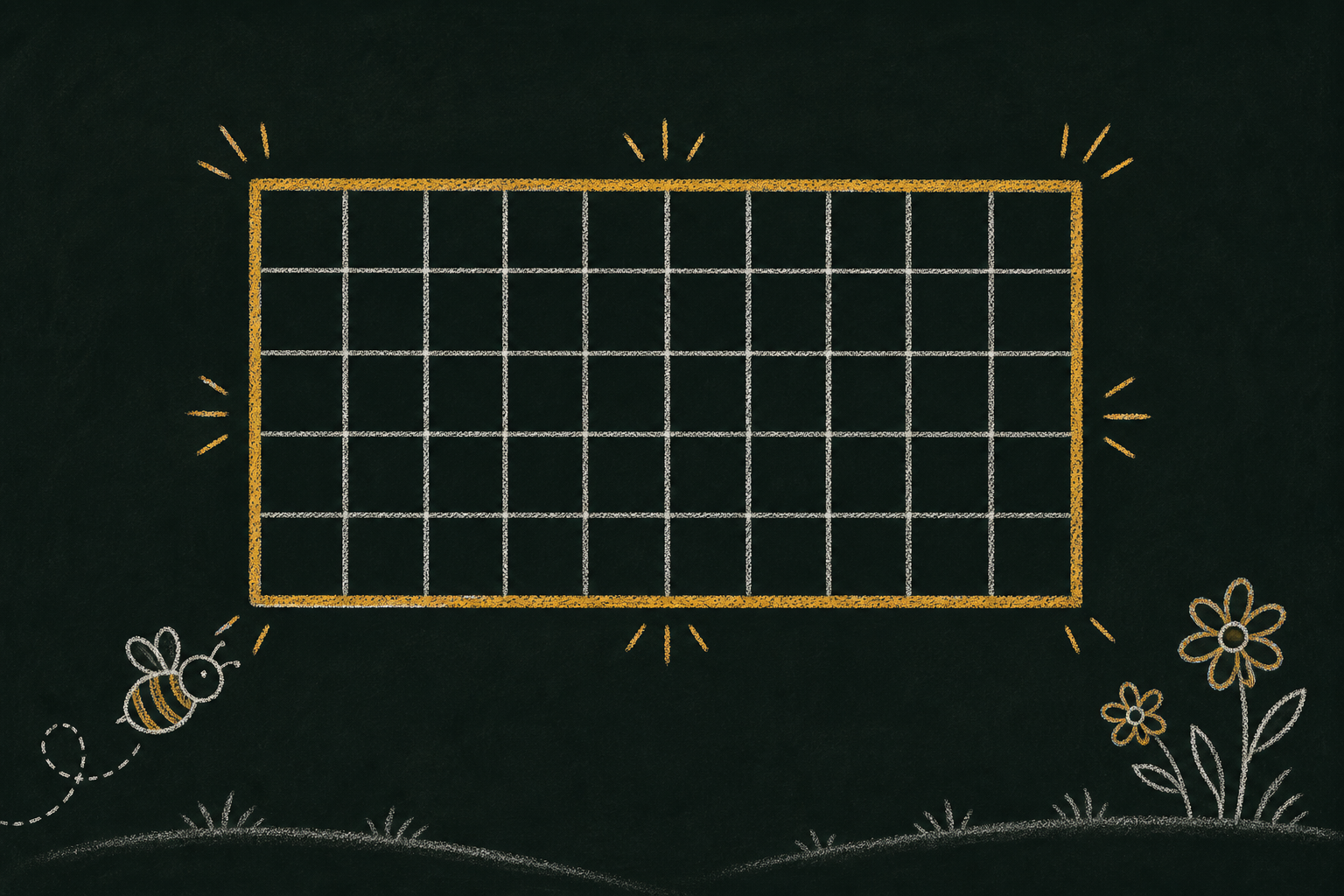
A garden needs a fence around it and grass inside it
Picture a rectangular garden. To buy the fence that goes all the way around the outside, you need to know the total distance around it. To buy the turf that covers the ground inside, you need to know how much surface it takes up. Those are two different questions about the same garden, and they have two different answers with two different kinds of unit.
The distance around the outside is the perimeter. The amount of flat surface inside is the area. Tiling a floor, painting a wall and laying a carpet are all area. Fencing a yard, framing a picture and running a border of lights are all perimeter. Today you will learn to find both, and above all to keep them apart, because mixing them up is the most common slip in all of measurement.
- Turf to cover the whole gardenthat is area, measured in square units such as square metres
- Fence around the edge of the gardenthat is perimeter, measured in length units such as metres
- Square tiles covering a floorcount the tiles for area: rows times columns of unit squares
- Wooden frame around a pictureadd the four sides for perimeter, the distance all the way round
What students will be able to do
Students will understand area as the number of unit squares that cover a flat shape with no gaps or overlaps, find the area of a rectangle by tiling and by multiplying length times width, find the perimeter of a polygon by adding its side lengths, use correct square units for area and length units for perimeter, and find an unknown side length of a rectangle given its perimeter.
- I can measure area by counting the unit squares that cover a shape.
- I can find the area of a rectangle by multiplying its length by its width.
- I can find the perimeter of a shape by adding all its side lengths.
- I can use square units for area and length units for perimeter, and not mix them.
- I can find a missing side of a rectangle when I know its perimeter.
Standards this unit teaches
- 3.MD.C.5Common Core (US)Understand area
Recognise area as an attribute of plane figures, and understand that a unit square is the amount of area a square with side length 1 unit covers, so that a figure covered by n unit squares with no gaps or overlaps has an area of n square units.
- 3.MD.C.7Common Core (US)Relate area to multiplication
Find the area of a rectangle by tiling it with unit squares and by multiplying its side lengths, and show that the two methods give the same result.
- 3.MD.D.8Common Core (US)Perimeter of polygons
Solve real-world and mathematical problems involving perimeters of polygons, including finding the perimeter given the side lengths and finding an unknown side length given the perimeter.
- AC9M3M02Australian Curriculum v9 (ACARA)Perimeter and area
Measure and compare objects using familiar metric units of length, and estimate and measure the perimeter and area of shapes and enclosed spaces using appropriate formal and informal units.
- AC9M5M02Australian Curriculum v9 (ACARA)Area of a rectangle formula (Year 5 bridge)
Establish the formula for the area of a rectangle and use it to solve practical problems. ACARA formalises the length times width rule at Year 5, so the multiplying method in this US Grade 3 unit reaches toward that Year 5 descriptor.
Prior knowledge
This unit builds on skills students should already have met. Revisit any that are shaky first.
Words to teach and display
- Area
- the amount of flat surface a shape covers, measured in square units
- Perimeter
- the total distance around the outside of a shape, measured in length units
- Unit square
- a square with sides of 1 unit, the tile used to measure area
- Square unit
- the unit of area, such as a square centimetre, the space one unit square covers
- Length
- how long the longer side of a rectangle is
- Width
- how wide the shorter side of a rectangle is
Teach it: concrete, pictorial, abstract
The lesson moves from things students can hold, to pictures and diagrams, to the written maths. The diagrams below are drawn from data, so they are accurate and print cleanly. Teach straight from them.
1. Area is covering with unit squares
ConcreteHand each pair a pile of identical square tiles. Cover a rectangle completely with them, leaving no gaps and no overlaps, then count the tiles. That count is the area. Area answers the question how much surface does this shape cover, and it is measured in square units because you are covering with squares. One tile is one square unit.
The rule that keeps area honest is no gaps and no overlaps. If the tiles leave holes or pile on top of each other, the count is not a fair measure of the surface. The tiles must sit flat and fill the shape exactly.
Lay the tiles out in neat rows and the shape becomes an array, the same picture as multiplication. That link is the key to the shortcut in section 3.
- Why must the tiles leave no gaps and no overlaps when we measure area?
- If a shape is covered by 15 unit squares, what is its area?
2. Area by multiplying length times width
PictorialCounting every tile is slow for a big rectangle, and you do not have to. Because the unit squares sit in equal rows, area is just an array: rows times columns. For a rectangle, the number of columns is its length and the number of rows is its width, so the area is length times width. A rectangle 5 units long and 3 units wide has 3 rows of 5 squares, which is 5 times 3, or 15 square units.
This is exactly the array multiplication from the multiplication unit, now wearing a measurement name. You can still check by counting the tiles, and the two methods always agree, which is the whole point of the rule.
Find the area of a rectangle 5 cm long and 3 cm wide.
- Picture the rectangle tiled with 1 cm unit squares. There are 3 rows with 5 squares in each.
- Multiply the length by the width: 5 times 3 = 15.
- The unit is square centimetres, because each tile is one square centimetre.
Answer: The area is 15 square centimetres.
- How many rows and how many columns of unit squares are in a 5 by 3 rectangle?
- Find the area of a rectangle 6 units long and 2 units wide.
3. Perimeter is the distance all the way around
PictorialNow walk your finger around the outside edge of the rectangle, all the way back to the start. The total distance you travel is the perimeter. For the 5 by 3 rectangle, that is 5 along the top, 3 down the side, 5 back along the bottom, and 3 up the other side. Add them: 5 plus 3 plus 5 plus 3 is 16. The perimeter is 16 units of length, not square units, because you measured a distance, not a surface.
There is a neat shortcut for a rectangle. It has two lengths and two widths, so the perimeter is two times length plus width. For the 5 by 3 rectangle that is 2 times (5 plus 3), which is 2 times 8, which is 16. Same answer, less adding.
Notice the same rectangle has an area of 15 square units and a perimeter of 16 units. Different questions, different numbers, different units. That contrast is worth pausing on.
Find the perimeter of a rectangle 5 cm long and 3 cm wide.
- List the four sides: 5 cm, 3 cm, 5 cm and 3 cm.
- Add all four side lengths: 5 + 3 + 5 + 3 = 16.
- Or use the shortcut: 2 times (5 + 3) = 2 times 8 = 16. The unit is centimetres, a length.
Answer: The perimeter is 16 centimetres.
- Why is perimeter measured in centimetres but area in square centimetres?
- Find the perimeter of a rectangle with sides 6 cm and 2 cm.
4. Keeping area and perimeter apart
AbstractBecause both use a rectangle's side lengths, area and perimeter are easy to muddle. The way to stay clear is to keep asking which question am I answering. Am I covering the inside, which is area in square units, or going around the outside, which is perimeter in length units? A quick clue is the unit: if the answer should be square something, it is area.
A powerful idea is that one does not fix the other. Two rectangles can have the same perimeter but different areas. A 4 by 2 rectangle and a 5 by 1 rectangle both have a perimeter of 12 units, but the first covers 8 square units and the second only 5. So knowing the distance around a shape does not tell you how much surface it covers.
- A problem asks how much carpet covers a floor. Is that area or perimeter, and what kind of unit?
- Can two shapes have the same perimeter but different areas? Give an example.
5. Finding a missing side from the perimeter
AbstractSometimes you know the perimeter and one side, and need the missing side. Work backwards through the perimeter. If a rectangle has a perimeter of 16 cm and one side is 5 cm, the two lengths of 5 cm use up 10 cm, leaving 6 cm for the other two sides, so each of them is 3 cm.
The reliable method is to subtract the sides you know from the perimeter, then share what is left between the sides you do not. It is the same reasoning as finding a missing part in a number bond, applied to the four sides of the shape.
A rectangle has a perimeter of 16 cm. One side is 5 cm. What is the length of the shorter side?
- A rectangle has two sides of 5 cm, using 5 + 5 = 10 cm of the perimeter.
- Subtract from the perimeter to find the other two sides together: 16 - 10 = 6 cm.
- The two shorter sides are equal, so share the 6 cm between them: 6 divided by 2 = 3 cm.
Answer: The shorter side is 3 cm.
- A rectangle has a perimeter of 20 cm and a long side of 7 cm. How much is left for the two short sides together?
- Why do we subtract two copies of the known side, not just one?
Common misconceptions and how to address them
MisconceptionArea and perimeter are the same thing, or one number tells you the other.
Why it happens: Both are found from a rectangle's side lengths, so students treat them as one idea.
How to address it: Anchor them to the garden: perimeter is the fence around the outside, area is the grass inside. Show a 4 by 2 and a 5 by 1 rectangle with the same perimeter but different areas, so one clearly does not fix the other.
MisconceptionTo find the perimeter of a rectangle you add only the two different side lengths, so a 5 by 3 rectangle has a perimeter of 8.
Why it happens: Students see two numbers on the shape and add just those, forgetting a rectangle has four sides.
How to address it: Trace all the way around with a finger and count four sides: 5, 3, 5 and 3. A rectangle has two lengths and two widths, so add all four, or double the sum of the two different sides.
MisconceptionArea is found by adding the side lengths, the same as perimeter.
Why it happens: Once perimeter is learned as adding sides, students apply the same move to area.
How to address it: Go back to the tiles. Area is how many unit squares cover the shape, which is rows times columns, a multiplication. Cover a 5 by 3 rectangle and count 15 squares, which is 5 times 3, not 5 plus 3.
MisconceptionThe unit does not matter, so area and perimeter can both be written as plain centimetres.
Why it happens: Students focus on the number and treat the unit as a label to copy, not part of the answer.
How to address it: Perimeter is a distance, so it is centimetres. Area is a covered surface, so it is square centimetres. Insist the word square appears on every area answer and never on a perimeter answer.
MisconceptionWhen tiling to find area, gaps or overlapping tiles are fine as long as you count them.
Why it happens: Students count tiles mechanically without checking they cover the shape exactly.
How to address it: Show a rectangle with tiles that leave a gap or ride over the edge, and ask whether the count is fair. Area needs the unit squares to fill the shape with no gaps and no overlaps.
MisconceptionYou can find the area only if you are told the length and width as numbers, never from a tiled picture.
Why it happens: Students latch onto the length times width rule and forget it came from counting squares.
How to address it: Remind them the rule is a shortcut for counting the tiles. If a rectangle is shown already tiled, they can count the squares directly, or read off the rows and columns and multiply.
Guided practice (with answers)
1. What is the area of this tiled rectangle?
Answer: 12 square units. There are 3 rows of 4 unit squares, and 4 times 3 = 12.
2. Find the area of a rectangle 6 cm long and 2 cm wide.
Answer: 12 square centimetres. Area is length times width: 6 times 2 = 12.
3. Find the perimeter of a rectangle 6 cm long and 2 cm wide.
Answer: 16 cm. Add the four sides: 6 + 2 + 6 + 2 = 16, or 2 times (6 + 2) = 16.
4. A carpet covers the floor of a room. Is its size area or perimeter, and what unit?
Answer: Area, in square units such as square metres, because it covers a surface.
5. A rectangle has a perimeter of 14 cm and one side of 4 cm. What is the other side?
Answer: 3 cm. Two sides of 4 cm use 8 cm, leaving 6 cm for the other two sides, so each is 3 cm.
6. A 3 by 3 square: give its area and its perimeter.
Answer: Area 9 square units (3 times 3), perimeter 12 units (3 + 3 + 3 + 3).
Independent practice worksheets
Set the matching ChalkBee worksheets for independent work. The answer keys are computed in code, so they are never wrong. The geometry sheets cover area and perimeter directly, and the multiplication sheets keep the length times width fact fluent.
Differentiation
- Stay concrete: keep square tiles or grid paper on the desk so area is always counted before it is multiplied.
- Give rectangles already drawn on a grid so the rows and columns can be counted directly.
- Colour the inside for area and trace the outside edge for perimeter, so the two are physically different actions.
- Keep side lengths small (under 10) so the multiplication and the addition stay easy.
- Find the area and perimeter of an L-shaped figure by splitting it into two rectangles.
- Draw every rectangle with a given area (say 12 square units) and compare their perimeters.
- Find a missing side when the area is given instead of the perimeter, using division.
- Investigate which rectangle with a fixed perimeter has the largest area, and describe the pattern.
Assessment: exit ticket
A three-question exit ticket for the last five minutes. It samples area by multiplying, perimeter by adding, and the difference between the two.
1. Find the area of a rectangle 4 cm by 3 cm.
Answer: 12 square centimetres, from 4 times 3.
2. Find the perimeter of the same 4 cm by 3 cm rectangle.
Answer: 14 cm, from 4 + 3 + 4 + 3, or 2 times (4 + 3).
3. Which is measured in square units, area or perimeter?
Answer: Area, because it covers a surface. Perimeter is a distance, measured in length units.
Teacher notes and timings
- Rough timing across four to five lessons: Lesson 1 covering with tiles (section 1), Lesson 2 area by multiplying (section 2), Lesson 3 perimeter (section 3), Lesson 4 keeping the two apart (section 4), Lesson 5 missing sides plus the exit ticket (section 5 and assessment).
- Language to keep saying: cover the inside for area, go around the outside for perimeter, square units for area. The unit is the fastest way for a student to self-check which quantity they found.
- Every figure is a real code-drawn array of unit squares. For area, count the squares inside. For perimeter, count the unit lengths along the outside edge of the same grid. The diagrams are not to a labelled centimetre scale, so treat each unit square as one unit and attach centimetres in the worked examples.
- Curriculum note and a US and AU divergence: US Grade 3 both tiles for area (3.MD.C.5, 3.MD.C.7) and multiplies side lengths, and does perimeter including missing sides (3.MD.D.8). ACARA introduces measuring and estimating perimeter and area at Year 3 (AC9M3M02) but formalises the area-of-a-rectangle formula later, at Year 5 (AC9M5M02). So the tiling and perimeter work maps to Australian Year 3, while the length times width rule reaches toward Year 5.
- The break-apart idea for L-shapes in the extension is the seed of finding areas of composite shapes in later grades. You do not need the formal name yet.
- Use Student view to project this lesson. Print saves the full teacher unit, including answers and teacher notes; use the linked independent-practice worksheets for student handouts.