Adding and subtracting within 100
Two-digit addition and subtraction with no regrouping, using tens and ones, the number line, and part-whole bars
About three to four lessons of 40 to 55 minutes
Adding up your points across two rounds
You are playing a board game with a friend. In round one you score 34 points, and in round two you score 23 more. How many points do you have altogether? And when your friend had 57 points and gave away 23 on a penalty card, how many were left? These are the everyday sums that fill a game night.
The numbers are bigger than the facts you know by heart, but there is a neat trick: you never add or subtract more than a single digit at a time. Split each two-digit number into its tens and its ones, work with the tens and the ones separately, and put them back together. Today every problem is chosen so the ones stay small enough that you never have to trade or carry, which keeps the whole thing tidy and quick.
- 34 points then 23 moreadd the tens (30 and 20) and the ones (4 and 3): 57 points
- 57 points, give away 23take the tens then the ones: 34 points left
- 45 in the first half, 32 in the second40 and 30 is 70, 5 and 2 is 7, so 77 points
- 68 stars, spend 4560 take 40 is 20, 8 take 5 is 3, so 23 stars left
What students will be able to do
Students will add and subtract two-digit numbers within 100 where no regrouping is needed, by partitioning each number into tens and ones and combining the tens and the ones separately, by counting on and back in jumps on a number line, and by using a part-whole bar to check with the inverse operation.
- I can split a two-digit number into its tens and its ones.
- I can add two two-digit numbers by adding the tens and the ones separately.
- I can subtract a two-digit number by taking away the tens and the ones separately.
- I can show an addition or subtraction as jumps on a number line.
- I can use a part-whole bar to check an answer with the opposite operation.
Standards this unit teaches
- 2.NBT.B.5Common Core (US)Add and subtract within 100
Fluently add and subtract within 100 using strategies based on place value, properties of operations, and/or the relationship between addition and subtraction.
- 2.OA.B.2Common Core (US)Fluency with single-digit facts (foundation)
Fluently add and subtract within 20 using mental strategies, and by the end of Grade 2 know from memory all sums of two one-digit numbers. These single-digit facts are what let students add the ones and the tens without any written working here.
- AC9M2N01Australian Curriculum v9 (ACARA)Partition into tens and ones (Year 2)
Partition, rearrange and regroup two-digit numbers using their place value, including splitting a two-digit number into tens and ones. Splitting each number into tens and ones is the core strategy of this unit.
- AC9M2N05Australian Curriculum v9 (ACARA)Model everyday adding problems (Year 2)
Model and solve everyday adding and taking-away problems, including simple money situations, using diagrams, materials and number sentences. The game-score problems in this unit are exactly this kind of modelling.
Prior knowledge
This unit builds on skills students should already have met. Revisit any that are shaky first.
- Grade 1 place value: tens and ones teaching unitseeing a two-digit number as tens and ones, the key move here
- Grade 1 addition and subtraction within 20 teaching unitthe single-digit facts used on the ones and the tens
- How to teach place valuethe value of each digit by its position
- How to teach additioncombining amounts to find a total
- How to teach subtractiontaking away and finding the difference
- Number bondspairs of numbers that make a total, used on the ones and tens
Words to teach and display
- Place value
- the value a digit has because of its position, tens or ones
- Tens
- the digit that counts groups of ten, the left digit in a two-digit number
- Ones
- the digit that counts single units, the right digit in a two-digit number
- Sum
- the total you get when you add
- Difference
- how much is left, or the gap between two numbers, when you subtract
- Regrouping
- trading ten ones for one ten (or the reverse), which these problems are chosen to avoid
Teach it: concrete, pictorial, abstract
The lesson moves from things students can hold, to pictures and diagrams, to the written maths. The diagrams below are drawn from data, so they are accurate and print cleanly. Teach straight from them.
1. Split into tens and ones
ConcreteBuild 34 with base-ten blocks: 3 ten-rods and 4 ones. Build 23 next to it: 2 ten-rods and 3 ones. The whole strategy lives in this picture. To add them, push the tens together and push the ones together, because you can only easily combine things of the same kind. Three tens and two tens make 5 tens. Four ones and three ones make 7 ones. Five tens and 7 ones is 57.
The reason this works: 34 is 30 and 4, and 23 is 20 and 3. Combining gives 30 and 20 which is 50, and 4 and 3 which is 7, and 50 and 7 is 57. Same kind with same kind.
Notice the ones: 4 and 3 is 7, which is still less than ten, so the ones stay in the ones place and there is nothing to trade. Every problem in this unit is chosen so the ones add to less than ten and subtract without needing to borrow.
- Split 46 into tens and ones. What is each part worth?
- When we add 34 and 23, why do the tens go with the tens and the ones with the ones?
2. Adding the tens and the ones
PictorialMove from blocks to the written numbers. Line up 45 and 32 so the tens sit above the tens and the ones above the ones. Add the ones first: 5 and 2 is 7. Add the tens: 4 tens and 3 tens is 7 tens, which is 70. Put them together: 70 and 7 is 77.
Adding the ones first is a good habit even when no trading is needed, because it is the same order you will use later when trading does happen. Here 5 and 2 is 7, safely under ten, so 7 ones are written and the tens are untouched.
Keep the digits lined up in neat columns. The single most common slip at this stage is a crooked column that adds a tens digit to a ones digit.
Add 45 + 32.
- Line up the tens above the tens and the ones above the ones.
- Add the ones: 5 + 2 = 7. Under ten, so nothing to trade.
- Add the tens: 40 + 30 = 70.
- Combine: 70 + 7 = 77.
Answer: 45 + 32 = 77.
- In 45 + 32, which digits do you add first?
- How do you know you will not need to trade any ones here?
3. Adding as jumps on a number line
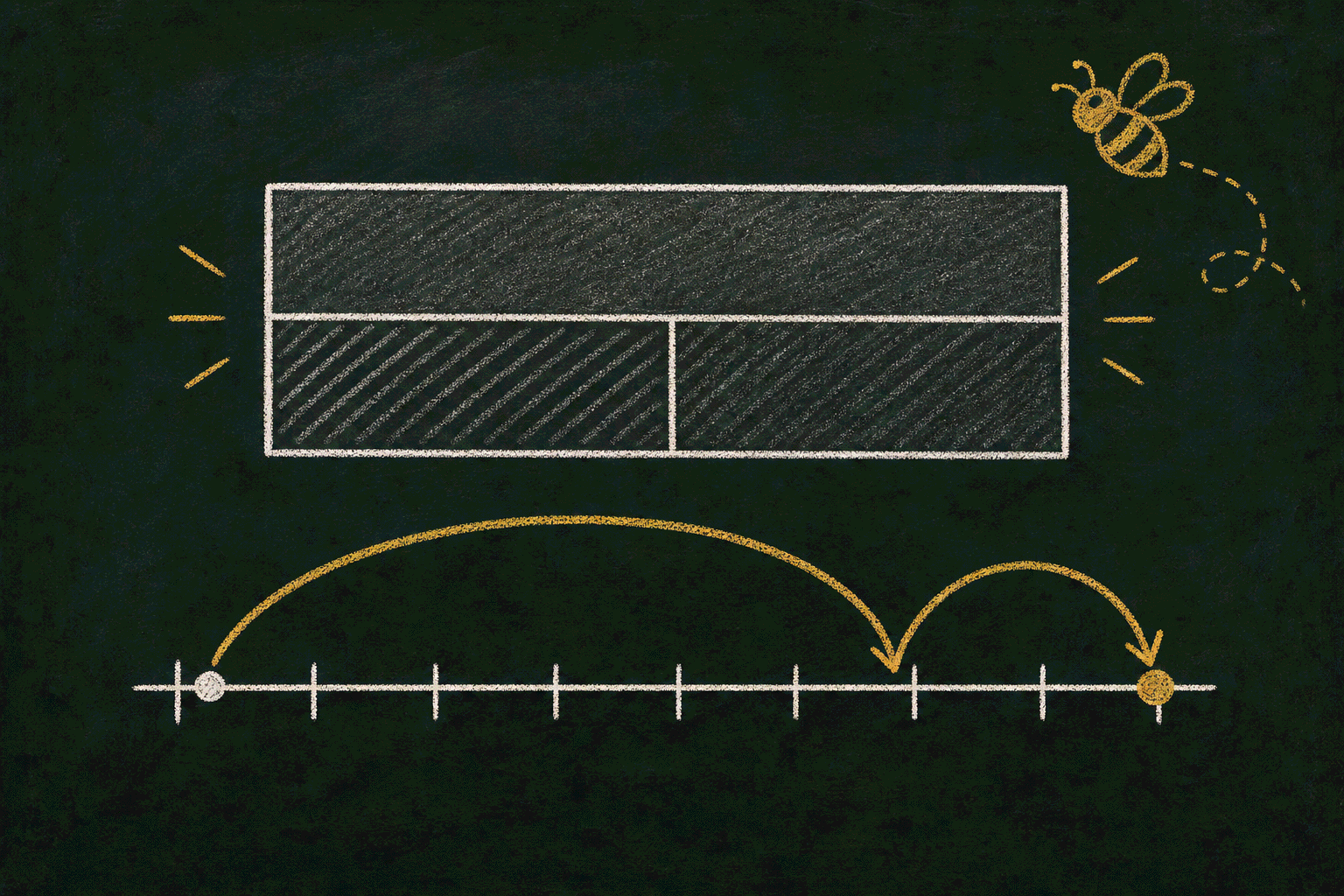
PictorialThe number line shows the same addition as movement. To work out 34 + 23, start on 34. Add the 23 in two easy jumps: first jump the 2 tens, a jump of 20 that lands on 54, then jump the 3 ones to land on 57. Counting on in a jump of tens and a jump of ones is fast and matches the tens-and-ones idea exactly.
Jumping the tens first, then the ones, keeps the mental arithmetic to easy steps: 34 and 20 is 54, then 54 and 3 is 57. The finish point, 57, is the sum.
The number line is friendly because it is forgiving: if a student loses track, they can count on in smaller jumps and still land in the right place.
- On the line, why do we jump the tens before the ones?
- Where do you land after the +20 jump from 34?
4. Subtracting the tens and the ones
PictorialSubtraction uses the very same split, but you take away instead of joining. To work out 57 - 23, split the 23 into 2 tens and 3 ones. Take the tens away first: 57 take 20 is 37. Then take the ones: 37 take 3 is 34. So 57 - 23 = 34, the points left after the penalty card.
On the number line you jump backward: start on 57, jump back 20 to 37, then back 3 to 34. Same jumps as addition, aimed the other way.
The ones subtract cleanly here: 7 take 3 is 4, no borrowing. Like the additions, every subtraction in this unit is chosen so the top ones digit is at least the bottom ones digit, so no trading is needed.
Subtract 68 - 45.
- Split 45 into 40 and 5.
- Take the tens: 68 - 40 = 28.
- Take the ones: 28 - 5 = 23.
Answer: 68 - 45 = 23.
- For 57 - 23, what do you take away first, the tens or the ones?
- How is a subtraction jump on the number line different from an addition jump?
5. Part-whole bars and checking
AbstractAddition and subtraction are two sides of one picture: the part-whole bar. The two parts 34 and 23 join to make the whole 57. Read the bar one way and it says 34 + 23 = 57. Cover a part and read it the other way and it says 57 - 23 = 34. The same three numbers make a little family.
This gives you a free check. After adding 34 + 23 = 57, confirm it by subtracting: 57 - 23 should return 34, and it does. After subtracting 57 - 23 = 34, confirm by adding: 34 + 23 should return 57.
Because addition undoes subtraction and subtraction undoes addition, the part-whole bar turns every answer into something you can check yourself without asking the teacher.
Work out 42 + 35, then check it with a subtraction.
- Add the ones: 2 + 5 = 7. Add the tens: 40 + 30 = 70. So 42 + 35 = 77.
- Check by taking one part from the whole: 77 - 35 should give 42.
- 77 - 35: take 30 to get 47, take 5 to get 42. It matches.
Answer: 42 + 35 = 77, and the subtraction check 77 - 35 = 42 confirms it.
- If 34 + 23 = 57, what subtraction fact is in the same family?
- How can you check a subtraction answer using addition?
Common misconceptions and how to address them
MisconceptionAdd all the digits together, so 34 + 23 becomes 3 + 4 + 2 + 3 = 12.
Why it happens: Students treat the two-digit numbers as loose single digits and lose the place value.
How to address it: Rebuild both numbers with tens and ones blocks so a 3 in 34 is plainly 3 tens, not 3. Add tens with tens and ones with ones: 30 + 20 = 50 and 4 + 3 = 7, giving 57.
MisconceptionLine the numbers up any way, so a tens digit gets added to a ones digit.
Why it happens: Without a place-value habit, students align numbers by their left edge or write them crookedly.
How to address it: Insist that ones sit under ones and tens under tens. Use squared paper or draw a tens box and a ones box so each digit has a home column.
MisconceptionOn the number line, count the tick marks you pass instead of the size of the jump.
Why it happens: It repeats the classic number-line slip of counting points rather than the distance moved.
How to address it: Say the jump size out loud as you draw the arc: a jump of +20, then a jump of +3. The label on the arc is how far you moved, not how many ticks you touched.
MisconceptionAdding and subtracting the tens and ones separately gives two answers you leave apart, like 5 tens and 7 ones written as '5 and 7'.
Why it happens: Students stop after partitioning and do not recombine the tens and ones into one number.
How to address it: Always finish by putting the parts back together: 5 tens and 7 ones is the single number 57. Read it as one total, then check it against a number-line landing point.
MisconceptionThe tens are also single digits, so 30 + 20 is just 3 + 2 = 5.
Why it happens: Students correctly see the tens digits as 3 and 2 but forget those digits stand for 30 and 20.
How to address it: Point to the ten-rods: 3 tens and 2 tens is 5 tens, which is 50, not 5. Say the value in full, thirty plus twenty is fifty, before writing the digit.
Guided practice (with answers)
1. Split 68 into tens and ones.
Answer: 6 tens and 8 ones, worth 60 and 8.
2. Add 34 + 23.
34 + 23 = 57. Answer: 57. Tens: 30 + 20 = 50. Ones: 4 + 3 = 7. Together 57.
3. Add 45 + 32.
Answer: 77. Tens: 40 + 30 = 70. Ones: 5 + 2 = 7. Together 77.
4. Subtract 57 - 23.
Answer: 34. Take 20 from 57 to get 37, then take 3 to get 34.
5. Subtract 68 - 45.
Answer: 23. Take 40 from 68 to get 28, then take 5 to get 23.
6. If 42 + 35 = 77, write a subtraction fact from the same family.
Answer: 77 - 35 = 42 (or 77 - 42 = 35).
Independent practice worksheets
Set the matching ChalkBee worksheets for independent work. The answer keys are computed in code, so they are never wrong. Start with addition, then subtraction, then the place-value set for students who still need the tens-and-ones support.
Differentiation
- Keep base-ten blocks on desks so a stuck student can build both numbers and physically push the tens and ones together.
- Give a pre-drawn tens box and ones box so each digit has a home column and nothing lines up crookedly.
- Start with adding a two-digit number and a pure tens number, such as 34 + 20, before adding two full two-digit numbers.
- Provide a printed number line marked in tens so students draw the jumps rather than picture them.
- Solve a two-step game-score problem: score 34, then 23, then lose 15, and find the running total.
- Find the missing part: 34 plus what makes 57? Read it off the part-whole bar.
- Add three two-digit numbers with no regrouping, such as 21 + 34 + 12.
- Explain why these problems never need trading, and make up one that would need trading to show the difference.
Assessment: exit ticket
A three-question exit ticket for the last five minutes. It samples addition, subtraction, and the inverse check, the core of the unit.
1. Add 45 + 32.
Answer: 77. Tens 70, ones 7.
2. Subtract 68 - 45.
Answer: 23. Take 40 then 5.
3. If 34 + 23 = 57, write a matching subtraction fact.
Answer: 57 - 23 = 34 (or 57 - 34 = 23).
Teacher notes and timings
- Rough timing across three to four lessons: Lesson 1 splitting into tens and ones and adding (sections 1 to 2), Lesson 2 the number line for addition (section 3), Lesson 3 subtraction (section 4), Lesson 4 part-whole bars and checking plus the exit ticket (section 5 and assessment).
- Every problem here is deliberately chosen with no regrouping: the ones digits add to less than ten and the top ones digit is at least the bottom ones digit. This lets students master the tens-and-ones method cleanly before trading is introduced in the regrouping units.
- Link forward: once this is secure, the Grade 2 addition-with-regrouping and subtraction-with-regrouping teaching units add the trading step onto the same tens-and-ones routine.
- Language to keep saying: tens with tens, ones with ones, then put them back together. Add this to insisting that the columns line up straight.
- The number-line diagrams run from 30 to 60 with the jumps labelled by size (+20, +3). Tell the class to read the jump labels, which say how far they moved, not the tick marks they passed.
- US and AU alignment: the US names fluent add and subtract within 100 at Grade 2 (2.NBT.B.5), resting on single-digit fact fluency (2.OA.B.2). ACARA reaches the same skill at Year 2 through partitioning into tens and ones (AC9M2N01) and modelling everyday problems (AC9M2N05); its formal written methods for larger two- and three-digit numbers with regrouping are named later, at Year 4 (AC9M4N04). So the no-regrouping two-digit work here sits at Year 2 for AU under the partitioning descriptor.
- Use Student view to project this lesson. Print saves the full teacher unit, including answers and teacher notes; use the linked independent-practice worksheets for student handouts.