Tens and ones
Bundling into tens, partitioning two-digit numbers, and what each digit means
About three to four lessons of 35 to 45 minutes
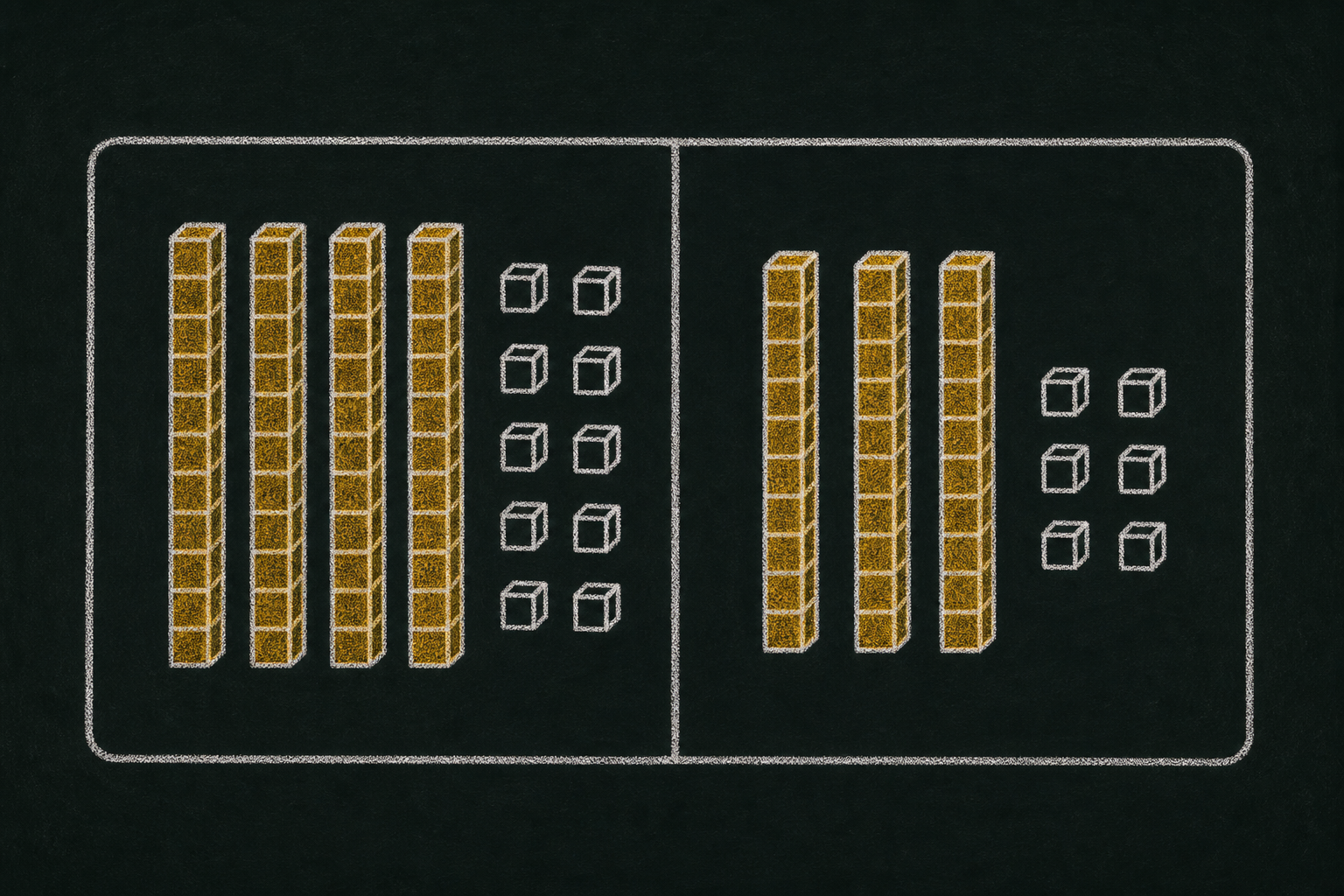
Ten straws in a bundle are easier to count than ten loose ones
Imagine a big pile of drinking straws on the table and someone asks how many there are. Counting them one by one is slow and easy to lose track of. So you do something clever: every time you gather ten straws, you wrap a rubber band around them to make one bundle of ten. Now the pile is a few tidy bundles and a small handful of loose straws, and you can read the total in a snap.
That is exactly how our numbers work. A two-digit number like 34 is really 3 bundles of ten and 4 loose ones. Today you will learn to bundle ten ones into a ten, to split any two-digit number into its tens and its ones, and to read what each of the two digits is telling you.
- 34 straws as 3 bundles of ten and 4 loose34 is 3 tens and 4 ones, or 30 and 4
- A box of ten crayons plus a few singlesone full box is one ten, the singles are the ones
- A ten-frame filled with ten countersten ones together make one ten
- Two full hands of fingers is tenten fingers is one ten, the starting bundle for all our numbers
What students will be able to do
Students will understand a two-digit number as a number of tens and ones, bundle ten ones into one ten, partition a two-digit number into its tens and ones, read the value each digit stands for, and recognise the teen numbers as a ten and some ones and the whole tens as tens with zero ones.
- I can bundle ten ones together and call it one ten.
- I can split a two-digit number into its tens and its ones.
- I can say what the tens digit and the ones digit each stand for.
- I can show a teen number such as 13 as one ten and some ones.
- I can show a whole ten such as 40 as tens with zero ones.
Standards this unit teaches
- 1.NBT.B.2Common Core (US)Tens and ones
Understand that the two digits of a two-digit number represent amounts of tens and ones, including that 10 is a bundle of ten ones called a ten, that 11 to 19 are a ten and some ones, and that 20, 30, 40 and so on are made of tens with zero ones.
- AC9M1N02Australian Curriculum v9 (ACARA)Partition numbers by place value
Partition one- and two-digit numbers in different ways using quantities and part-part-whole relationships, and recognise how the position of a digit shows its value.
- AC9M2N01Australian Curriculum v9 (ACARA)Split two-digit numbers into tens and ones (Year 2 bridge)
Partition, regroup and rename two- and three-digit numbers in different ways using materials, including splitting two-digit numbers into tens and ones. ACARA names the explicit tens-and-ones split at Year 2, so this US Grade 1 unit reaches toward that Year 2 descriptor.
Prior knowledge
This unit builds on skills students should already have met. Revisit any that are shaky first.
Words to teach and display
- Ten
- a bundle of ten ones counted as one group
- One
- a single item, a loose unit that is not yet in a bundle
- Digit
- one of the number symbols 0 to 9 used to write a number
- Tens digit
- the left digit of a two-digit number, showing how many bundles of ten
- Ones digit
- the right digit of a two-digit number, showing how many loose ones
- Place value
- the value a digit has because of where it sits in the number
- Bundle
- a group of ten ones tied together to make one ten
Teach it: concrete, pictorial, abstract
The lesson moves from things students can hold, to pictures and diagrams, to the written maths. The diagrams below are drawn from data, so they are accurate and print cleanly. Teach straight from them.
1. Bundling ten ones into a ten
ConcreteStart with loose objects: straws, sticks or counters. Count out ten of them and wrap them into one bundle. Say the important sentence together: ten ones make one ten. That bundle is now treated as a single thing, a ten, even though it holds ten ones inside. This one trade, ten ones for one ten, is the idea our whole number system is built on.
Keep making bundles. Twenty ones make two tens, thirty ones make three tens. Counting bundles is fast because you count them in tens: 10, 20, 30, the skip counting the class already knows.
Leftover ones that do not make a full group of ten stay loose. So 34 straws become 3 full bundles and 4 loose straws, no fifth bundle because there are not ten more.
- How many loose ones do we gather before we make a bundle?
- If I have 2 bundles of ten, how many ones is that altogether?
2. Splitting a number into tens and ones
PictorialTake the number 34. Bundle the straws and you get 3 tens and 4 ones. Drawn as a part-whole bar, the 34 splits into a tens part worth 30 and a ones part worth 4. The 3 tens are worth 30 because three bundles of ten is thirty, and the 4 ones are worth 4. Together the two parts rebuild the whole: 30 and 4 is 34.
This splitting is called partitioning the number. Every two-digit number partitions this way, into some tens and some ones. Reading the split aloud, 34 is 3 tens and 4 ones, or 30 and 4, keeps the meaning of the number in view.
Split 27 into tens and ones.
- Bundle the ones into groups of ten: 27 makes 2 full bundles with 7 left loose.
- The 2 tens are worth 20, and the 7 ones are worth 7.
- So 27 is 2 tens and 7 ones, which is 20 and 7.
Answer: 27 is 2 tens and 7 ones, worth 20 and 7.
- Split 45 into tens and ones. How much is each part worth?
- How many tens and how many ones are in 52?
3. What each digit tells you
AbstractNow look at the written number 34. It has two digits, and their positions carry the meaning. The left digit, 3, is the tens digit: it says 3 tens, which is 30. The right digit, 4, is the ones digit: it says 4 ones, which is 4. The same digit means something different depending on where it sits, and that is the whole idea of place value.
Test it with the digit 3. In 34 the 3 sits in the tens place and is worth 30. In 3 on its own, or in a number like 43, the 3 in the ones place is worth just 3. The position, not the digit alone, decides the value.
In the number 52, what is each digit worth?
- The left digit is 5, in the tens place, so it is worth 5 tens, which is 50.
- The right digit is 2, in the ones place, so it is worth 2 ones, which is 2.
- Read it back: 52 is 5 tens and 2 ones, 50 and 2.
Answer: In 52 the 5 is worth 50 and the 2 is worth 2.
- In 61, what is the 6 worth and what is the 1 worth?
- The digit 8 is worth 80 in one number and 8 in another. What decides which?
4. Teen numbers and whole tens
AbstractTwo special families are worth a close look. The teen numbers, 11 to 19, are each one ten and some ones. The number 13 is 1 ten and 3 ones, even though its name, thirteen, hides the ten a little. The whole tens, like 20, 30 and 40, are tens with zero ones. The number 40 is 4 tens and 0 ones, and that 0 is doing an important job: it holds the ones place to show there are none.
The teens trip students up because the words come in a tricky order. Say it with the bundle in hand: thirteen is ten and three, so 13 is 1 ten and 3 ones. And 10 itself is the very first bundle: 1 ten and 0 ones.
For the whole tens, the zero is not nothing, it is a placeholder. Without it, 40 would look like 4. The zero in the ones place says there are no loose ones, only the 4 tens.
- How many tens and ones are in 16?
- Why does 40 need a 0 in the ones place instead of just being written as 4?
Common misconceptions and how to address them
MisconceptionIn the number 34, both digits just mean 3 and 4, so the number is worth 3 and 4.
Why it happens: Before place value, a digit means only its face value, and children carry that over to two-digit numbers.
How to address it: Bundle the straws: the 3 is 3 bundles of ten, worth 30, not 3. Show the part-whole bar with 30 and 4, and read it as 3 tens and 4 ones so the position gives the value.
MisconceptionThe teen numbers put the ones first, so 13 is 3 tens and 1 one.
Why it happens: The word thirteen says the three before the ten, so children match the first sound to the tens.
How to address it: Build 13 with one bundle of ten and 3 loose ones. Thirteen means ten and three, so it is 1 ten and 3 ones. Compare 13 with 31 using bundles so the two are clearly different.
MisconceptionThe zero in 40 means nothing, so 40 is the same as 4.
Why it happens: Children learn zero means none and conclude the digit can simply be dropped.
How to address it: Show 4 loose ones next to 4 bundles of ten. The zero in 40 marks the empty ones place and keeps the 4 in the tens place. Remove it and the 4 slides into the ones place and shrinks to four.
MisconceptionA bundle can be made from any handful, not exactly ten ones.
Why it happens: Children group objects freely in early counting, without the fixed size a ten needs.
How to address it: Insist every bundle is exactly ten ones, checked by counting. A group of nine or eleven is not a ten. Our whole number system trades in tens, so the bundle size is fixed.
MisconceptionThe tens and the ones can be read in any order, so 3 tens and 4 ones could be written 43.
Why it happens: Children know the parts but not that the tens digit must go on the left.
How to address it: Line up the bar with tens on the left and ones on the right, and write the number in the same order. 3 tens and 4 ones is 34, while 4 tens and 3 ones is 43. The order of the digits is what tells them apart.
Guided practice (with answers)
1. How many tens and ones are in 25?
Answer: 2 tens and 5 ones, worth 20 and 5.
2. Ten ones are bundled together. What is the bundle called?
Answer: One ten. Ten ones make one ten.
3. In the number 47, what is the 4 worth?
Answer: 40. The 4 is in the tens place, so it is 4 tens, which is 40.
4. Show 18 as tens and ones.
Answer: 1 ten and 8 ones. Eighteen is ten and eight.
5. How many tens and ones are in 30?
Answer: 3 tens and 0 ones. The zero shows there are no loose ones.
6. Which is bigger, 3 tens and 6 ones, or 6 tens and 3 ones?
Answer: 6 tens and 3 ones, which is 63, is bigger than 3 tens and 6 ones, which is 36. The tens decide it.
Independent practice worksheets
Set the matching ChalkBee worksheets for independent work. The answer keys are computed in code, so they are never wrong. ChalkBee does not yet have a dedicated Grade 1 place-value set, so the Grade 1 sheets below build the bundling and comparing that tens and ones rests on, and the Grade 2 place-value set is the natural next step once tens and ones are secure.
Differentiation
- Stay concrete: keep straws, sticks or interlocking cubes and rubber bands on the desk so every number is bundled before it is written.
- Use a ten-frame so ten ones filling the frame becomes one ten in a way the child can see.
- Give a part-whole frame with the tens part already drawn, so the child only counts the loose ones.
- Keep to numbers under 30 until bundling is secure, then extend toward 100.
- Partition the same number more than one way, such as 34 as 3 tens and 4 ones, and also as 2 tens and 14 ones.
- Compare two two-digit numbers by their tens and ones and say which is greater.
- Find ten more or ten less than a number by adding or removing one bundle.
- Build every two-digit number that uses the digits 3 and 6, and read what each digit is worth.
Assessment: exit ticket
A three-question exit ticket for the last five minutes. It samples partitioning, the value of a digit, and a teen number.
1. How many tens and ones are in 42?
Answer: 4 tens and 2 ones, worth 40 and 2.
2. In the number 58, what is the 5 worth?
Answer: 50, because it is in the tens place.
3. Show 15 as tens and ones.
Answer: 1 ten and 5 ones. Fifteen is ten and five.
Teacher notes and timings
- Rough timing across three to four lessons: Lesson 1 bundling ten ones into a ten (section 1), Lesson 2 partitioning into tens and ones (section 2), Lesson 3 the value of each digit (section 3), Lesson 4 teens and whole tens plus the exit ticket (section 4 and assessment).
- Language to keep saying: ten ones make one ten, how many tens and how many ones, the tens digit is worth. Read every two-digit number as its tens and ones, not just its name.
- The part-whole bars are drawn to scale, so the tens part of a number like 34 is much wider than the ones part. That is honest, the 30 really is far bigger than the 4, and it reinforces that most of the number lives in the tens.
- Curriculum note and a US and AU divergence: US Grade 1 (1.NBT.B.2) names tens and ones explicitly, including the teens and the whole tens. ACARA Year 1 (AC9M1N02) partitions numbers by place value more generally, and names the explicit split into tens and ones at Year 2 (AC9M2N01). So this unit maps to Australian Year 1 and reaches into Year 2.
- The teens are the hardest part because the number words say the ones before the ten. Slow down there and always have a bundle of ten and the loose ones in hand while you say the word.
- Use Student view to project this lesson. Print saves the full teacher unit, including answers and teacher notes; use the linked independent-practice worksheets for student handouts.