Addition and subtraction within 20
Number bonds, counting on, counting back, making ten, and fact families
About four to five lessons of 35 to 50 minutes
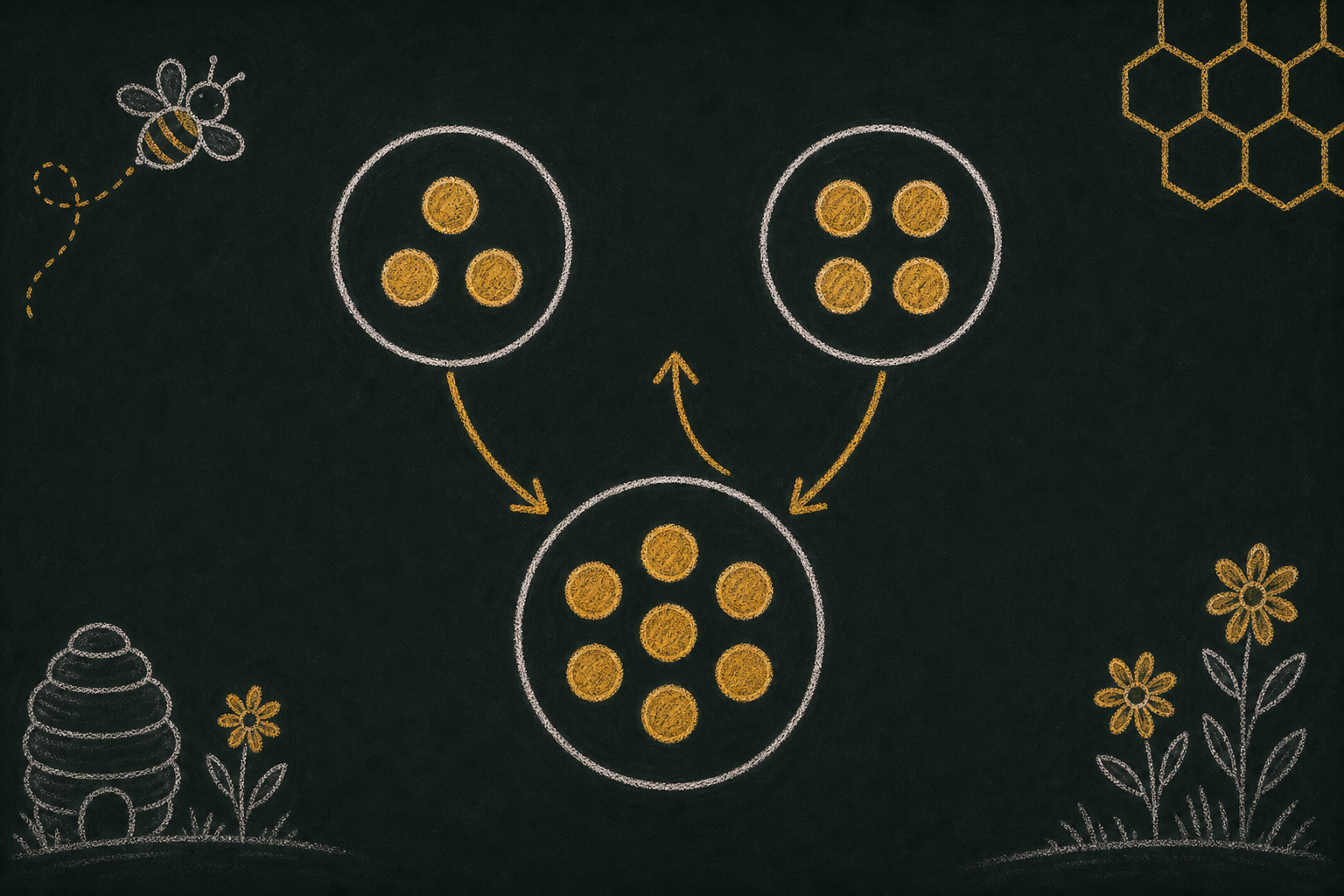
You add and take away every single day
You already add and subtract without thinking of it as maths. When you hold up fingers to show how old you are and then one more for next year, that is adding one. When you have some sweets, eat a couple, and see how many are left, that is subtracting. When a domino shows 4 dots on one side and 3 on the other, you can already feel that it is 7.
This unit gives those everyday moves their proper tools. You will learn number bonds, the pairs that make each number, how to count on to add and count back to subtract, and a clever make-a-ten trick for the trickier sums. By the end, adding and subtracting up to 20 will feel quick and sure, not like counting everything on your fingers one by one.
- 5 fingers and 3 morecount on from 5: six, seven, eight, so 5 + 3 = 8
- 9 sweets, eat 2count back from 9: eight, seven, so 9 - 2 = 7
- A domino with 4 and 3 dotsthe two parts make a whole: 4 + 3 = 7, a number bond
- A ten-frame with 8 counters2 more would fill it to ten, so 8 and 2 bond to make 10
What students will be able to do
Students will add and subtract within 20 using number bonds, counting on from the larger number, counting back, and the make-a-ten strategy, and will use the link between addition and subtraction to write and solve fact families.
- I can split a number into two parts and name the number bond.
- I can add by counting on from the larger number.
- I can subtract by counting back.
- I can add across ten by making ten first.
- I can use an addition fact to work out a subtraction (fact families).
Standards this unit teaches
- 1.OA.C.6Common Core (US)Add and subtract within 20
Add and subtract within 20, demonstrating fluency for addition and subtraction within 10, using strategies such as counting on, making ten, and using the relationship between addition and subtraction.
- 1.OA.C.5Common Core (US)Relate counting to adding and subtracting
Relate counting to addition and subtraction, for example by counting on 2 to add 2, and counting back to subtract. This is the reasoning behind the count-on and count-back strategies in this unit.
- 1.OA.A.1Common Core (US)Add and subtract word problems within 20
Use addition and subtraction within 20 to solve word problems involving adding to, taking from, putting together, taking apart and comparing, with unknowns in all positions.
- AC9M1N03Australian Curriculum v9 (ACARA)Add and subtract within 20 with part-whole
Add and subtract numbers within 20, using physical and virtual materials, part-part-whole knowledge to 10, and a variety of counting strategies.
- AC9M1A02Australian Curriculum v9 (ACARA)Addition facts to 20 and related subtraction facts
Build fluency with addition facts to 20, and use these to determine related subtraction facts through the connection between the two operations.
Prior knowledge
This unit builds on skills students should already have met. Revisit any that are shaky first.
Words to teach and display
- Sum
- the total you get when you add
- Difference
- the answer you get when you subtract
- Number bond
- a pair of parts that join to make a whole, such as 4 and 3 make 7
- Part and whole
- the two parts join to make the whole; the whole splits into the parts
- Count on
- to add by counting forward from a number
- Count back
- to subtract by counting backward from a number
Teach it: concrete, pictorial, abstract
The lesson moves from things students can hold, to pictures and diagrams, to the written maths. The diagrams below are drawn from data, so they are accurate and print cleanly. Teach straight from them.
1. Number bonds: parts that make a whole
ConcreteStart with a small group of counters and the big idea of the whole unit: a whole can split into two parts, and two parts join to make a whole. Take 7 counters and push them into two piles, 4 and 3. Those are the parts, 7 is the whole. Say it together: 4 and 3 make 7. That pair is a number bond. Break the 7 a different way, 5 and 2, and you have found another bond for 7.
Draw it as a part-whole picture, the whole on top and the two parts below, so the structure is always visible. Bonds to 10 matter most of all, so practise them until they are instant: 6 and 4, 7 and 3, 8 and 2.
The bar model below shows 7 as its parts 4 and 3. From this one bond come two additions and, later in the unit, two subtractions, because the parts and the whole are always linked.
- Show me two parts that make 6.
- What is the bond partner of 8 to make 10?
2. Counting on to add
PictorialTo add without counting everything, count on. To work out 6 + 3, start at the larger number, 6, and count on three more: seven, eight, nine. You land on 9. The trick is to hold the first number in your head and count only the second one, and to start from the bigger number so there is less to count.
On the number line below, start at 6 and make three jumps of one. Each jump says the next number, and the first jump lands on 7, not 6. Counting on from the larger number is faster and makes fewer mistakes than counting from one.
Add 4 + 5 by counting on from the larger number.
- Start at the larger number, 5. Hold it in your head.
- Count on 4 more, one at a time: six, seven, eight, nine.
- The number you land on is the total.
Answer: 4 + 5 = 9.
- Which number should you start from to add 3 + 8, and why?
- When you count on 2 from 7, what is the first number you say?
3. Counting back to subtract
PictorialSubtracting a small amount works the same way, going the other direction. To work out 9 - 3, start at 9 and count back three: eight, seven, six. You land on 6, so 9 - 3 = 6. Counting back is taking away by stepping down the number line one at a time.
On the number line below, start at 9 and make three jumps back of one. As with counting on, the first jump lands on 8, not 9. Counting back is the natural tool when the number being taken away is small.
Subtract 12 - 4 by counting back.
- Start at 12.
- Count back 4, one at a time: eleven, ten, nine, eight.
- The number you land on is what is left.
Answer: 12 - 4 = 8.
- When you count back 2 from 10, what is the first number you say?
- Would you count back to work out 15 - 2 or 15 - 13? Why?
4. Making ten to add across ten
AbstractSome sums cross over ten, like 8 + 5, and counting on five is slow. There is a neat trick: make ten first. Ten is a friendly number, so fill the 8 up to 10 by taking 2 from the 5. That leaves 3 of the 5. Now the sum is 10 + 3, which is easy: 13. So 8 + 5 = 13.
The number line below shows the two jumps: from 8, a jump of 2 reaches the ten at 10, then the remaining 3 reaches 13. The make-a-ten strategy leans on the bonds to 10 from section 1, which is why those bonds are worth knowing by heart.
Add 9 + 4 by making ten.
- Ask how many the 9 needs to reach ten: 1. Take that 1 from the 4.
- Now you have 10, and 3 of the 4 are left.
- Add the rest: 10 + 3.
Answer: 9 + 4 = 13.
- How many does 8 need to make ten, and where does that come from in 8 + 6?
- After making ten in 9 + 4, how much of the 4 is left to add?
5. Fact families: addition and subtraction together
AbstractAddition and subtraction are two sides of the same coin. If you know 8 + 5 = 13, you also know 5 + 8 = 13, and you can turn it around to subtract: 13 - 5 = 8 and 13 - 8 = 5. These four facts all come from the same three numbers, 8, 5 and 13. They are a fact family.
The bar model below shows 13 as its parts 8 and 5. Reading the whole and one part tells you the other part, which is exactly what a subtraction asks. So instead of counting back a long way for 13 - 5, you can think: 5 and what make 13? The bond gives 8.
You know 6 + 4 = 10. Write the other three facts in the family.
- Swap the two parts for the second addition: 4 + 6 = 10.
- Take one part from the whole for a subtraction: 10 - 4 = 6.
- Take the other part from the whole for the last one: 10 - 6 = 4.
Answer: 6 + 4 = 10, 4 + 6 = 10, 10 - 4 = 6, and 10 - 6 = 4.
- If 7 + 3 = 10, what subtraction fact can you write straight away?
- How does knowing 8 + 5 help you work out 13 - 8?
Common misconceptions and how to address them
MisconceptionTo add 6 + 3, count everything from one: one, two, three, four, five, six, then seven, eight, nine.
Why it happens: Children first learn to add by counting all the objects, and keep doing it after they no longer need to.
How to address it: Cover the first group and hold its number in your head, then count on only the second group. Start from the larger number so there is even less to count.
MisconceptionWhen counting on 3 from 6, say six as the first count and land on 8.
Why it happens: The starting number gets counted as one of the steps, giving an answer one too small.
How to address it: The number you start on is where you already are, not a jump. The first thing you say is the next number: seven, eight, nine. Point to the jumps on the number line, not the starting dot.
MisconceptionSubtraction can be turned around like addition, so 9 - 3 is the same as 3 - 9.
Why it happens: Addition can be done in any order, and children over-apply that to subtraction.
How to address it: Act it out with counters: you can take 3 away from 9, but you cannot take 9 away from only 3. In subtraction the larger amount you start with comes first.
MisconceptionIn a number bond the two parts have to be equal, or a part can be larger than the whole.
Why it happens: Early bond work often shows tidy equal splits like 5 and 5, and the part-whole roles are still settling.
How to address it: Show many bonds for the same number, 7 as 6 and 1, 5 and 2, 4 and 3, so students see the parts can be different. The parts always join to make the whole, so neither part can be bigger than it.
MisconceptionWhen making ten, split the second number wrongly, taking 5 from the 5 in 8 + 5 instead of 2.
Why it happens: The make-ten step needs the exact bond to ten, and students grab the whole second number instead.
How to address it: Always ask first how many the larger number needs to reach ten. For 8 that is 2, so only 2 comes across, and the rest of the second number stays. Lean on the bonds to 10.
MisconceptionAddition and subtraction are unrelated, so 13 - 5 must be counted back from scratch even though you know 8 + 5 = 13.
Why it happens: The two operations are often taught separately, so the link between them is missed.
How to address it: Use the fact family: a subtraction is asking for a missing part. Since 8 and 5 make 13, taking 5 from 13 must leave 8. Read the bar model, do not count back the long way.
Guided practice (with answers)
1. Show two parts that make 6.
Answer: Any bond of 6, for example 4 and 2, or 5 and 1, or 3 and 3.
2. Add 7 + 2 by counting on.
Answer: 9. Start at 7 and count on two: eight, nine.
3. Subtract 10 - 4 by counting back.
Answer: 6. Start at 10 and count back four: nine, eight, seven, six.
4. Add 9 + 3 by making ten.
Answer: 12. 9 needs 1 to make ten, leaving 2, so 10 + 2 = 12.
5. You know 6 + 4 = 10. What is 10 - 4?
Answer: 6. The same bond turned around: take one part from the whole to get the other part.
6. There are 8 birds and 5 fly away. How many are left?
Answer: 3. 8 - 5 = 3, or think 5 and 3 make 8.
Independent practice worksheets
Set the matching ChalkBee worksheets for independent work. The answer keys are computed in code, so they are never wrong. Start with number bonds, then move to addition and subtraction within 20.
Differentiation
- Stay concrete: keep counters, a ten-frame and a number track on the desk to act out every bond, jump and take-away.
- Secure the bonds within 10 before working across ten, so the make-ten step has something to stand on.
- Give a part-whole frame with the whole already written, so the student only finds the two parts.
- Keep sums and differences within 10 until counting on and back are confident, then extend to 20.
- Find every number bond for a number, such as all the ways to make 10, and put them in order.
- Solve missing-part problems, like 6 + ? = 13, using the bond rather than counting.
- Use make-ten to add three small numbers, spotting a pair that makes ten first.
- Write their own fact family from three numbers and explain why the four facts belong together.
Assessment: exit ticket
A three-question exit ticket for the last five minutes. It samples a number bond, adding within 20, and the link between addition and subtraction.
1. Fill in the bond: 4 and _ make 10.
Answer: 6.
2. Add 8 + 5.
Answer: 13 (make ten: 8 + 2 = 10, then 10 + 3 = 13).
3. You know 7 + 6 = 13. What is 13 - 6, and how do you know?
Answer: 7, because it is the same fact family turned around (13 - 6 leaves the other part, 7).
Teacher notes and timings
- Rough timing across four to five lessons: Lesson 1 number bonds (section 1), Lesson 2 counting on (section 2), Lesson 3 counting back (section 3), Lesson 4 making ten (section 4), Lesson 5 fact families plus the exit ticket (section 5 and assessment).
- Language to keep saying: parts and whole, count on from the larger number, make ten first, the same fact turned around. These phrases pre-empt most of the errors.
- The bonds to 10 are the engine of the whole unit. Time spent making them instant pays off in counting on, making ten and fact families alike.
- The number lines here are labelled with whole numbers only, well within the range Grade 1 has met, so no decimal or fraction tick values appear.
- Curriculum note: US Grade 1 covers adding and subtracting within 20 (1.OA.C.6), relating counting to the operations (1.OA.C.5) and word problems (1.OA.A.1). ACARA places the matching work at Year 1: adding and subtracting within 20 with part-whole knowledge (AC9M1N03) and addition facts to 20 with related subtraction facts (AC9M1A02).
- This unit is the foundation the Grade 2 regrouping units build on: secure bonds and the make-ten idea here become composing and decomposing a ten there. Use Student view to project this lesson. Print saves the full teacher unit, including answers and teacher notes; use the linked independent-practice worksheets for student handouts.