Adding and subtracting fractions
Unlike denominators, common denominators, and checking answers are reasonable
About four to five lessons of 45 to 60 minutes
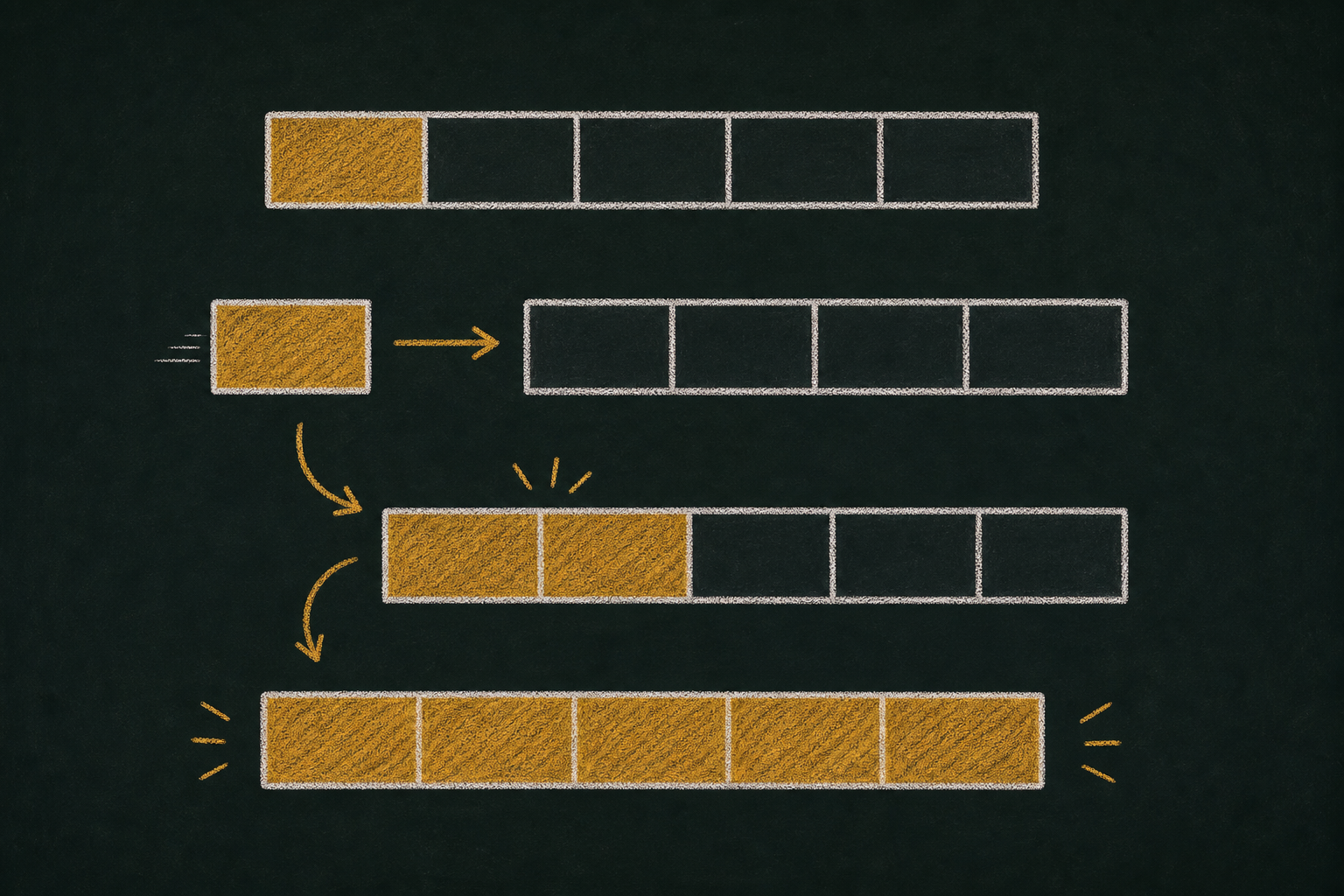
Two fractions in a recipe do not always add up the easy way
You are making honey granola. The recipe needs half a cup of oats and a third of a cup of honey stirred together. Someone asks how much is in the bowl so far. You cannot just say two out of five, because a half and a third are different sized scoops. To add them you first have to cut them into pieces of the same size.
That is the whole story of this unit. Fractions only add or subtract when their parts match, so when the bottom numbers are different you rebuild both fractions with a common denominator first. In Grade 4 you learned to make equivalent fractions. Now you will use that skill to add and subtract any two fractions, and to check that your answer makes sense.
- Half a cup of oats plus a third of a cup of honeydifferent sized scoops, so rebuild both in sixths: 3/6 + 2/6 = 5/6 of a cup
- A quarter of a pizza left, and you eat an eighth2/8 minus 1/8 = 1/8 of the pizza remains
- Reading for half an hour then a quarter of an hour2/4 + 1/4 = 3/4 of an hour
- A board 3/4 of a metre long, cut off 1/2 a metre3/4 minus 2/4 = 1/4 of a metre is left
What students will be able to do
Students will add and subtract two fractions with unlike denominators by rewriting them as equivalent fractions with a common denominator, add or subtract the numerators over that shared denominator, write the answer in simplest form, and use benchmark fractions to check that a sum or difference is reasonable.
- I can explain why two fractions must have the same denominator before I add or subtract them.
- I can find a common denominator for two fractions and rebuild each one.
- I can add fractions with unlike denominators and simplify the answer.
- I can subtract fractions with unlike denominators.
- I can use a benchmark such as 1/2 or 1 to check my answer is reasonable.
Standards this unit teaches
- 5.NF.A.1Common Core (US)Add and subtract fractions with unlike denominators
Add and subtract fractions with unlike denominators, including mixed numbers, by replacing the given fractions with equivalent fractions in such a way as to produce an equivalent sum or difference with like denominators.
- 5.NF.A.2Common Core (US)Fraction word problems and reasonableness
Solve word problems involving addition and subtraction of fractions referring to the same whole, including unlike denominators, and use benchmark fractions and number sense to estimate mentally and judge the reasonableness of answers.
- AC9M5N05Australian Curriculum v9 (ACARA)Add and subtract fractions using equivalence
Solve problems involving adding and subtracting fractions with the same or related denominators, using knowledge of equivalent fractions.
- AC9M6N04Australian Curriculum v9 (ACARA)Add and subtract fractions (Year 6 bridge)
Solve problems that add and subtract fractions with the same or related denominators using a range of strategies. ACARA reaches truly unrelated denominators (such as thirds and quarters) at Year 6 and beyond, so this US Grade 5 unit spans Australian Years 5 and 6.
Prior knowledge
This unit builds on skills students should already have met. Revisit any that are shaky first.
Words to teach and display
- Fraction
- a number that names equal parts of one whole
- Numerator
- the top number, how many equal parts you have
- Denominator
- the bottom number, how many equal parts the whole is cut into
- Unlike denominators
- two fractions whose bottom numbers are different, such as 1/2 and 1/3
- Common denominator
- the same bottom number given to both fractions so their parts are the same size
- Equivalent fractions
- different fractions that name the same amount, such as 1/2 and 3/6
- Simplest form
- a fraction written with the smallest possible numbers, such as 1/2 instead of 3/6
Teach it: concrete, pictorial, abstract
The lesson moves from things students can hold, to pictures and diagrams, to the written maths. The diagrams below are drawn from data, so they are accurate and print cleanly. Teach straight from them.
1. Why the parts must be the same size
ConcreteFold two identical paper strips. Fold the first in half and shade one half. Fold the second into thirds and shade one third. Lay them together and try to say how much is shaded in total. You cannot name it in halves or in thirds, because the two shaded pieces are different sizes. Adding fractions is only fair when every part is the same size, exactly like adding whole numbers only works when you count the same kind of thing.
This is the single idea the whole unit rests on. When the denominators already match, such as 1/5 and 2/5, the parts are the same size and you simply count them: 1/5 and 2/5 is 3/5. The bottom number does not change, because the size of each part did not change.
The trouble starts only when the denominators are different. Then, before you can add or subtract, you must first make the parts the same size. That is what a common denominator does.
- Why can we add 2/5 and 1/5 straight away, but not 1/2 and 1/3?
- When the denominators are already the same, what happens to the bottom number in the answer?
2. Making a common denominator
PictorialTo add a half and a third, cut both strips into the same number of equal parts. Sixths work for both: a half is 3 of those sixths, and a third is 2 of those sixths. Now the parts match. The picture shows why 1/2 becomes 3/6 and 1/3 becomes 2/6, so the two fractions can finally be counted together.
A denominator that works for both fractions is called a common denominator. The quickest reliable one is the product of the two denominators, and often a smaller one exists. For halves and thirds, 2 times 3 is 6, and 6 is the smallest that works, so 6 is the least common denominator.
Rebuild each fraction with the rule you already know from equivalent fractions: multiply the top and bottom by the same number. Halves to sixths multiplies by 3, thirds to sixths multiplies by 2.
- What common denominator would you use for 1/2 and 1/3, and why?
- What do you multiply the top and bottom of 1/3 by to write it in sixths?
3. Adding fractions with unlike denominators
AbstractNow put the steps together. Find a common denominator, rewrite both fractions with it, add the numerators, and keep the shared denominator. The denominator names the size of the part and that size did not change, so only the count of parts, the numerator, is added. Finish by writing the answer in simplest form if you can.
Read the answer back against the picture every time. Three sixths and two sixths is five sixths, and the five-sixths bar shades exactly as far as the half bar and the third bar laid end to end.
Add 1/2 + 1/3.
- The denominators 2 and 3 are different, so find a common denominator. The least one is 6.
- Rebuild each fraction in sixths: 1/2 = 3/6 (multiply top and bottom by 3) and 1/3 = 2/6 (multiply by 2).
- Add the numerators over the shared denominator: 3/6 + 2/6 = 5/6. Check 5 and 6 share no factor bigger than 1, so it is already in simplest form.
Answer: 1/2 + 1/3 = 5/6.
- In 3/6 + 2/6, why does the bottom number stay 6 instead of becoming 12?
- Add 1/4 + 1/2 by first writing 1/2 as fourths.
4. Subtracting fractions with unlike denominators
AbstractSubtraction uses the very same first step. Give both fractions a common denominator, then take one numerator away from the other over the shared denominator. To find 3/4 minus 1/2, rewrite the half as 2/4 so the parts match, then subtract: 3/4 minus 2/4 is 1/4.
Here 4 is already a common denominator because 2 divides into 4, so only the half needs rebuilding. Whenever one denominator is a multiple of the other, that larger denominator is the common one and you rebuild just the smaller-denominator fraction.
Subtract 3/4 - 1/2.
- The denominators 4 and 2 are different. Since 2 divides into 4, use 4 as the common denominator.
- Rewrite 1/2 as fourths: 1/2 = 2/4 (multiply top and bottom by 2). The 3/4 already has the right denominator.
- Subtract the numerators over the shared denominator: 3/4 - 2/4 = 1/4.
Answer: 3/4 - 1/2 = 1/4.
- Why is 4 a good common denominator for 3/4 and 1/2?
- Subtract 5/6 - 1/3 by first writing 1/3 in sixths.
5. Word problems and checking answers are reasonable
AbstractFractions earn their keep in real problems, and a wrong answer is easy to catch if you estimate first. Before working out 1/2 + 1/3 exactly, notice both are less than 1, and one is a half, so the total should be a bit more than a half but still less than one whole. When your exact answer, 5/6, lands in that range, it passes the check.
Benchmarks like 1/2 and 1 are the quickest reasonableness check. If a student added the bottoms and got 2/5, the benchmark spots the error at once: 2/5 is less than a half, but adding something to a half must give more than a half.
Always make sure both fractions in a problem describe the same whole before combining them. Half of one cup and a third of the same cup can be added. Half of a cup and a third of a bucket cannot.
A jug holds 3/4 of a litre of juice. You pour out 1/3 of a litre. How much is left? Estimate first, then work it out.
- Estimate: 3/4 is close to 1, and 1/3 is a bit less than a half, so the answer should be roughly a bit less than a half.
- Find a common denominator for 4 and 3. It is 12. Rebuild: 3/4 = 9/12 and 1/3 = 4/12.
- Subtract: 9/12 - 4/12 = 5/12. Check against the estimate: 5/12 is just under a half, which matches.
Answer: 5/12 of a litre is left, and it is reasonable because it is a little less than a half.
- Before adding 2/3 + 1/4, is the answer going to be more or less than 1? How do you know?
- Why must both fractions describe the same whole before you combine them?
Common misconceptions and how to address them
MisconceptionTo add fractions you add the tops and add the bottoms, so 1/2 + 1/3 = 2/5.
Why it happens: It copies how whole numbers add and ignores that the two fractions have different sized parts.
How to address it: Use the benchmark check: 1/2 + 1/3 must be more than a half, but 2/5 is less than a half, so it cannot be right. Then show that rebuilding in sixths gives 3/6 + 2/6 = 5/6. You add the parts, never the size of the part.
MisconceptionOnce the fractions have a common denominator you add the denominators too, so 3/6 + 2/6 = 5/12.
Why it happens: Students keep operating on the bottom number out of habit, even after the parts already match.
How to address it: The denominator only names the size of each part, and that size has not changed, so it stays the same. Count the sixths: three sixths and two more sixths is five sixths, still sixths.
MisconceptionAny common denominator has to be the two denominators multiplied together, so for 3/4 and 1/2 you must use 8.
Why it happens: The product always works, so students think it is the only choice and end up with bigger numbers than needed.
How to address it: Show that 4 already works for 3/4 and 1/2 because 2 divides into 4. Using 8 is not wrong, it just needs simplifying at the end. Look for the least common denominator to keep the numbers small.
MisconceptionYou can compare or combine 1/2 of one thing with 1/3 of a different thing.
Why it happens: Students treat a fraction as a bare number and forget it always refers to a particular whole.
How to address it: Ask about half of a cup of water and a third of a swimming pool. The two wholes are wildly different, so the fractions cannot be added. Combining fractions needs the same whole.
MisconceptionThe answer is finished as soon as the numerators are added, so 2/4 + 1/4 = 3/4 needs no more thought but 2/6 + 2/6 = 4/6 is left as is.
Why it happens: Simplifying is a separate habit that students forget once they have an answer.
How to address it: Add a final step to every problem: can the answer be written in smaller numbers? 4/6 divides top and bottom by 2 to give 2/3, the same amount in simplest form.
MisconceptionWhen subtracting, take the smaller numerator from the larger no matter which fraction it belongs to, so 1/3 - 1/2 is just 3/6 - 2/6 = 1/6.
Why it happens: Students reorder the numbers to make the subtraction easy, the same slip they make with column subtraction.
How to address it: Keep the fractions in the order the problem gives. 1/3 is 2/6 and 1/2 is 3/6, so 1/3 - 1/2 is 2/6 - 3/6, which is less than zero. You cannot take a bigger amount from a smaller one, so the order matters.
Guided practice (with answers)
1. Add 2/5 + 1/5.
Answer: 3/5. The denominators already match, so add the numerators and keep the 5.
2. Write 1/2 and 1/3 with a common denominator.
Answer: 3/6 and 2/6. Sixths is the least common denominator, so multiply 1/2 by 3/3 and 1/3 by 2/2.
3. Add 1/2 + 1/3.
Answer: 5/6. In sixths this is 3/6 + 2/6 = 5/6, already in simplest form.
4. Subtract 3/4 - 1/2.
Answer: 1/4. Write 1/2 as 2/4, then 3/4 - 2/4 = 1/4.
5. Add 1/6 + 2/3 and simplify.
Answer: 5/6. Write 2/3 as 4/6, then 1/6 + 4/6 = 5/6.
6. Estimate: is 2/3 + 3/4 more or less than 1?
Answer: More than 1. Each fraction is more than a half, so the two together pass one whole. (The exact answer is 17/12, which is 1 and 5/12.)
Independent practice worksheets
Set the matching ChalkBee worksheets for independent work. The answer keys are computed in code, so they are never wrong. The dedicated fraction sheets below build the equivalence and comparing skills this unit rests on, so run them alongside the worked add-and-subtract examples above.
Differentiation
- Stay concrete: keep fraction strips or a fraction wall on the desk so a common denominator can be found by lining pieces up.
- Limit the first problems to pairs where one denominator is a multiple of the other (halves and quarters, thirds and sixths), so only one fraction needs rebuilding.
- Give the common denominator already chosen, so the student only rebuilds the numerators and adds.
- Colour the two fractions in different shades on the same bar so the total is visible before it is written.
- Add and subtract three fractions with related denominators in one problem.
- Add mixed numbers such as 1 and 1/2 plus 2 and 1/3, handling the whole numbers and the fractions.
- Tackle a pair with unrelated denominators, such as 2/3 + 3/4, and find the least common denominator.
- Write a two-step recipe or measurement word problem for a partner and provide a worked answer with a reasonableness check.
Assessment: exit ticket
A three-question exit ticket for the last five minutes. It samples a common denominator, an addition, and a subtraction with unlike denominators.
1. Write 1/2 and 1/4 with a common denominator.
Answer: 2/4 and 1/4. Fourths is the common denominator.
2. Add 1/3 + 1/6.
Answer: 1/2. Write 1/3 as 2/6, then 2/6 + 1/6 = 3/6, which simplifies to 1/2.
3. Subtract 5/6 - 1/2.
Answer: 1/3. Write 1/2 as 3/6, then 5/6 - 3/6 = 2/6, which simplifies to 1/3.
Teacher notes and timings
- Rough timing across four to five lessons: Lesson 1 why parts must match and common denominators (sections 1 to 2), Lesson 2 adding (section 3), Lesson 3 subtracting (section 4), Lesson 4 word problems and reasonableness (section 5), with Lesson 5 for mixed numbers as extension plus the exit ticket.
- This unit assumes the Grade 4 fractions unit: equivalent fractions, common denominators and simplest form. Revisit it first if rebuilding a fraction is shaky, because every problem here starts with that step.
- Language to keep saying: same size parts, common denominator, add the parts not the size, does the answer make sense. These pre-empt the two big errors, adding denominators and skipping the reasonableness check.
- Curriculum note and a US and AU divergence: US Grade 5 (5.NF.A.1) expects adding and subtracting with any unlike denominators, including unrelated ones like thirds and quarters. ACARA Year 5 (AC9M5N05) keeps to the same or related denominators using equivalence, and continues that at Year 6 (AC9M6N04), with the full range of unrelated denominators and the four operations on fractions sitting at Year 7 (AC9M7N06). So the core of this unit maps to Australian Years 5 and 6, and the unrelated-denominator extension reaches toward Year 7.
- The figures shade contiguous parts of a bar, which is exactly right for a sum or difference where the pieces sit end to end. When you rebuild a fraction, project the before and after bars together so the equal shaded length makes the equivalence obvious.
- Use Student view to project this lesson. Print saves the full teacher unit, including answers and teacher notes; use the linked independent-practice worksheets for student handouts.