Understanding fractions
Naming fractions, fractions on a number line, equivalence and comparing
About four lessons of 45 to 60 minutes
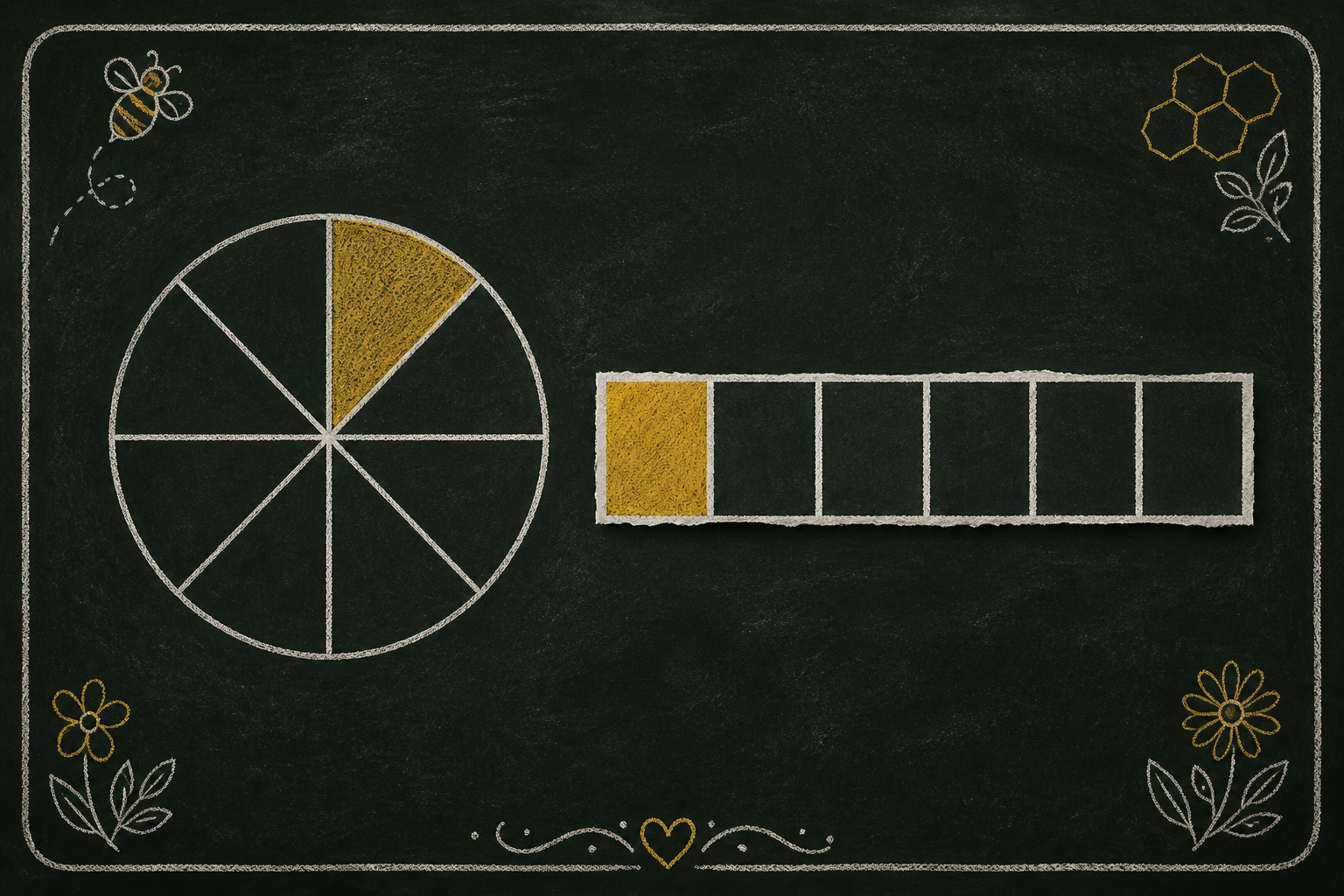
Fractions are already everywhere in your day
You have been using fractions since long before this lesson. When you split a chocolate bar so a friend gets a fair share, when you eat two slices of a pizza cut into eight, when the clock says quarter past three, when the soccer coach calls half time, you are living inside fractions.
A fraction is just a fair way of talking about parts of one whole thing. Today we are going to give those everyday parts their proper names and learn to write them down. By the end you will look at a shaded shape, a point on a line, or two slices of cake, and know exactly which fraction you are looking at and which is bigger.
- Two slices of an eight-slice pizzathat is two eighths, 2/8, of the whole pizza
- Half a chocolate bar for you and half for a friendone whole shared into 2 equal parts, 1/2 each
- Quarter past the hourthe hour cut into 4 equal parts, we are 1/4 of the way through
- A glass filled three quarters fullthe glass in 4 equal parts, 3 of them full, 3/4
What students will be able to do
Students will understand a fraction as a number that describes equal parts of one whole, name and write fractions from shapes and from a number line, recognise simple equivalent fractions, and compare two fractions that share a numerator or a denominator.
- I can split a whole into equal parts and name each part as a unit fraction.
- I can read and write a fraction from a shaded shape.
- I can place a fraction as a point on a number line.
- I can show that two fractions such as 1/2 and 2/4 are equivalent.
- I can compare two fractions and explain which is greater and why.
Standards this unit teaches
- 3.NF.A.1Common Core (US)Understand unit fractions
Understand a fraction 1/b as the quantity formed by 1 part when a whole is partitioned into b equal parts; understand a fraction a/b as the quantity formed by a parts of size 1/b.
- 3.NF.A.2Common Core (US)Fractions on a number line
Understand a fraction as a number on the number line; represent fractions on a number line diagram by marking off equal lengths from 0.
- 3.NF.A.3Common Core (US)Equivalence and comparing
Explain equivalence of fractions in special cases, and compare fractions by reasoning about their size, recognising that comparisons are valid only when the two fractions refer to the same whole.
- AC9M3N02Australian Curriculum v9 (ACARA)Unit fractions and their multiples
Recognise and represent unit fractions such as halves, thirds, quarters, fifths and tenths, and combine same-denominator fractions to make a whole.
- AC9M4N03Australian Curriculum v9 (ACARA)Fractions on a number line (Year 4 bridge)
Count by fractions, including mixed numerals, and locate and represent them as points on a number line. The number-line and equivalence work in this unit reaches toward this Year 4 descriptor.
Printable anchor chart
Print a wall poster to go with this unit, a code-drawn diagram students can point to during and after the lesson.
Prior knowledge
This unit builds on skills students should already have met. Revisit any that are shaky first.
Words to teach and display
- Fraction
- a number that names equal parts of one whole
- Numerator
- the top number, how many equal parts you have
- Denominator
- the bottom number, how many equal parts the whole is cut into
- Unit fraction
- a fraction with 1 on top, one single equal part, such as 1/4
- Equivalent fractions
- different fractions that name the same amount, such as 1/2 and 2/4
- Whole
- the one thing, or one group, that is being split into parts
Teach it: concrete, pictorial, abstract
The lesson moves from things students can hold, to pictures and diagrams, to the written maths. The diagrams below are drawn from data, so they are accurate and print cleanly. Teach straight from them.
1. Equal parts and the unit fraction
ConcreteStart with one whole and the single most important word in fractions: equal. Fold a paper strip or a paper circle in front of the class. Fold it once into two matching parts and shade one. Those parts are the same size, so each one has a name: one half. Fold a fresh strip into four matching parts and each part is one quarter. The bottom number tells you how many equal parts the whole was cut into.
The clearest first fraction is the unit fraction, a single equal part, with 1 on top. If the whole is cut into 4 equal parts, one of those parts is 1/4. Read it as 'one quarter' and say what it means out loud: one part out of four equal parts.
Then build up from the unit. Three of those quarter parts is 3/4. The top number (numerator) counts the parts you have, the bottom number (denominator) names how big each part is. A fraction is really just a count of unit fractions: 3/4 is 1/4 and 1/4 and 1/4.
- If I cut this whole into 5 equal parts, what is one part called?
- Point to the numerator. What is it counting?
- Why does it matter that the parts are equal?
2. Reading and writing a fraction
PictorialMove from folded paper to drawn shapes. Show a shape split into equal parts with some of them shaded, and turn naming it into a two-step routine the class says together: first count the total equal parts for the bottom number, then count the shaded parts for the top number.
Name the fraction shown by this shaded bar.
- Count all the equal parts the whole is cut into: 4. That is the denominator, so the bottom number is 4.
- Count how many parts are shaded: 3. That is the numerator, so the top number is 3.
- Write the count of shaded parts over the total parts.
Answer: The fraction is 3/4 (three quarters).
- How would this fraction change if only 1 part were shaded?
- If every part were shaded, what fraction would that be, and what whole number does it equal?
3. Fractions as points on a number line
PictorialA fraction is not only a piece of a shape, it is a number, so it has a home on the number line. Draw the line from 0 to 1 and tell the class that the space from 0 to 1 is one whole. To place fourths, split that space into 4 equal lengths, exactly the way you split the paper strip. Count the equal jumps from 0: one jump lands on 1/4, two jumps on 2/4, three jumps on 3/4.
The key move is counting the equal gaps from 0, not the tick marks. Three equal jumps from 0 lands you on 3/4. The number line makes a big idea visible: 4/4 sits exactly on 1, because four quarter-jumps cover the whole distance from 0 to 1.
Where does 3/4 sit on a number line from 0 to 1?
- The denominator is 4, so split the length from 0 to 1 into 4 equal parts.
- The numerator is 3, so count 3 equal jumps from 0.
- Mark the point you land on.
Answer: 3/4 sits at the third mark, three quarters of the way from 0 to 1.
- How many equal jumps take you from 0 all the way to 1 here?
- Which is further from 0 on this line, 2/4 or 3/4?
4. Equivalent fractions
PictorialNow the surprise that delights students: two fractions that look different can be the same amount. Line up a bar showing 1/2 above a bar the same length showing 2/4. The shaded parts reach exactly as far. So 1/2 and 2/4 name the same amount. We call them equivalent fractions.
The parts got smaller and there are more of them, but the total shaded amount did not move. On a shape, equivalence is when the shaded region is the same size even though the whole is cut more finely.
The abstract rule comes from the picture: multiply the top and the bottom by the same number and the value stays the same, because you are cutting every part into the same number of smaller pieces. 1/2 = 2/4 = 4/8. The classic trap is adding instead of multiplying, which we meet head on in the misconceptions below.
Find a fraction equivalent to 1/2 in fourths, then in eighths.
- To go from halves to fourths, each half is cut into 2, so multiply top and bottom by 2: (1 x 2)/(2 x 2) = 2/4.
- To go from halves to eighths, each half is cut into 4, so multiply top and bottom by 4: (1 x 4)/(2 x 4) = 4/8.
- Check against the bars: all three shade the same length.
Answer: 1/2 = 2/4 = 4/8. They are equivalent fractions.
- Why did the amount of shading stay the same when we changed 1/2 to 2/4?
- What do we multiply the top and bottom of 1/2 by to get 4/8?
5. Comparing two fractions
AbstractFinish with the everyday question: which is more? There are two friendly cases at this grade, and both are reasoned from the picture, never from a rule learned blindly.
Same denominator, different numerator: the parts are the same size, so more parts means more. 3/5 is greater than 2/5 because three fifth-size parts beat two fifth-size parts. Compare the top numbers.
Same numerator, different denominator: you have the same number of parts, but a bigger denominator cuts the whole into more and therefore smaller parts. 1/3 is greater than 1/4 because a third of a cake is a bigger piece than a quarter of the same cake. This is the case that feels backward to students, so lean on the diagram.
One warning that runs through both cases: a comparison is only fair when the two fractions describe the same whole. Half a small cookie is not more than a quarter of a large cake.
Compare 2/5 and 3/5, then compare 1/3 and 1/4.
- 2/5 and 3/5 have the same denominator, so the parts are the same size. Compare the numerators: 3 is more than 2.
- 1/3 and 1/4 have the same numerator. The bigger denominator, 4, makes smaller parts. Thirds are bigger than quarters.
- Read the diagrams to confirm each result.
Answer: 3/5 is greater than 2/5, and 1/3 is greater than 1/4.
- Which is bigger, 1/6 or 1/8, and how do you know without drawing it?
- Why must both fractions be parts of the same whole before we compare them?
Common misconceptions and how to address them
MisconceptionA bigger bottom number means a bigger fraction, so 1/8 is more than 1/4.
Why it happens: Students carry over whole-number thinking where 8 beats 4. But the denominator counts how many parts the whole is cut into, and more parts means each part is smaller.
How to address it: Put 1/4 and 1/8 bars side by side so the eighth is visibly the thinner slice. Say it in cake language: would you rather share a cake with 4 people or 8? The more people, the smaller your piece.
MisconceptionAny shape split into pieces can be named as a fraction, even when the pieces are different sizes.
Why it happens: Early picture work sometimes shows unequal parts, and students count parts without checking they match.
How to address it: Insist on the word equal every time. Show a shape cut into unequal parts and refuse to name it until the parts are made the same size. Fair shares must be equal shares.
MisconceptionThe top and bottom numbers are swapped, so one part out of four is written as 4/1.
Why it happens: The two positions are easy to mix up before the meaning of each is secure.
How to address it: Anchor the bottom number to the whole with a phrase students repeat: bottom is how many the whole is broken into, top is how many you took. The denominator is down and it is the total.
MisconceptionTo make an equivalent fraction you add the same number to the top and the bottom, so 1/2 becomes 2/3.
Why it happens: It mirrors the correct rule for multiplying, and adding feels like the natural move.
How to address it: Show with bars that 1/2 and 2/3 shade different amounts, so they are not equal. Then show that multiplying both by 2 cuts each part into the same smaller pieces and keeps the amount, giving 2/4. Equivalence multiplies, it does not add.
MisconceptionOn a number line, count the tick marks to find the fraction rather than the equal spaces.
Why it happens: It repeats the classic number-line slip of counting points instead of the gaps between them.
How to address it: Trace the jumps from 0 with a finger and count the equal spaces out loud. The denominator is the number of equal spaces in one whole, and the numerator is how many spaces you jump from 0.
MisconceptionYou can compare any two fractions straight away, ignoring what the whole is.
Why it happens: Students treat the fraction as a bare number and forget it always refers to a whole.
How to address it: Ask which is more, half of a grape or a quarter of a watermelon. The laughter makes the point: comparisons are only fair when both fractions are parts of the same whole.
Guided practice (with answers)
1. Name the fraction shaded here.
Answer: 2/3. The whole is in 3 equal parts and 2 are shaded.
2. Place 2/4 on a number line from 0 to 1.
Answer: Split 0 to 1 into 4 equal jumps and count 2 from 0. It lands halfway, on the same point as 1/2.
3. Write a fraction equivalent to 1/2 using sixths.
Answer: 3/6. Multiply the top and bottom of 1/2 by 3.
4. Which is greater, 4/5 or 2/5?
Answer: 4/5. Same-size fifth parts, and 4 of them is more than 2.
5. Which is greater, 1/2 or 1/5?
Answer: 1/2. Same one part each, but halves are bigger parts than fifths.
6. True or false: 3/3 is the same as one whole.
Answer: True. All 3 of the 3 equal parts together make the whole, so 3/3 = 1.
Independent practice worksheets
Set the matching ChalkBee worksheets for independent work. The answer keys are computed in code, so they are never wrong. Start with naming fractions, then move to comparing once naming is secure.
Differentiation
- Stay concrete for longer: keep folding and cutting paper strips and circles before moving to drawn shapes.
- Limit denominators to halves and quarters until naming is confident, then add thirds and fifths.
- Give a partly built fraction (denominator already written) so the student only counts the shaded parts.
- Use the same shape shaded and unshaded side by side so 'out of the whole' stays visible.
- Ask for two different equivalent fractions for the same amount, and to justify each with a diagram.
- Introduce comparing fractions to the benchmark 1/2 (is 3/8 more or less than a half?).
- Bring in fractions greater than 1 on the number line, such as 5/4, as a bridge to Year 4 work.
- Have students write their own 'same whole' trap question, like the grape and the watermelon, for a partner.
Assessment: exit ticket
A three-question exit ticket. Students answer on a slip in the last five minutes. It samples naming, equivalence and comparing, the three pillars of the unit.
1. Write the fraction for 3 shaded parts out of 5 equal parts.
Answer: 3/5.
2. Fill in the blank: 1/2 = _/4.
Answer: 2. So 1/2 = 2/4.
3. Circle the greater fraction and say why: 1/3 or 1/6.
Answer: 1/3, because thirds are bigger parts than sixths (the same 1 part, but a smaller denominator means bigger pieces).
Teacher notes and timings
- Rough timing across four lessons: Lesson 1 equal parts and naming (sections 1 to 2), Lesson 2 the number line (section 3), Lesson 3 equivalence (section 4), Lesson 4 comparing plus the exit ticket (section 5 and assessment).
- Language to keep saying: equal parts, out of the whole, the same whole. These three phrases pre-empt most of the misconceptions.
- Keep the paper folding out on desks through the pictorial sections. When a student is stuck on a drawn shape, hand them the strip and let them fold the same fraction.
- The number-line diagram partitions the whole into fourths. If your class has not met decimals, tell them to read only the fraction labels above the line and ignore the numbers below the marks for now.
- For comparing, resist giving the cross-multiplying shortcut. At this grade the reasoning from the picture is the learning. The shortcut comes in a later year.
- Use Student view to project this lesson. Print saves the full teacher unit, including answers and teacher notes; use the linked independent-practice worksheets for student handouts.