Division with remainders
Sharing that does not come out even, writing the remainder, and reading what is left over
About four lessons of 45 to 60 minutes
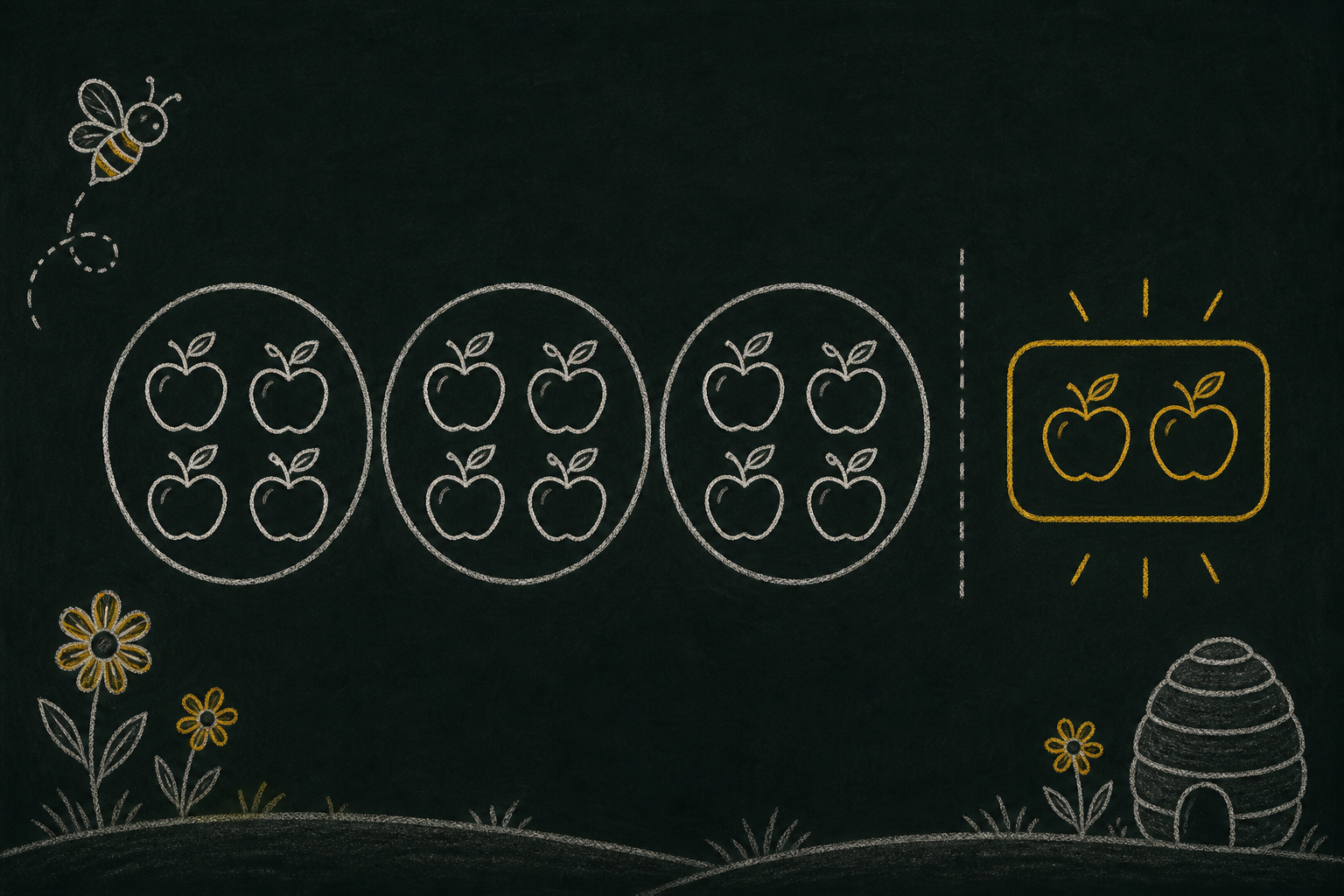
What happens to the last lolly?
You have 13 lollies and 4 friends. Share them out fairly: one each, two each, three each, and now everyone has 3 and there is 1 lolly sitting on the table. It cannot be split without cutting it, so it just waits. That leftover has a name in maths: the remainder.
Real life rarely divides evenly. Thirty players will not always make whole teams, a packet of eggs will not always fill every carton, a class trip will not always fit exactly into the buses. Today you will learn to divide when it does not come out even, write the answer with its remainder, and, most importantly, decide what that leftover means, because sometimes it needs a whole extra bus and sometimes you just ignore it.
- 13 lollies shared among 4 friends13 divided by 4 = 3 each, remainder 1 left on the table
- 26 eggs packed into cartons of 626 divided by 6 = 4 full cartons, remainder 2 eggs
- 26 children, each bus holds 826 divided by 8 = 3 remainder 2, so you need 4 buses, not 3
- 17 players making teams of 517 divided by 5 = 3 full teams, remainder 2 players waiting
What students will be able to do
Students will divide a two-digit number by a one-digit number when it does not share evenly, find the whole-number quotient and the remainder using known multiplication facts, check that the remainder is smaller than the divisor, and interpret the remainder correctly in a word problem.
- I can share a total that does not come out even and name the leftover as the remainder.
- I can find a quotient and remainder using the nearest multiplication fact.
- I can check my answer with quotient times divisor plus remainder equals the total.
- I can explain why the remainder must be smaller than the divisor.
- I can decide what the remainder means in a real problem.
Standards this unit teaches
- 4.NBT.B.6Common Core (US)Whole-number quotients and remainders
Find whole-number quotients and remainders with up to four-digit dividends and one-digit divisors, using strategies based on place value, the properties of operations, and the relationship between multiplication and division. Illustrate and explain the calculation by using equations, rectangular arrays, and area models.
- 4.OA.A.3Common Core (US)Interpret remainders in word problems
Solve multistep word problems posed with whole numbers using the four operations, including problems in which remainders must be interpreted. Assess the reasonableness of answers using estimation strategies including rounding.
- 3.OA.C.7Common Core (US)Fact fluency (foundation)
Fluently multiply and divide within 100, knowing the single-digit facts from memory. Finding a remainder means reaching for the nearest multiple below the dividend, which is a known times-table fact, so this fluency is the foundation.
- AC9M4N05Australian Curriculum v9 (ACARA)Efficient division strategies (Year 4)
Develop efficient strategies, and use appropriate digital tools, for solving problems involving division. ACARA v9 keeps Year 4 division to exact sharing with no remainder, so this descriptor is the Year 4 division home. The formal interpretation of remainders is a Year 6 descriptor (see AC9M6N06 below).
- AC9M6N06Australian Curriculum v9 (ACARA)Interpreting remainders (Year 6 bridge)
Solve problems involving division, choosing efficient strategies and interpreting any remainder in the context of the problem, expressing the result as a whole number, decimal or fraction. This unit reaches toward this Year 6 descriptor by naming and interpreting the remainder early.
Prior knowledge
This unit builds on skills students should already have met. Revisit any that are shaky first.
Words to teach and display
- Dividend
- the total you start with and are dividing up
- Divisor
- the number you divide by, the number of groups or the group size
- Quotient
- the whole-number part of a division answer, how many in each group
- Remainder
- the amount left over that cannot be shared into another whole group
- Multiple
- a number you reach by counting in equal steps, such as the multiples of 5: 5, 10, 15, 20
- Factor
- a number that divides into another with nothing left over
Teach it: concrete, pictorial, abstract
The lesson moves from things students can hold, to pictures and diagrams, to the written maths. The diagrams below are drawn from data, so they are accurate and print cleanly. Teach straight from them.
1. When sharing does not come out even
ConcreteStart with counters that will not share evenly. Take 13 counters and share them one at a time onto 4 plates, going round and round. Each plate reaches 3, and then there is 1 counter you cannot place without giving someone more than the others. That single leftover is the remainder. Write it as 13 divided by 4 = 3 remainder 1.
The number line shows the same division as counting groups of 4. Jump 4, jump 4, jump 4, and you have reached 12 using three jumps. That is the quotient, 3. From 12 to 13 there is 1 step you cannot complete as a full group of 4, and that is the remainder.
Say the whole sentence together: 13 divided by 4 is 3 remainder 1. The quotient counts the full groups, the remainder counts what is left over once no more full groups can be made.
- Share 14 counters among 4 plates. How many on each plate, and how many are left over?
- In 13 divided by 4, what does the 3 count and what does the leftover 1 count?
2. Remainders in sharing and in grouping
ConcreteA remainder shows up in both meanings of division. Sharing 17 pencils among 5 children gives 3 each with 2 left over (17 divided by 5 = 3 remainder 2). Making teams of 5 from 17 players gives 3 full teams with 2 players waiting (also 17 divided by 5 = 3 remainder 2). Same division, same remainder, told two ways.
Whether you are finding how many in each group or how many groups, the leftover is whatever is too small to complete another equal group. Keep acting these out with counters so the remainder is a real object, not just a symbol.
There are 22 stickers shared equally among 4 children. How many each, and how many left?
- Find the biggest multiple of 4 that is not over 22: 4 x 5 = 20.
- Each child gets 5 stickers, using 20 in all.
- 22 take away 20 leaves 2 stickers over.
Answer: 22 divided by 4 = 5 remainder 2. Each child gets 5 stickers and 2 are left over.
- How many full teams of 5 can 17 players make, and how many wait?
- Is the leftover in a grouping problem different from the leftover in a sharing problem?
3. Finding the remainder with a known fact
PictorialYou do not need to deal out counters every time. To divide 29 by 5, ask which multiple of 5 sits just below 29. Count the fives: 5, 10, 15, 20, 25. The biggest that is not over 29 is 25, which is 5 x 5. So the quotient is 5. Then 29 take away 25 leaves 4, and 4 is smaller than 5, so the remainder is 4.
The bar below shows the 29 as five groups of 5 (that is 25) plus a remainder of 4. Reaching for the nearest multiple below the dividend turns every remainder question into a times-table fact plus a small subtraction.
Find 30 divided by 7.
- List multiples of 7: 7, 14, 21, 28, 35.
- The biggest not over 30 is 28, which is 7 x 4, so the quotient is 4.
- 30 take away 28 leaves 2, and 2 is smaller than 7.
Answer: 30 divided by 7 = 4 remainder 2.
- What is the nearest multiple of 6 below 20, and what is 20 divided by 6?
- Why do we pick the multiple just below the total, not the one just above?
4. Writing the answer and checking it
AbstractWrite a division with a remainder as quotient remainder amount, for example 29 divided by 5 = 5 remainder 4. Two rules keep it correct. First, the remainder must always be smaller than the divisor, if it is not, another full group still fits. Second, you can check any answer by working backwards: quotient times divisor plus remainder should give the dividend back.
Check 29 divided by 5 = 5 remainder 4 like this: 5 x 5 = 25, then 25 + 4 = 29. It matches the dividend, so the answer is right. This backwards check catches almost every mistake, so make it a habit.
If a student writes 29 divided by 5 = 4 remainder 9, the remainder 9 is bigger than the divisor 5, which is the signal that another group of 5 fits. Nudge them back to the nearest multiple.
Solve 45 divided by 6 and check your answer.
- Nearest multiple of 6 below 45 is 42, which is 6 x 7, so the quotient is 7.
- 45 take away 42 leaves 3, and 3 is smaller than 6, so the remainder is 3.
- Check: 7 x 6 = 42, then 42 + 3 = 45. It matches.
Answer: 45 divided by 6 = 7 remainder 3.
- Check whether 23 divided by 4 = 5 remainder 3 is correct.
- Why can a remainder never be equal to or larger than the divisor?
5. What does the remainder mean?
AbstractThe cleverest part of remainders is deciding what to do with the leftover, because it depends on the question. Take 26 children going on a trip with buses that hold 8. That is 26 divided by 8 = 3 remainder 2. You cannot leave 2 children behind, so you round up: 4 buses. But 26 eggs into cartons of 6 is 26 divided by 6 = 4 remainder 2, and here you keep 4 full cartons and the 2 spare eggs stay out. Same size remainder, opposite decision.
There are three common things a remainder can mean. Sometimes you round the quotient up (you need one more bus, box or table for the leftover). Sometimes you keep the quotient and the remainder is the answer (how many are left over). Sometimes you ignore the remainder (how many full teams can play). Always reread the question and ask what the leftover means here.
A baker has 30 muffins and boxes that hold 4. How many boxes can she completely fill, and how many muffins are left unboxed?
- Divide: nearest multiple of 4 below 30 is 28, which is 4 x 7, so 30 divided by 4 = 7 remainder 2.
- The question asks for completely filled boxes, so use the quotient: 7 full boxes.
- The remainder is what is left unboxed: 2 muffins.
Answer: She fills 7 boxes completely and 2 muffins are left over.
- 25 fans travel in taxis holding 4 each. How many taxis are needed?
- In that taxi problem, why can you not just ignore the remainder?
Common misconceptions and how to address them
MisconceptionA remainder can be as big as or bigger than the divisor, so 13 divided by 4 might be 2 remainder 5.
Why it happens: Students stop at the wrong multiple and do not check whether another full group still fits.
How to address it: State the rule and test it: if the remainder is 5 and you are dividing by 4, another group of 4 fits inside the 5. The remainder must always be smaller than the divisor. Go back to the nearest multiple.
MisconceptionThe remainder is written joined to the quotient, so 13 divided by 4 becomes 31 or 3.1.
Why it happens: Students squash the two numbers together or read remainder as a decimal point.
How to address it: The r stands for remainder, a separate leftover amount, not a decimal and not a second digit. Write it in full as 3 remainder 1 and read it aloud that way.
MisconceptionYou always just ignore the remainder because the real answer is the quotient.
Why it happens: Early exact divisions never had a leftover, so the remainder feels like something to throw away.
How to address it: Show the bus problem: ignoring the remainder leaves 2 children stranded. The leftover is real, and the question decides whether you round up, report it, or set it aside.
MisconceptionThe remainder is always the final answer to the word problem.
Why it happens: After the effort of finding it, students assume the remainder is what the question wants.
How to address it: Reread the question. How many full boxes wants the quotient, how many are left over wants the remainder, how many buses needed rounds the quotient up. The maths is the same, the answer depends on the words.
MisconceptionGetting a remainder means the division was done wrong.
Why it happens: Students expect a clean whole-number answer and read a leftover as a mistake.
How to address it: Reassure them that most real divisions leave a remainder and that is completely normal. The backwards check (quotient times divisor plus remainder) proves the answer is right even with a leftover.
Guided practice (with answers)
1. Share 17 counters among 5. How many each and how many left?
Answer: 17 divided by 5 = 3 remainder 2. Three each, 2 left over.
2. Find 23 divided by 4.
Answer: 5 remainder 3, because 4 x 5 = 20 and 23 take away 20 is 3.
3. Check whether 30 divided by 7 = 4 remainder 2 is correct.
Answer: Correct. 7 x 4 = 28, then 28 + 2 = 30, and 2 is smaller than 7.
4. 19 books are put on shelves that hold 6. How many shelves are completely full, and how many books are left?
Answer: 19 divided by 6 = 3 remainder 1. Three full shelves and 1 book left over.
5. Find 100 divided by 9.
Answer: 11 remainder 1, because 9 x 11 = 99 and 100 take away 99 is 1.
6. 25 pencils are shared equally among 4 friends. How many each, and how many are left?
Answer: 25 divided by 4 = 6 remainder 1. Six each and 1 left over.
Independent practice worksheets
Set the matching ChalkBee worksheets for independent work. The answer keys are computed in code, so they are never wrong. Start with plain division that leaves a remainder, then use the word-problem sets to practise interpreting the leftover.
Differentiation
- Stay concrete: keep sharing real counters and physically setting the leftover aside as the remainder.
- Provide a multiplication chart so the nearest multiple below the dividend is easy to spot.
- Limit divisors to 2, 5 and 10 first, where the multiples are quickest to count.
- Give a sentence frame: ___ divided by ___ = ___ remainder ___, so the student only fills the numbers.
- Move into short and long division with remainders on larger dividends, such as 137 divided by 6.
- Explore what the remainder could become as a fraction, so 13 divided by 4 is 3 and one quarter, as a bridge to later years.
- Sort a mixed set of word problems by whether the remainder is rounded up, reported, or ignored.
- Pose a puzzle: find a number that leaves a remainder of 3 when divided by 5, and check it.
Assessment: exit ticket
A three-question exit ticket for the last five minutes. It samples finding a remainder, checking an answer, and interpreting the leftover in context.
1. Find 22 divided by 5.
Answer: 4 remainder 2 (5 x 4 = 20, and 22 take away 20 is 2).
2. Check: is 23 divided by 4 = 5 remainder 3 correct? Show why.
Answer: Yes. 4 x 5 = 20, then 20 + 3 = 23, and 3 is smaller than 4.
3. 30 children ride in vans that hold 7. How many vans are needed?
Answer: 30 divided by 7 = 4 remainder 2, so 5 vans are needed (the 2 extra children still need a van).
Teacher notes and timings
- Rough timing across four lessons: Lesson 1 sharing that does not come out even (section 1), Lesson 2 both meanings and finding remainders with facts (sections 2 to 3), Lesson 3 writing and checking (section 4), Lesson 4 interpreting the remainder plus the exit ticket (section 5 and assessment).
- Language to keep saying: nearest multiple below, remainder smaller than the divisor, what does the leftover mean. Always run the backwards check, quotient times divisor plus remainder.
- A key curriculum note for Australian classes: ACARA v9 keeps Year 4 division to exact sharing with no remainder (AC9M4N05), and the formal interpretation of remainders is a Year 6 descriptor (AC9M6N06). This unit follows the US Grade 4 Common Core placement (4.NBT.B.6 and 4.OA.A.3) and can be used earlier in an Australian class as a gentle introduction that the Year 6 work later formalises.
- The interpret-the-remainder section is the mathematically rich part and the one students find hardest. Spend real time sorting problems into round up, report the remainder, and ignore the remainder, because the arithmetic is easy but the decision is not.
- Remainders lead naturally into short and long division. Once the nearest-multiple idea is secure, the written method is just the same reasoning organised in columns.
- Use Student view to project this lesson. Print saves the full teacher unit, including answers and teacher notes; use the linked independent-practice worksheets for student handouts.