Making inferences
Reading between the lines: using text clues and what you already know to work out what the author does not say outright
About three lessons of 40 to 50 minutes
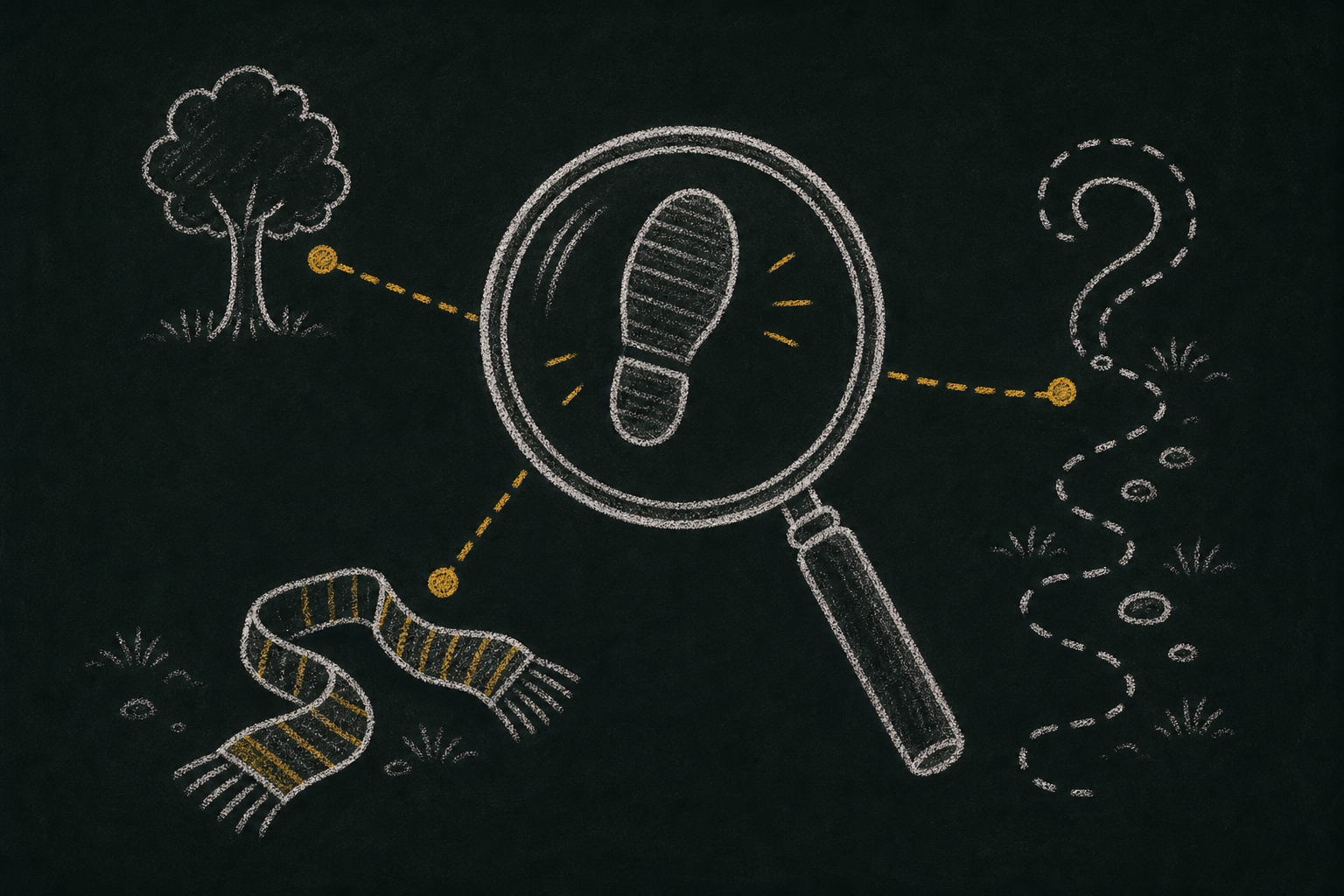
Every reader is a detective
A detective almost never gets a full confession. Instead they read the clues left behind, a muddy footprint, a window left open, a cup of tea gone cold, and work out what must have happened. You do exactly the same thing every time you read a good story.
Authors do not spell out everything. They leave clues and trust you to put them together with what you already know. That is called making an inference, reading between the lines. Today you will become a reading detective and work out the things the author only hinted at.
- Wet umbrellas dripping by the front dooryou infer it has been raining, even though nobody said so
- Candles blown out and everyone singingyou infer it is somebody's birthday
- She slammed the door and folded her armsyou infer she is angry, from what she does not from what she says
- He pulled on a thick coat, hat and glovesyou infer it is cold outside
What students will be able to do
Students will understand that an inference is a conclusion the reader works out by combining clues in the text with their own background knowledge, will locate the clues that support an idea, will infer characters' feelings and motives, and will check an inference against the text and revise it when the clues do not fit.
- I can explain what an inference is and how it differs from something the text states directly.
- I can find the clues in a text that support an idea.
- I can combine a text clue with what I already know to make an inference.
- I can infer how a character feels or why they act, and point to the words that show it.
- I can check my inference against the text and change it if the clues do not fit.
Standards this unit teaches
- RL.3.1Common Core (US)Refer to the text to answer questions
Ask and answer questions to demonstrate understanding of a text, referring explicitly to the text as the basis for the answers.
- RL.3.3Common Core (US)Describe characters, their feelings and motivations
Describe characters in a story (their traits, motivations, or feelings) and explain how their actions contribute to the sequence of events.
- RI.3.1Common Core (US)Refer to informational text for answers
Ask and answer questions to demonstrate understanding of an informational text, referring explicitly to the text as the basis for the answers.
- AC9E3LY05Australian Curriculum v9 (ACARA)Comprehension strategies for literal and inferred meaning
Use comprehension strategies such as visualising, predicting, connecting, summarising, monitoring and questioning to build literal and inferred meanings of texts, and to draw on prior and topic knowledge.
Prior knowledge
This unit builds on skills students should already have met. Revisit any that are shaky first.
- Building reading fluencysmooth, accurate reading frees up attention for meaning, which is what inference needs
- Using context cluesworking out an unknown word from nearby words is the same clue-reading habit, at word level
- Using decodable readersconfident decoding so attention is on the meaning of the passage, not on sounding words out
- Sight wordsinstant recognition of common words keeps reading smooth enough to think about meaning
Words to teach and display
- Inference
- a conclusion you work out from clues plus what you already know, not stated in the text
- Text evidence
- the exact words or details in the passage that back up an idea
- Background knowledge
- what you already know about the world and bring to the text
- Literal meaning
- what the text says right there on the page, in plain words
- Motive
- the reason a character does something, often not said outright
- Main idea
- what a text is mostly about, the point the details support
Teach it: model, guided practice, independent
The lesson moves from a teacher think-aloud, to reading clues together, to students inferring on their own. Every example is a short passage, so the strategy is practised on real text rather than learned as a rule. Read each passage aloud, then show your thinking out loud before asking students to try.
1. What an inference is
Open like a detective. A detective never has someone confess everything. Instead they read the clues at the scene, a muddy footprint, an open window, a cold cup of tea, and work out what must have happened. Good readers do exactly the same with a text. Authors leave clues instead of spelling everything out, and the reader puts them together. An inference is the smart conclusion you reach from clues in the text plus what you already know.
Give the class the simple formula and keep it on the board all unit: text clue plus what I know equals my inference. Both parts matter. A guess with no clue is just a guess, and a clue you ignore is a missed answer.
Contrast it with the literal meaning. If the text says 'Maya put on her raincoat', the literal meaning is that she put on a raincoat. The inference is that it is raining or about to rain, because you know people wear raincoats in the rain. The author did not say it was raining. You worked it out.
- What are the two ingredients of every inference?
- What is the difference between what a text says and what it means?
- Why is an inference more than just a guess?
2. Text clues and background knowledge
Slow down on the two ingredients. First, hunt for the clue: the exact words the author chose. Then add your background knowledge: what those words tell you because of things you already know. Model this with a single sentence so students see both moves clearly before meeting a whole passage.
Teach students to underline or point to the clue words first, then say the sentence 'This makes me think... because I know...'. Naming the knowledge out loud is what turns a lucky guess into a reasoned inference.
Warn them that the clue must come from the text. If they cannot point to words on the page, they are guessing, not inferring.
Read the sentence and make one inference. 'Jack zipped up his coat, pulled his hat down over his ears, and watched his breath make little clouds in the air.'
- Find the text clues: he zips up a coat, pulls a hat over his ears, and his breath makes clouds.
- Add what you know: people bundle up in warm clothes when it is cold, and you can see your breath in cold air.
- Put them together into an inference the author did not state.
Answer: It is cold, probably a winter day. The author never wrote the word cold, but the clues plus what we know make it clear.
- Which words in the sentence were the clues?
- What did you already know that helped you decide it was cold?
3. Modelling an inference from a passage
Now model the whole strategy on a short passage with a genuine think-aloud. Read it aloud once, then read it again stopping to think out loud: 'The author says... that makes me think... because I know...'. Students should hear you find clues and admit what you already know, so the invisible thinking becomes visible.
Read the passage and infer where the children are. 'The doors slid open with a soft hiss. Priya kept her voice to a whisper as they walked past the long rows of shelves. A grown-up with a name badge pressed a finger to her lips and pointed at a sign on the wall. Priya nodded and tiptoed to a low table covered in picture books.'
- Collect the clues: rows of shelves, everyone whispering, a staff member shushing them, a sign on the wall, and a table covered in picture books.
- Add background knowledge: a quiet place full of shelves of books where you must whisper is a library.
- Check that every clue fits the inference before you commit to it.
Answer: The children are in a library. No sentence says the word library, but the shelves of books, the whispering, the shushing and the picture books all point to it.
- Which clue was the strongest for you, and why?
- Could this be a bookshop instead? What clue makes a library a better fit?
4. Inferring feelings and motives
The richest inferences are about people. Authors rarely write 'she was proud' or 'he was nervous'. Instead they show it through what a character does, says and notices. Teach students to read actions as evidence of feelings, and to ask why a character acts as they do, which is the character's motive.
Give the class a bank of 'show not tell' signals: a clenched jaw and folded arms can show anger, a grin and a run can show excitement, a wobbling voice and a looked-away gaze can show worry. The feeling word is the inference, the action is the evidence.
Push from feeling to motive with the question 'why did they do that?'. The answer is almost always inferred, because motives live inside characters and authors leave them for the reader to work out.
Infer how Sam feels and why he acts as he does. 'Sam read the last line of his report twice. He punched the air, grabbed the paper, and sprinted down the hall calling for his mum before he had even reached the kitchen.'
- Find the action clues: he rereads the last line, punches the air, grabs the paper and sprints to tell his mum straight away.
- Infer the feeling from the actions: punching the air and rushing to share the news show he is thrilled and proud.
- Infer the motive with 'why?': he runs because he cannot wait to share good news, so the report must say something he is proud of.
Answer: Sam feels proud and excited, and his motive is to share the good news with his mum. The author showed this through his actions rather than naming the feeling.
- Which action was your best evidence that Sam was pleased?
- What was Sam's motive for running to the kitchen?
5. Checking an inference against the text
Finish with the habit that separates a strong reader from a careless one: an inference must fit all the clues, not just one. Teach students to test a candidate inference against the whole passage and to revise it when a detail does not fit. A tempting first idea is not always the best one.
Model the test out loud: 'Does every clue still make sense with this answer? Is there a detail that argues against it?'. If a clue contradicts the inference, the inference is wrong or incomplete and needs changing.
This is also the fix for wild guessing. If a student cannot point to text that supports their idea, or a clue clearly disagrees, the inference does not stand.
A reader infers that the dog in this passage is asleep. Check it. 'Rex lay in his basket by the door. His ears twitched at every footstep in the street, and a low growl rumbled in his chest whenever a shadow crossed the window.'
- Test the inference 'the dog is asleep' against the clues.
- Find the clue that does not fit: his ears twitch at every footstep and he growls at shadows, which a sleeping dog would not do.
- Revise the inference so it fits all the clues.
Answer: The first inference is wrong. Rex is awake and alert, probably guarding the door, because he reacts to sounds and shadows. Checking against the text caught the mistake.
- Which clue proved the 'asleep' inference wrong?
- What should you do when one clue disagrees with your inference?
Common misconceptions and how to address them
MisconceptionAn inference is just a wild guess, so any answer will do.
Why it happens: Students hear 'work it out' and think anything goes, without grounding the idea in the text.
How to address it: Insist on the formula: clue plus knowledge. Make every inference come with the words from the text that support it. No text evidence means it is a guess, not an inference.
MisconceptionIf the answer is not written in the text, there is no way to answer the question.
Why it happens: Younger readers expect every answer to be copied straight from a sentence, so an unstated answer feels impossible.
How to address it: Show a sentence like the raincoat example where the answer (it is raining) is clearly meant but never stated. Inference questions are answerable precisely because the author left clues on purpose.
MisconceptionRetelling what happened is the same as making an inference.
Why it happens: Students confuse literal comprehension (what the text says) with inferring (what it means).
How to address it: Sort questions into 'right there' and 'read between the lines'. Retelling answers the first kind, inference answers the second. Ask 'did the author say this, or did you work it out?'.
MisconceptionMy background knowledge is enough, so I can answer without reading the clues.
Why it happens: A confident student leans on what they already know and skips the text.
How to address it: Give a passage whose clues overturn an expectation (a beach scene that turns out to be freezing). Knowledge alone gets it wrong. The text clues must steer the inference.
MisconceptionThere is only one correct inference and everyone must reach the same one.
Why it happens: Students expect a single right answer as in maths.
How to address it: Explain that a good inference is one the text supports, and more than one reasonable inference can fit. The test is not 'the one answer' but 'does the evidence back it up?'. Reject inferences a clue contradicts.
MisconceptionThe first idea that pops into my head must be right.
Why it happens: Students commit to an early guess and stop reading for clues that disagree.
How to address it: Teach the check-against-the-text step every time. A candidate inference has to survive all the clues, or it gets revised. Model catching and fixing your own tempting wrong answer.
Guided practice (with answers)
1. Read the clue and infer the place. 'Popcorn crunched under their feet, the lights dimmed, and everyone stared up at the huge glowing screen.' Where are they?
Answer: At the cinema. Clues: popcorn underfoot, lights dimming and a huge screen; plus what we know about movie theatres.
2. Infer the weather. 'She squinted, pulled her cap lower, and wiped her forehead with the back of her hand.' What is it like outside?
Answer: It is hot and sunny. Clues: squinting, a cap pulled low and wiping a sweaty forehead point to bright, hot weather.
3. Infer the feeling. 'Ben's hand shot up before the teacher had finished the question, and he could barely stay in his seat.' How does Ben feel?
Answer: Ben feels eager and confident. His hand shooting up and struggling to sit still show he is keen to answer.
4. Infer the motive. 'Ella slipped her little brother the last biscuit and told him she was not hungry, even though her tummy was rumbling.' Why did Ella do this?
Answer: Ella gave up the biscuit because she wanted her brother to have it. Her rumbling tummy shows she was hungry, so her motive was kindness, not a full stomach.
5. Check this inference: a reader says the character is scared. 'Tom skipped up to the front, beaming, and could not wait for his turn on the stage.' Does 'scared' fit?
Answer: No. The clues (skipping, beaming, not being able to wait) show excitement, not fear. The inference should be revised to eager or excited.
6. Two ingredients: name the text clue and the background knowledge behind this inference. 'The candles were blown out and everyone sang, so it was somebody's birthday.'
Answer: Text clue: candles blown out and everyone singing. Background knowledge: we sing and blow out candles at birthday parties. Together they give the inference that it is a birthday.
Independent practice worksheets
Set the matching ChalkBee reading passages for independent work. Narrative passages are richest for inference, so start with a story before nonfiction. Ask students to underline the clue for every inference answer.
Differentiation
- Work at sentence level for longer: one clue, one inference, before moving to whole passages.
- Provide a sentence frame for every answer: 'I think ___ because the text says ___ and I know ___'.
- Read the passage aloud so decoding does not use up the attention the student needs for meaning.
- Offer two inference choices and ask the student to pick the one the clues support, before asking them to generate their own.
- Ask for two reasonable inferences from the same passage, each with its own text evidence.
- Move to inferring the theme or lesson of a short story, not just a single feeling or place.
- Have students write their own three-sentence 'show not tell' passage for a partner to infer the hidden feeling.
- Compare an inference across two short texts on the same topic and discuss why the clues differ.
Assessment: exit ticket
A three-question exit ticket. Students answer on a slip in the last five minutes. Each question needs an inference and the text evidence that supports it, sampling place, feeling and the checking habit.
1. Infer the place and give the clue. 'Waves fizzed over their toes, a gull cried overhead, and sand stuck to their sun-cream.'
Answer: The beach. Clues: waves over their toes, a gull, and sand stuck to sun-cream.
2. Infer the feeling and give the evidence. 'Noah stared at his shoes and mumbled his answer so quietly the teacher had to lean in.'
Answer: Noah feels shy or nervous. Evidence: staring at his shoes and mumbling very quietly.
3. A reader infers the dog is friendly from: 'The dog backed away, its tail low, and let out a warning growl.' Is that inference right? Explain.
Answer: No. The clues (backing away, tail low, a warning growl) show the dog is frightened or defensive, not friendly. The inference should be revised.
Teacher notes and timings
- Rough timing across three lessons: Lesson 1 what inference is plus clues and knowledge (sections 1 and 2), Lesson 2 modelling a passage plus feelings and motives (sections 3 and 4), Lesson 3 checking against the text plus the exit ticket (section 5 and assessment).
- Language to keep saying: clue plus what I know, show not tell, does every clue still fit. These three phrases pre-empt most of the misconceptions.
- The think-aloud is the heart of this unit. Do not shortcut it. Students learn inference by hearing an expert reader find clues and name their own knowledge out loud, then imitating it.
- Keep questions sorted into 'right there' (literal) and 'read between the lines' (inferred) all unit, so students always know which kind of thinking a question asks for.
- Accept any inference the text supports, and reject any a clue contradicts. The goal is evidence-backed reasoning, not one memorised answer.
- Use Student view to project this lesson. Print saves the full teacher unit, including answers and teacher notes; use the linked independent-practice worksheets for student handouts.