Two-digit subtraction with regrouping
Tens and ones, breaking a ten open, and the column algorithm for borrowing
About four lessons of 40 to 55 minutes
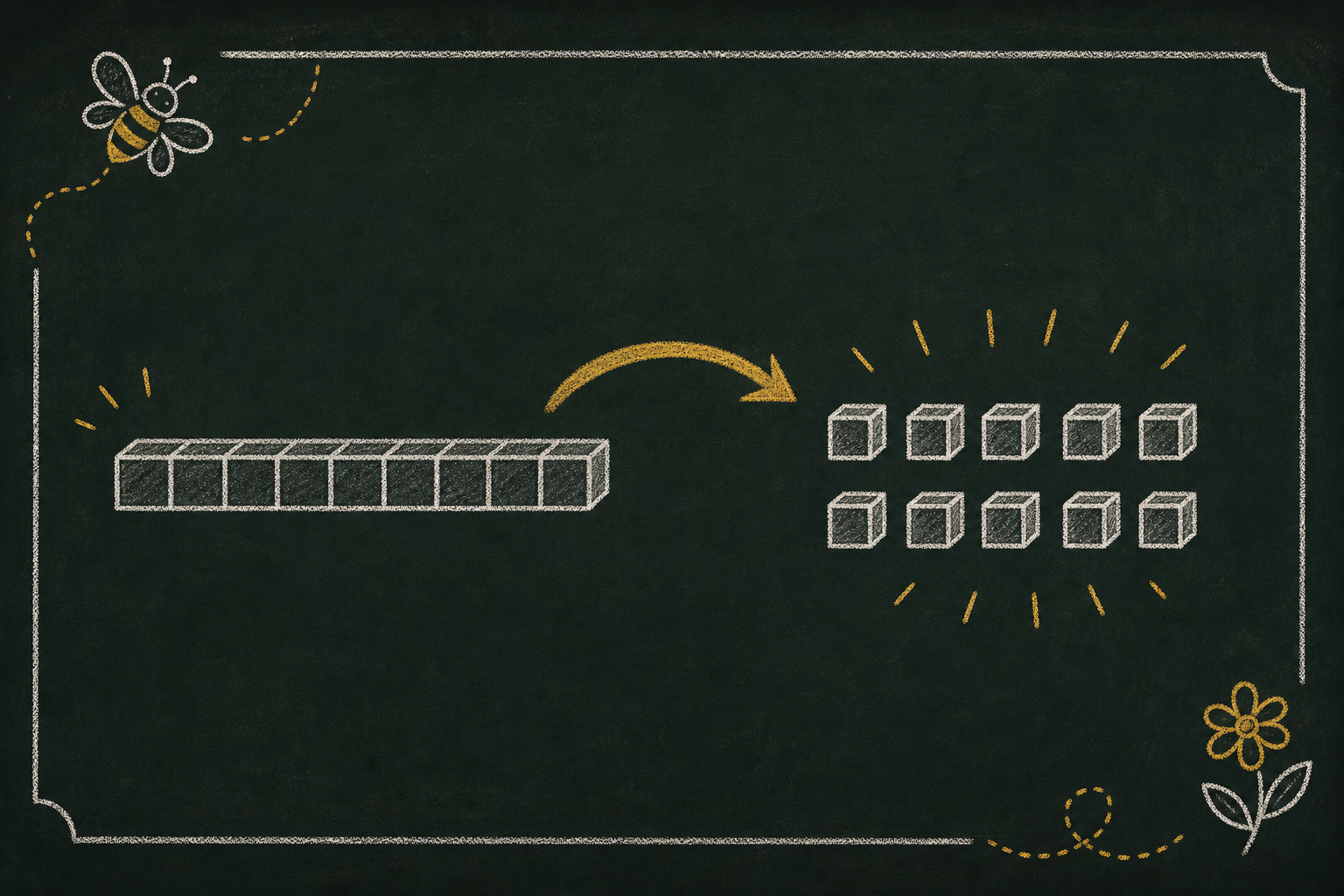
When you run out of ones, break a ten open
Picture paying for a 7 dollar toy when your pocket holds two 10 dollar notes and no coins. You cannot hand over 7 single dollars, because you have none. So you break one 10 dollar note at the shop counter into ten 1 dollar coins, and now you can pay. Untying a bundle of ten straws to get more loose ones works the same way, and so does taking one full ten-frame apart back into single counters.
That trade, one ten swapped back for ten ones, is the whole secret of borrowing. When you subtract and the ones column does not have enough to take away from, you open up a ten and move its ten ones next door. Today you will learn to spot when a ten must be broken and to borrow neatly, so numbers like 52 minus 27 hold no fear.
- A 10 dollar note broken into ten 1 dollar coinsswap 1 ten for 10 ones so you have single dollars to pay with, that is regrouping
- Untying a bundle of 10 strawsone bundle becomes ten loose straws when you need more ones
- A full ten-frame taken apartthe ten spills back into ten single counters you can take from
- A bead rolling back over tenpast ten going down, the count rolls back into the ones
What students will be able to do
Students will subtract two-digit numbers within 100, recognise when the ones column does not have enough to subtract, decompose a ten and borrow it into the ones column, record the subtraction neatly using the standard column method, and check the result by adding back.
- I can split a two-digit number into tens and ones.
- I can subtract the ones and the tens in the right columns.
- I can tell when the ones are too few and I need to regroup.
- I can break a ten into ten ones and borrow it into the ones column.
- I can check my answer by adding the parts back together.
Standards this unit teaches
- 2.NBT.B.5Common Core (US)Add and subtract within 100
Fluently add and subtract within 100 using strategies based on place value, properties of operations, and the relationship between addition and subtraction.
- 2.NBT.B.7Common Core (US)Decompose a ten when subtracting
Add and subtract within 1000 using concrete models and place-value strategies, understanding that sometimes it is necessary to compose or decompose a ten. This unit teaches that decomposing-a-ten step (borrowing), applied within 100.
- AC9M2N01Australian Curriculum v9 (ACARA)Partition, regroup and rename into tens and ones
Partition, regroup and rename two- and three-digit numbers in different ways, including splitting two-digit numbers into tens and ones. This place-value regrouping is exactly what borrowing rests on.
- AC9M3N03Australian Curriculum v9 (ACARA)Add and subtract with regrouping (Year 3 bridge)
Add and subtract two- and three-digit numbers by using place value to partition, rearrange and regroup. ACARA places the full written subtract-with-regrouping algorithm at Year 3, so this US Grade 2 unit reaches toward that Year 3 descriptor.
Prior knowledge
This unit builds on skills students should already have met. Revisit any that are shaky first.
Words to teach and display
- Difference
- the answer you get when you subtract
- Place value
- what a digit is worth from its position, tens or ones
- Digit
- a single number symbol, 0 to 9
- Regroup
- to trade 1 ten for 10 ones (or the other way round)
- Borrow
- to break a ten and move its ten ones into the ones column
- Decompose a ten
- to open one ten back into ten ones
Teach it: concrete, pictorial, abstract
The lesson moves from things students can hold, to pictures and diagrams, to the written maths. The diagrams below are drawn from data, so they are accurate and print cleanly. Teach straight from them.
1. A number is tens and ones
ConcreteBefore subtracting, make sure every child can pull a two-digit number apart. Show 52 with base-ten blocks or bundled straws: 5 tens and 2 ones. Say it together, fifty-two is 5 tens and 2 ones, worth 50 and 2. The tens live on the left, the ones on the right. This split is the ground everything else stands on, because borrowing is really just re-splitting the same number.
Do a few quickly: 64 is 6 tens and 4 ones, 30 is 3 tens and 0 ones, 45 is 4 tens and 5 ones. The bar model below shows 52 broken into its 50 and its 2, the same partition students will re-open when a subtraction needs a borrow.
- How many tens and how many ones are in 47?
- Which digit is worth more in 52, the 5 or the 2? Why?
2. Subtracting when the ones are enough
PictorialStart with subtractions that do not need borrowing, so the column routine is clear before regrouping arrives. Take 47 minus 23. Subtract the ones first: 7 take away 3 leaves 4, and there were enough ones to do it, so nothing is traded. Then subtract the tens: 4 tens take away 2 tens leaves 2 tens, worth 20. Together that is 24.
The rule to build now, before any borrowing, is always subtract the ones column first, then the tens. Keeping the ones under one another and the tens under one another stops digits drifting into the wrong place.
Subtract 58 minus 24.
- Subtract the ones: 8 take away 4 leaves 4. There were enough ones, so it stays in the ones place.
- Subtract the tens: 5 tens take away 2 tens leaves 3 tens, worth 30.
- Put them together: 30 and 4.
Answer: 58 minus 24 = 34.
- In 69 minus 26, which column do you subtract first?
- Are there enough ones to subtract here? So do we need to trade?
3. Breaking a ten: the borrow
PictorialNow the heart of the unit. Take 52 minus 27. Try the ones first: 2 take away 7. You cannot take 7 ones from only 2 ones. So we trade: break one of the 5 tens open into 10 ones. Now the top number is re-split as 4 tens and 12 ones, still worth 52. With 12 ones we can subtract: 12 take away 7 leaves 5. That broken ten is the whole trick.
The bar model below shows 52 re-split into the 40 that is left in the tens and the 12 ones we now have to subtract from. Say the trade out loud every time: not enough ones, break a ten, now there are twelve ones.
Then finish in the tens. One ten was used up in the trade, so only 4 tens remain: 4 tens take away 2 tens leaves 2 tens, worth 20. With the 5 ones, that is 25.
- When do we have to break a ten and borrow?
- In 52 minus 27, how many ones do you have to subtract from after the trade, and how many tens are left?
4. The column method, start to finish
AbstractPut it all together in the neat written method. Stack the two numbers so tens sit above tens and ones above ones. Subtract the ones column. If the top ones are too few, cross out the tens digit, drop it by one, and give the ones ten more (the borrowed ten). Then subtract the ones, and finally subtract the tens column using the reduced tens digit.
Work 52 minus 27 the standard way and narrate every step, because the language is what makes it stick.
Subtract 52 minus 27 using the column method.
- Line up the columns: 52 above 27, tens above tens, ones above ones.
- Ones: 2 take away 7 will not go. Borrow: cross the 5 tens to 4, and make the 2 ones into 12.
- Subtract the ones: 12 take away 7 leaves 5. Write 5 in the ones place.
- Subtract the tens: 4 take away 2 leaves 2. Write 2 in the tens place.
Answer: 52 minus 27 = 25.
- Where does the borrowed ten come from, and what does it do to the tens digit?
- After borrowing in 52 minus 27, how many tens are you subtracting from?
5. Checking by adding back, and borrowing over a zero
AbstractSubtraction and addition undo each other, so the surest check is to add the answer to the number you took away and see if you land back on the start. For 52 minus 27 = 25, add 25 and 27: that makes 52, so the answer is right. This is also the moment to meet a tricky case, a zero in the ones, such as 40 minus 13.
In 40 minus 13 the ones are 0 take away 3, which will not go, so break a ten: 40 becomes 3 tens and 10 ones. Now 10 take away 3 leaves 7, and 3 tens take away 1 ten leaves 2 tens, giving 27. Check by adding back: 27 and 13 make 40.
Encourage students to add back every answer. If the check does not return the starting number, there is a slip to find, usually a forgotten borrow.
- How do you check a subtraction using addition?
- In 40 minus 13, why do you have to break a ten before you can subtract the ones?
Common misconceptions and how to address them
MisconceptionIn each column just take the smaller digit from the larger, so 52 minus 27 gives 35 (doing 7 take away 2 in the ones).
Why it happens: Students flip the ones so the subtraction is easy, ignoring that the top number is the one being subtracted from.
How to address it: Stop at the ones: you must take 7 from 2, not 2 from 7. Since 2 is too few, break a ten to make 12, then 12 take away 7. Model it with bundled straws so the direction is unmistakable.
MisconceptionBorrow to make the ones work, but then forget to drop the tens digit, so 52 minus 27 comes out as 35.
Why it happens: The trade in the ones is remembered but the ten it cost the tens column is not.
How to address it: Say the trade both ways: the ones gain a ten AND the tens lose one. Cross out the 5 and write 4 above it before touching the tens column.
MisconceptionWith a zero on top in the ones, write 0 as the answer or skip the column, so 40 minus 13 gives 33 or 30.
Why it happens: Zero take away a number feels like it should just be zero, and borrowing from further along looks hard.
How to address it: Zero ones is still not enough to take 3 from, so break a ten: the 0 ones become 10 ones. Then 10 take away 3 leaves 7. Rebuild it with a full ten-frame opened back into ten counters.
MisconceptionEvery two-digit subtraction needs a borrow.
Why it happens: After a run of regrouping practice, students borrow out of habit even when the ones are already enough.
How to address it: Check the ones first: only break a ten when the top ones are too few. In 58 minus 24 there are enough ones, so nothing is traded. Mix no-borrow and borrow problems so the check stays alive.
MisconceptionSubtraction can be swapped like addition, so 27 minus 52 is the same as 52 minus 27.
Why it happens: Addition can be done in any order, and students over-apply that to subtraction.
How to address it: Act it out: you cannot take 52 away from only 27. Order matters in subtraction, the larger amount you start with must be written on top.
MisconceptionThe borrowed ten adds ten to the tens digit instead of to the ones.
Why it happens: The trade gets remembered in the wrong direction under pressure.
How to address it: Anchor it to the materials: you broke a ten into ten ONES, so the ten new units land in the ones column, and the tens column goes DOWN by one, never up.
Guided practice (with answers)
1. Split 64 into tens and ones.
Answer: 6 tens and 4 ones, worth 60 and 4.
2. Subtract 58 minus 24. Does it need a borrow?
Answer: 34, and no borrow. Ones 8 take away 4 = 4 (enough ones), tens 5 take away 2 = 3.
3. The ones are 3 take away 8. What do you do?
Answer: Break a ten. The 3 ones become 13 ones, then 13 take away 8 = 5, and the tens digit drops by one.
4. Subtract 45 minus 27 with the column method.
Answer: 18. Ones 5 take away 7 will not go, borrow to make 15 take away 7 = 8, tens 3 take away 2 = 1. Check: 18 + 27 = 45.
5. Subtract 72 minus 38.
Answer: 34. Ones 2 take away 8 will not go, borrow to make 12 take away 8 = 4, tens 6 take away 3 = 3. Check: 34 + 38 = 72.
6. Subtract 40 minus 16, then check by adding back.
Answer: 24. Break a ten: 10 take away 6 = 4, 3 tens take away 1 ten = 2 tens. Check: 24 + 16 = 40.
Independent practice worksheets
Set the matching ChalkBee worksheets for independent work. The answer keys are computed in code, so they are never wrong. Start with place value, then move to two-digit subtraction once the trade is understood.
Differentiation
- Keep base-ten blocks or bundled straws on the desk and act out the trade for every subtraction.
- Use a printed tens-and-ones chart so digits cannot drift into the wrong column.
- Start with a ten already broken and shown as ten ones, so the student only subtracts and finishes the tens.
- Limit to subtractions that borrow just one ten before moving to the zero-on-top case.
- Subtract across a middle zero in three-digit numbers, bridging to 2.NBT.B.7.
- Ask students to write the addition that checks each subtraction (fact families).
- Pose a missing-number puzzle: 52 minus ? = 25, reasoned from place value.
- Find the difference two ways, borrowing and counting up, and compare which felt quicker.
Assessment: exit ticket
A three-question exit ticket for the last five minutes. It samples place value, a no-borrow subtraction, and a borrow subtraction.
1. How many tens and ones are in 63?
Answer: 6 tens and 3 ones.
2. Subtract 59 minus 24.
Answer: 35 (no regrouping needed).
3. Subtract 53 minus 28, and say what you borrowed.
Answer: 25. Ones 3 take away 8 will not go, so break a ten to make 13 take away 8 = 5, tens 4 take away 2 = 2.
Teacher notes and timings
- Rough timing across four lessons: Lesson 1 tens and ones plus no-borrow subtractions (sections 1 to 2), Lesson 2 breaking a ten (section 3), Lesson 3 the column method (section 4), Lesson 4 checking by adding back and borrowing over a zero (section 5 and assessment).
- Language to keep saying: subtract the ones first, not enough ones so break a ten, the tens digit drops by one. These phrases pre-empt most of the errors.
- Keep base-ten materials out through the pictorial sections. When a borrow confuses a student, hand them one ten to physically break into ten ones.
- Curriculum note: US Grade 2 teaches this within 100 (2.NBT.B.5) and decomposing a ten (2.NBT.B.7). ACARA introduces partitioning and regrouping tens and ones at Year 2 (AC9M2N01) but places the full written subtract-with-regrouping algorithm at Year 3 (AC9M3N03), so Australian teachers may meet this unit across Years 2 and 3.
- This is the mirror of the addition-with-regrouping unit: there ten ones compose into a ten, here one ten decomposes back into ten ones. Teaching the two close together makes the single idea of trading obvious.
- Use Student view to project this lesson. Print saves the full teacher unit, including answers and teacher notes; use the linked independent-practice worksheets for student handouts.