Two-digit addition with regrouping
Tens and ones, composing a ten, and the column algorithm for carrying
About four lessons of 40 to 55 minutes
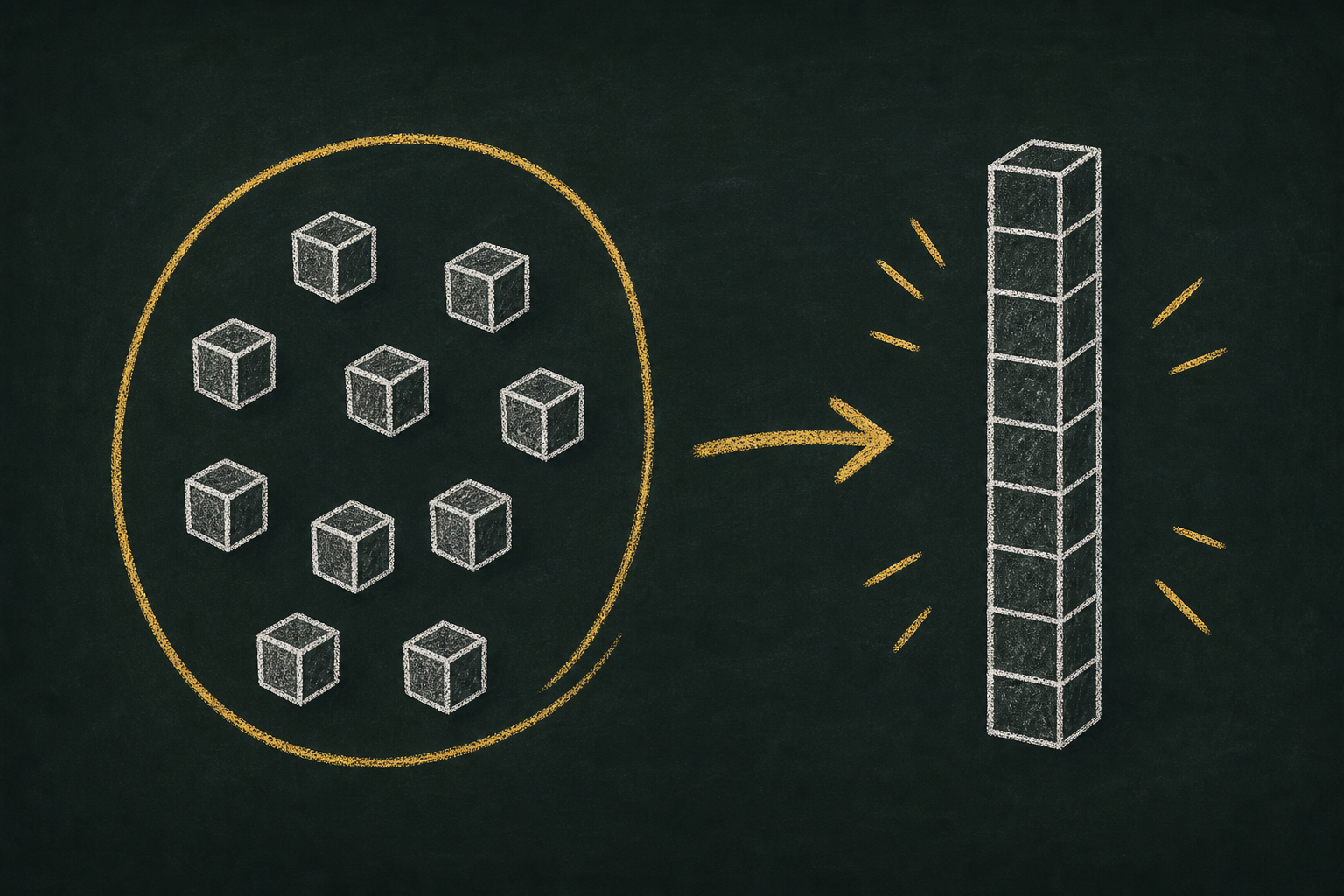
Ten ones always want to become one ten
Imagine saving pennies in a jar with a rule: every time you collect ten pennies, you swap them for one shiny dime and start a new pile. You never keep eleven loose pennies, you trade ten of them up. Bundling ten straws with a rubber band works the same way, and so does a ten-frame that fills up and spills into the next one.
That trade, ten ones for one ten, is the whole secret of carrying. When you add two numbers and the ones column overflows past nine, you make a ten and slide it over to the tens column. Today you will learn to spot when a ten needs making and to carry it neatly, so numbers like 28 + 15 hold no fear.
- Ten pennies traded for one dimecollect 10 ones, swap them for 1 ten, that is regrouping
- A ten-frame filling upthe eleventh counter starts a new frame, one full ten and one extra
- Bundling 10 straws with a bandloose straws become one bundle of ten once you reach ten
- Beads sliding along to the next wirepast ten, the count rolls over into the tens place
What students will be able to do
Students will add two-digit numbers within 100, recognise when the ones add to ten or more, compose a ten and carry it into the tens column, and record the addition neatly using the standard column method, checking the result makes sense.
- I can split a two-digit number into tens and ones.
- I can add the ones and the tens in the right columns.
- I can tell when the ones make a ten or more and need regrouping.
- I can carry the new ten into the tens column and finish the sum.
- I can check my answer with a friendly mental strategy.
Standards this unit teaches
- 2.NBT.B.5Common Core (US)Add and subtract within 100
Fluently add and subtract within 100 using strategies based on place value, properties of operations, and the relationship between addition and subtraction.
- 2.NBT.B.7Common Core (US)Compose a ten when adding
Add and subtract within 1000 using concrete models and place-value strategies, understanding that sometimes it is necessary to compose or decompose a ten. This unit teaches that composing-a-ten step, applied within 100.
- AC9M2N01Australian Curriculum v9 (ACARA)Partition, regroup and rename into tens and ones
Partition, regroup and rename two- and three-digit numbers in different ways, including splitting two-digit numbers into tens and ones. This place-value regrouping is exactly what carrying rests on.
- AC9M3N03Australian Curriculum v9 (ACARA)Add and subtract with regrouping (Year 3 bridge)
Add and subtract two- and three-digit numbers by using place value to partition, rearrange and regroup. ACARA places the full written add-with-regrouping algorithm at Year 3, so this US Grade 2 unit reaches toward that Year 3 descriptor.
Prior knowledge
This unit builds on skills students should already have met. Revisit any that are shaky first.
Words to teach and display
- Sum
- the total you get when you add
- Place value
- what a digit is worth from its position, tens or ones
- Digit
- a single number symbol, 0 to 9
- Regroup
- to trade 10 ones for 1 ten (or the other way round)
- Carry
- to move the made ten into the tens column
- Compose a ten
- to build one ten out of ten ones
Teach it: concrete, pictorial, abstract
The lesson moves from things students can hold, to pictures and diagrams, to the written maths. The diagrams below are drawn from data, so they are accurate and print cleanly. Teach straight from them.
1. A number is tens and ones
ConcreteBefore adding, make sure every child can pull a two-digit number apart. Show 28 with base-ten blocks or bundled straws: 2 tens and 8 ones. Say it together, twenty-eight is 2 tens and 8 ones, worth 20 and 8. The tens live on the left, the ones on the right. This split is the ground everything else stands on.
Do a few quickly: 34 is 3 tens and 4 ones, 60 is 6 tens and 0 ones, 45 is 4 tens and 5 ones. The bar model below shows 28 broken into its 20 and its 8, the same partition students will use when they line up a sum.
- How many tens and how many ones are in 47?
- Which digit is worth more in 53, the 5 or the 3? Why?
2. Adding when the ones stay under ten
PictorialStart with sums that do not need carrying, so the column routine is clear before regrouping arrives. Take 24 + 13. Add the ones first: 4 + 3 = 7, which is still a single digit, so it stays put. Then add the tens: 2 + 1 = 3 tens, worth 30. Together that is 37.
The rule to build now, before any carrying, is always add the ones column first, then the tens. Keeping the ones under a partner line and the tens under theirs stops digits drifting into the wrong place.
Add 35 + 22.
- Add the ones: 5 + 2 = 7. Under ten, so it stays in the ones place.
- Add the tens: 3 + 2 = 5 tens, worth 50.
- Put them together: 50 and 7.
Answer: 35 + 22 = 57.
- In 41 + 26, which column do you add first?
- Do the ones make ten or more here? So do we need to trade?
3. Composing a ten: the carry
PictorialNow the heart of the unit. Take 28 + 15. Add the ones: 8 + 5 = 13. But 13 ones cannot all stay in the ones place, because a place only holds a single digit, 0 to 9. So we trade: 13 ones is 1 ten and 3 ones. The 3 ones stay, and the 1 new ten is carried over to join the tens column. That carried 1 is the whole trick.
The bar model below shows the 13 ones splitting into the ten we carry and the 3 that stay. Say the trade out loud every time: thirteen ones is one ten and three ones, write the 3, carry the 1.
Then finish in the tens: 2 tens plus 1 ten plus the carried 1 ten is 4 tens, worth 40. With the 3 ones, that is 43.
- When do we have to make a ten and carry?
- In 8 + 5 = 13, which digit stays in the ones place and which is carried?
4. The column method, start to finish
AbstractPut it all together in the neat written method. Stack the two numbers so tens sit above tens and ones above ones. Add the ones column. If it reaches ten or more, write the ones digit below and carry the ten as a small 1 above the tens column. Then add the tens column, including any carried 1.
Work 28 + 15 the standard way and narrate every step, because the language is what makes it stick.
Add 28 + 15 using the column method.
- Line up the columns: 28 above 15, tens above tens, ones above ones.
- Add the ones: 8 + 5 = 13. Write 3 in the ones place, carry 1 above the tens.
- Add the tens: 2 + 1 + the carried 1 = 4. Write 4 in the tens place.
- Read the answer: 4 tens and 3 ones.
Answer: 28 + 15 = 43.
- Where does the carried 1 go, and what is it worth?
- After carrying, how many tens are you adding in 28 + 15?
5. Checking with a make-a-ten jump
AbstractA good mental strategy both checks the answer and shows why carrying works. To add 28 + 15 in your head, jump up to the next ten first. From 28, add 2 to land on 30 (that used 2 of the 15). Then add the remaining 13: 30 + 13 = 43. Making the ten on the way is the same trade as carrying, just done on a number line.
Encourage students to check every column answer this way. If the mental jump and the written method disagree, one of them has a slip to find.
- How much do you add to 28 to reach the next ten?
- After landing on 30, how much of the 15 is left to add?
Common misconceptions and how to address them
MisconceptionWhen the ones make 13, write all of 13 in the ones place, so 28 + 15 = 313.
Why it happens: Students record the full sum of the ones without trading, ignoring that a place holds only one digit.
How to address it: Return to the trade: 13 ones is 1 ten and 3 ones. Only a single digit fits in the ones place, so the 3 stays and the ten moves next door. Model it with bundled straws until the trade is automatic.
MisconceptionAdd the tens column first, then the ones.
Why it happens: Reading runs left to right, so students start on the left, but carrying needs the ones settled first.
How to address it: Always add the ones column first. You cannot know whether a ten will be carried into the tens until the ones are done. Draw an arrow starting at the ones column as a reminder.
MisconceptionForget to add the carried ten, so 28 + 15 comes out as 33.
Why it happens: The small carried 1 is easy to write and then overlook when adding the tens.
How to address it: Say the carried ten aloud as part of the tens sum: 'two tens, one ten, and the carried ten makes four tens'. Point to the little 1 before adding the column.
MisconceptionLine the numbers up by the left edge instead of by place value.
Why it happens: Students align the first digits they write rather than matching tens to tens and ones to ones.
How to address it: Use squared paper or a place-value chart with a column for tens and a column for ones. Ones must sit under ones, tens under tens, before any adding starts.
MisconceptionCarry the larger digit instead of the ten, e.g. carry 3 and write 1.
Why it happens: The trade gets remembered backwards under pressure.
How to address it: Anchor it to the trade: ten ones become one ten, so the ONE ten is what travels and the leftover ones stay. Rebuild it with a ten-frame that fills, spills one full ten, and leaves the extras behind.
MisconceptionEvery two-digit addition needs a carry.
Why it happens: After a run of regrouping practice, students carry out of habit even when the ones stay under ten.
How to address it: Mix in sums that need no trade, like 24 + 13. Check the ones first: only make a ten when the ones reach ten or more. Otherwise there is nothing to carry.
Guided practice (with answers)
1. Split 46 into tens and ones.
Answer: 4 tens and 6 ones, worth 40 and 6.
2. Add 32 + 25. Does it need a carry?
Answer: 57, and no carry. Ones 2 + 5 = 7 stays under ten, tens 3 + 2 = 5.
3. The ones add to 8 + 6. What do you write and what do you carry?
Answer: 8 + 6 = 14, so write 4 in the ones place and carry 1 ten.
4. Add 47 + 26 with the column method.
Answer: 73. Ones 7 + 6 = 13, write 3 carry 1. Tens 4 + 2 + 1 = 7.
5. Add 58 + 24.
Answer: 82. Ones 8 + 4 = 12, write 2 carry 1. Tens 5 + 2 + 1 = 8.
6. Use a make-a-ten jump to add 36 + 27.
Answer: 63. From 36 add 4 to reach 40, then add the remaining 23: 40 + 23 = 63.
Independent practice worksheets
Set the matching ChalkBee worksheets for independent work. The answer keys are computed in code, so they are never wrong. Start with place value, then move to two-digit addition once the trade is understood.
Differentiation
- Keep base-ten blocks or bundled straws on the desk and act out the trade for every sum.
- Use a printed tens-and-ones chart so digits cannot drift into the wrong column.
- Start with a made ten already shown, so the student only carries and finishes the tens.
- Limit to sums whose ones make exactly ten or eleven before moving to larger carries.
- Add three two-digit numbers, where the ones may make twenty and carry two tens.
- Move to three-digit sums that compose a ten and a hundred (bridging to 2.NBT.B.7).
- Ask students to write a subtraction that checks their addition (fact families).
- Pose a missing-addend puzzle: 28 + ? = 43, reasoned from place value.
Assessment: exit ticket
A three-question exit ticket for the last five minutes. It samples place value, a no-carry sum, and a carry sum.
1. How many tens and ones are in 53?
Answer: 5 tens and 3 ones.
2. Add 34 + 25.
Answer: 59 (no regrouping needed).
3. Add 29 + 16, and say what you carried.
Answer: 45. Ones 9 + 6 = 15, write 5 and carry 1 ten, tens 2 + 1 + 1 = 4.
Teacher notes and timings
- Rough timing across four lessons: Lesson 1 tens and ones plus no-carry sums (sections 1 to 2), Lesson 2 composing a ten (section 3), Lesson 3 the column method (section 4), Lesson 4 the make-a-ten check plus the exit ticket (section 5 and assessment).
- Language to keep saying: add the ones first, trade ten ones for one ten, write the ones and carry the ten. These phrases pre-empt most of the errors.
- Keep base-ten materials out through the pictorial sections. When a carry confuses a student, hand them ten ones to physically trade for one ten.
- Curriculum note: US Grade 2 teaches this within 100 (2.NBT.B.5) and composing a ten (2.NBT.B.7). ACARA introduces partitioning and regrouping tens and ones at Year 2 (AC9M2N01) but places the full written add-with-regrouping algorithm at Year 3 (AC9M3N03), so Australian teachers may meet this unit across Years 2 and 3.
- Resist teaching carrying as a rule with no meaning. The trade of ten ones for one ten is the understanding, and it carries straight into three-digit addition.
- Use Student view to project this lesson. Print saves the full teacher unit, including answers and teacher notes; use the linked independent-practice worksheets for student handouts.