Skip counting and number patterns
Counting in 2s, 5s and 10s, the pattern in the digits, and the runway to multiplication
About three to four lessons of 40 to 50 minutes
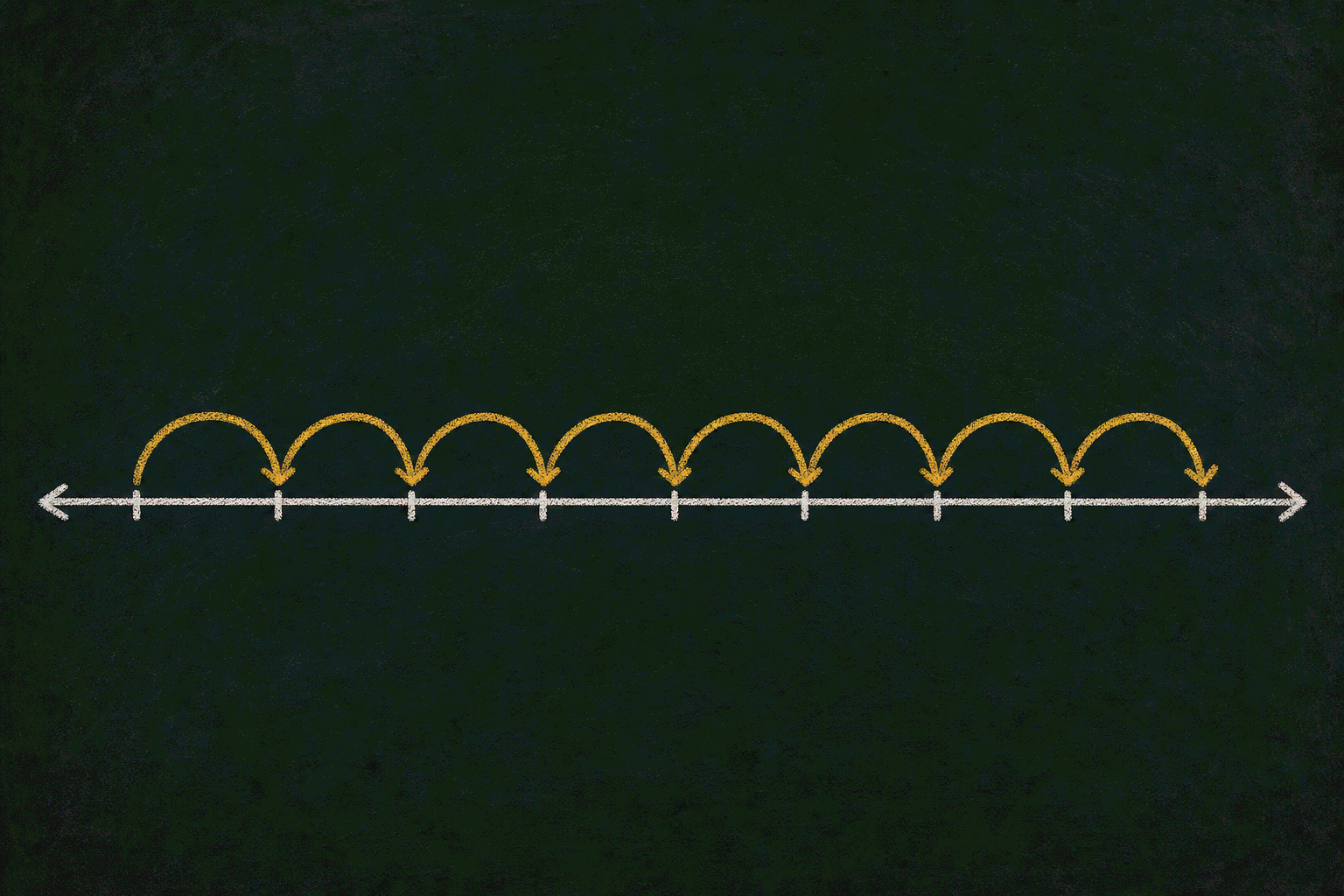
Some things come in twos, fives and tens, so count them that way
Look at your hands. Ten fingers, and they come in two fives. Socks come in pairs, so a drawer of socks comes in twos. Fingers on both hands, a high five, hands around the class, they come in fives. And ten cents, ten toes, ten in a full box, they come in tens. When things arrive in equal groups, counting them one at a time is slow. There is a faster way.
Skip counting means jumping along the numbers in equal steps: 2, 4, 6, 8 for pairs, 5, 10, 15, 20 for fives, 10, 20, 30 for tens. Today we learn to skip count in 2s, 5s and 10s, to spot the neat pattern hiding in the last digit, and to keep any number pattern going. Best of all, skip counting is the secret runway to the times tables you will meet next year.
- 5 pairs of sockscount the socks in 2s: 2, 4, 6, 8, 10
- 4 hands held upcount the fingers in 5s: 5, 10, 15, 20
- 3 full ten-framescount the dots in 10s: 10, 20, 30
- A row of five-cent coinscount the money in 5s: 5, 10, 15, 20, 25
What students will be able to do
Students will skip count forwards and backwards in 2s, 5s and 10s from a range of starting points, recognise the pattern in the ones digit for each count, connect skip counting to counting equal groups and to early multiplication, and continue and describe simple growing number patterns.
- I can count forwards in 2s, 5s and 10s.
- I can count backwards in 2s, 5s and 10s.
- I can show a skip count as equal jumps on a number line.
- I can spot the pattern in the last digit when I count in 2s, 5s or 10s.
- I can find the missing number in a growing pattern and say the rule.
Standards this unit teaches
- 2.NBT.A.2Common Core (US)Count within 1000 and skip count
Count within 1000, and skip count by fives, tens and hundreds, building the number-sequence patterns that underpin place value and multiplication.
- 2.OA.C.3Common Core (US)Even and odd, counting by twos
Determine whether a group of up to 20 objects is odd or even by pairing them or counting by twos, and write an even number as a sum of two equal addends.
- AC9M2N03Australian Curriculum v9 (ACARA)Count collections by skip counting (Year 2)
Count collections of up to at least 120 by grouping the objects equally and skip counting, connecting the count to the size of the groups.
- AC9M2A01Australian Curriculum v9 (ACARA)Repeating patterns and the unit (Year 2)
Recognise, continue and create patterns with numbers, shapes and objects, and name the part that repeats. Number patterns that grow by a steady step, such as skip counting, extend this idea.
Prior knowledge
This unit builds on skills students should already have met. Revisit any that are shaky first.
Words to teach and display
- Skip counting
- counting in equal steps instead of by ones, such as 5, 10, 15
- Multiple
- a number you land on when you skip count, such as 10 being a multiple of 5
- Even number
- a number you land on counting by 2s from 0, that splits into two equal groups
- Pattern
- a sequence that follows a rule, like adding the same amount each time
- Step
- the equal amount you add each jump, such as 5 when counting in fives
- Number line
- a line with numbers in order, where equal jumps show a skip count
Teach it: concrete, pictorial, abstract
The lesson moves from things students can hold, to pictures and diagrams, to the written maths. The diagrams below are drawn from data, so they are accurate and print cleanly. Teach straight from them.
1. Counting equal groups the fast way
ConcreteStart with real things that come in equal groups. Lay out five pairs of socks. Ask the class to count all the socks one by one, then count them again in twos: 2, 4, 6, 8, 10. Same answer, far fewer words. When objects sit in equal groups, you can count the groups in steps instead of counting every object.
Group first, then count. Two socks in a pair, so we count in twos. Five fingers on a hand, so we count in fives. Ten in a full ten-frame, so we count in tens. The size of the group is the size of your jump.
Keep saying the numbers out loud together, and touch each group as you say its running total. Touching the second pair as you say eight, not four, is the move that turns one-by-one counting into skip counting.
- There are 4 hands up. Count the fingers in fives. How many?
- Why is counting these socks in twos faster than counting by ones?
- If things come in groups of ten, what size jump should you count in?
2. Skip counting as equal jumps
PictorialMove the counting onto a number line so the jumps are visible. Counting in twos is a line of equal hops, each one 2 long: start at 0 and hop to 2, 4, 6, 8, 10. Every hop is the same size, and the numbers you land on are the count.
The same picture works for any step. For fives, each hop is 5 long: 5, 10, 15, 20, 25. For tens, each hop is 10 long: 10, 20, 30. The bigger the step, the bigger the hop and the faster you travel along the line.
This is why skip counting builds number sense. You are not just chanting, you are seeing equal jumps land on the same numbers every time, which is exactly the pattern that becomes multiplication.
Skip count in tens from 0 to 50, and show the jumps.
- Start at 0. Each jump is 10 long.
- Jump: 0 to 10, 10 to 20, 20 to 30, 30 to 40, 40 to 50.
- The numbers you land on are the count.
Answer: 10, 20, 30, 40, 50. Five equal jumps of 10.
- How big is each jump when you count in fives?
- On the twos line, what number comes after 8?
3. The pattern in the last digit
PictorialSkip counting hides a tidy pattern in the ones digit, and spotting it makes the counts stick. Write the counts in a column and look only at the last digit of each number. A pattern jumps out for every step.
Count in tens: 10, 20, 30, 40, 50. Every number ends in 0. Count in fives: 5, 10, 15, 20, 25, 30. The last digit goes 5, 0, 5, 0, over and over. Count in twos from 0: 2, 4, 6, 8, 10, 12. Every number is even, and the last digit repeats 2, 4, 6, 8, 0.
These are not tricks to memorise on their own, they are checks. If you count in fives and land on 23, the last digit tells you something went wrong, because a count of fives can only end in 5 or 0. The pattern lets a child catch their own mistakes.
Sam counts in fives and says 5, 10, 15, 20, 24. Which number is wrong, and how do you know?
- A count of fives must end in 5 or 0. Check each last digit.
- 5, 0, 5, 0 are all fine, but 24 ends in 4.
- So 24 breaks the pattern. After 20, the next five is 25.
Answer: 24 is wrong. Counting in fives, the number after 20 is 25, because fives always end in 5 or 0.
- What digit does every number end in when you count in tens?
- You count in twos from 0 and land on 15. How does the last digit tell you that is a mistake?
4. Starting anywhere and counting backwards
AbstractReal counting does not always start at 0, and sometimes you count down. Skip counting works from any starting point and in either direction, as long as every jump stays the same size.
Start a twos count at 3 instead of 0: 3, 5, 7, 9, 11. The jumps are still 2 each, so the count still moves in equal steps, it just lands on odd numbers this time. Start a tens count at 4: 4, 14, 24, 34.
Counting backwards is the same jumps in reverse. Count back in fives from 30: 30, 25, 20, 15, 10, 5. Count back in tens from 50: 50, 40, 30, 20, 10. Backwards skip counting is the seed of subtraction and of dividing into equal groups.
Count on in twos starting at 6, four more numbers.
- Start at 6. Each jump adds 2.
- 6, then 8, then 10, then 12, then 14.
- The jumps stayed equal, so the count is still a twos count, just starting from 6.
Answer: 6, 8, 10, 12, 14.
- Count back in fives from 25. What are the next three numbers?
- Start a tens count at 7. What comes after 7?
5. Growing number patterns and the rule
AbstractSkip counting is one kind of number pattern: a sequence that grows by the same step each time. Turn it into a puzzle. Show a pattern with a gap and ask two questions: what is the step, and what number fills the gap?
To find the rule, look at how much the numbers jump each time. In 3, 6, 9, 12 the numbers go up by 3 every time, so the rule is start at 3, add 3 each time, and the next number is 15. Once you know the step, you can fill any gap and keep the pattern going.
Not every pattern adds the same as a skip count you know, so always check the step first. The step might be 3, 4 or 6. Read two or three numbers, find the constant jump, then use it forwards to continue or backwards to fill an earlier gap.
Find the missing number and the rule: 5, 10, __, 20, 25.
- Find the step: 5 to 10 is up 5, and 20 to 25 is up 5, so the rule is add 5.
- The gap sits after 10, so add 5 to 10.
- 10 add 5 is 15, which also fits before 20.
Answer: The missing number is 15. The rule is start at 5 and add 5 each time.
- What is the step in the pattern 10, 20, 30, 40?
- Fill the gap: 2, 4, __, 8, 10. What is the rule?
Common misconceptions and how to address them
MisconceptionSkip counting gives a different total from counting the objects one by one.
Why it happens: Children trust one-by-one counting and doubt the faster count, especially if they lose their place.
How to address it: Count the same equal-group collection both ways and land on the same total. Touch each group as you say its running total. Same objects, same answer, fewer counts.
MisconceptionWhen you count in twos, you say 2, 4, 6 but only three things are there, because you skipped 1, 3, 5.
Why it happens: Children think the skipped numbers are missing objects rather than skipped labels.
How to address it: Show that each jump of 2 covers two objects at once. You did not skip any socks, you counted them two at a time. Point to two socks for each number you say.
MisconceptionEvery number pattern goes up by ones between the numbers shown.
Why it happens: One-by-one counting is so familiar that children read every list as consecutive.
How to address it: Circle the jump between two terms and count it: from 5 to 10 is a jump of 5, not 1. Find the step before continuing any pattern.
MisconceptionSkip counting only ever starts at 0.
Why it happens: Every early example starts at 0, so children assume it must.
How to address it: Start counts from other numbers: 3, 5, 7, 9 is still a twos count. The rule is equal jumps, not a fixed starting point. What matters is that every step is the same size.
MisconceptionCounting in fives can land on numbers like 23 or 37.
Why it happens: Children chant the rhythm without checking the numbers they say.
How to address it: Teach the last-digit check: a fives count only ends in 5 or 0. If you land on 23, the last digit shows the slip. Use the digit pattern to self-check.
MisconceptionCounting backwards is a different, harder skill unrelated to skip counting.
Why it happens: Backwards counting is practised less, so it feels new.
How to address it: Show backwards counting as the same jumps in reverse. Count-on in tens is 10, 20, 30, and count-back is 30, 20, 10. Same steps, opposite direction along the line.
Guided practice (with answers)
1. Count in twos from 0 to 12.
Answer: 2, 4, 6, 8, 10, 12. Each jump adds 2.
2. Count in fives from 0 to 25.
Answer: 5, 10, 15, 20, 25. Every number ends in 5 or 0.
3. Count back in tens from 40.
Answer: 40, 30, 20, 10, 0. The same jumps of 10, going left.
4. Fill the gap: 2, 4, 6, __, 10.
Answer: 8. The step is 2, and 6 add 2 is 8.
5. What is the rule for 5, 10, 15, 20?
Answer: Start at 5 and add 5 each time. It is counting in fives.
6. Sam counts in twos and says 2, 4, 5, 8. Which number is wrong?
Answer: 5. Counting in twos from 0 lands only on even numbers, so after 4 comes 6, not 5.
Independent practice worksheets
Set the matching ChalkBee skip-counting and pattern worksheets for independent work. The answer keys are computed in code, so they are never wrong. Start with counting in 2s, 5s and 10s, then move to filling gaps in growing patterns.
Differentiation
- Keep real equal-group objects on the desk (pairs of counters, ten-frames) so every skip count can be checked by touching the groups.
- Start with tens, the easiest pattern, then fives, then twos.
- Use a hundred square and colour the numbers landed on, so the pattern is a picture the child can see.
- Count out loud together as a class before any child counts alone.
- Skip count in 3s and 4s, and look for the last-digit pattern in each.
- Connect a skip count to multiplication in words: four jumps of 5 is 20, that is four fives.
- Start a fives count at a number like 3 (3, 8, 13, 18) and describe the new last-digit pattern.
- Make up a growing pattern with a step of 3 or 4 and a gap, and swap with a partner to solve.
Assessment: exit ticket
A three-question exit ticket for the last five minutes, sampling a forwards count, a backwards count, and a missing number in a pattern.
1. Count in fives from 0 to 20.
Answer: 5, 10, 15, 20.
2. Count back in twos from 10, three numbers.
Answer: 10, 8, 6.
3. Fill the gap and say the rule: 10, 20, __, 40.
Answer: 30. The rule is add 10 each time (counting in tens).
Teacher notes and timings
- Rough timing across three to four lessons: Lesson 1 counting equal groups (section 1), Lesson 2 jumps on the number line (section 2), Lesson 3 the last-digit pattern (section 3), Lesson 4 starting anywhere, backwards, and patterns plus the exit ticket (sections 4 to 5 and assessment).
- Language to keep saying: equal groups, equal jumps, the same step each time, count the groups not the objects. These pre-empt most of the misconceptions.
- The number-line diagrams show only whole numbers, so the equal jumps are clear at a glance. Point to each hop as the class says the running total.
- The single most useful habit is the last-digit check: fives end in 5 or 0, tens end in 0, twos from 0 are even. It lets children catch their own slips.
- Link forward to multiplication in words only at this grade: four jumps of 5 is 20 previews 4 times 5. Do not introduce the times symbol yet, keep it as equal jumps.
- Curriculum note and a US and AU alignment: the US places skip counting by 5s, 10s and 100s in Grade 2 (2.NBT.A.2) and counting by 2s through even and odd in Grade 2 (2.OA.C.3). ACARA introduces steady-step growing patterns a year earlier at Year 1 (AC9M1A01) and equal-group skip counting at Year 2 (AC9M2N03), with continuing and naming patterns at Year 2 (AC9M2A01), so the two frameworks line up closely around Year 2.
- Use Student view to project this lesson. Print saves the full teacher unit, including answers and teacher notes; use the linked independent-practice worksheets for student handouts.