Rhyming and beginning sounds
Hearing rhymes and identifying the first sound in a spoken word, the foundation phonological awareness skills before letters and spelling
About three lessons of 20 to 30 minutes
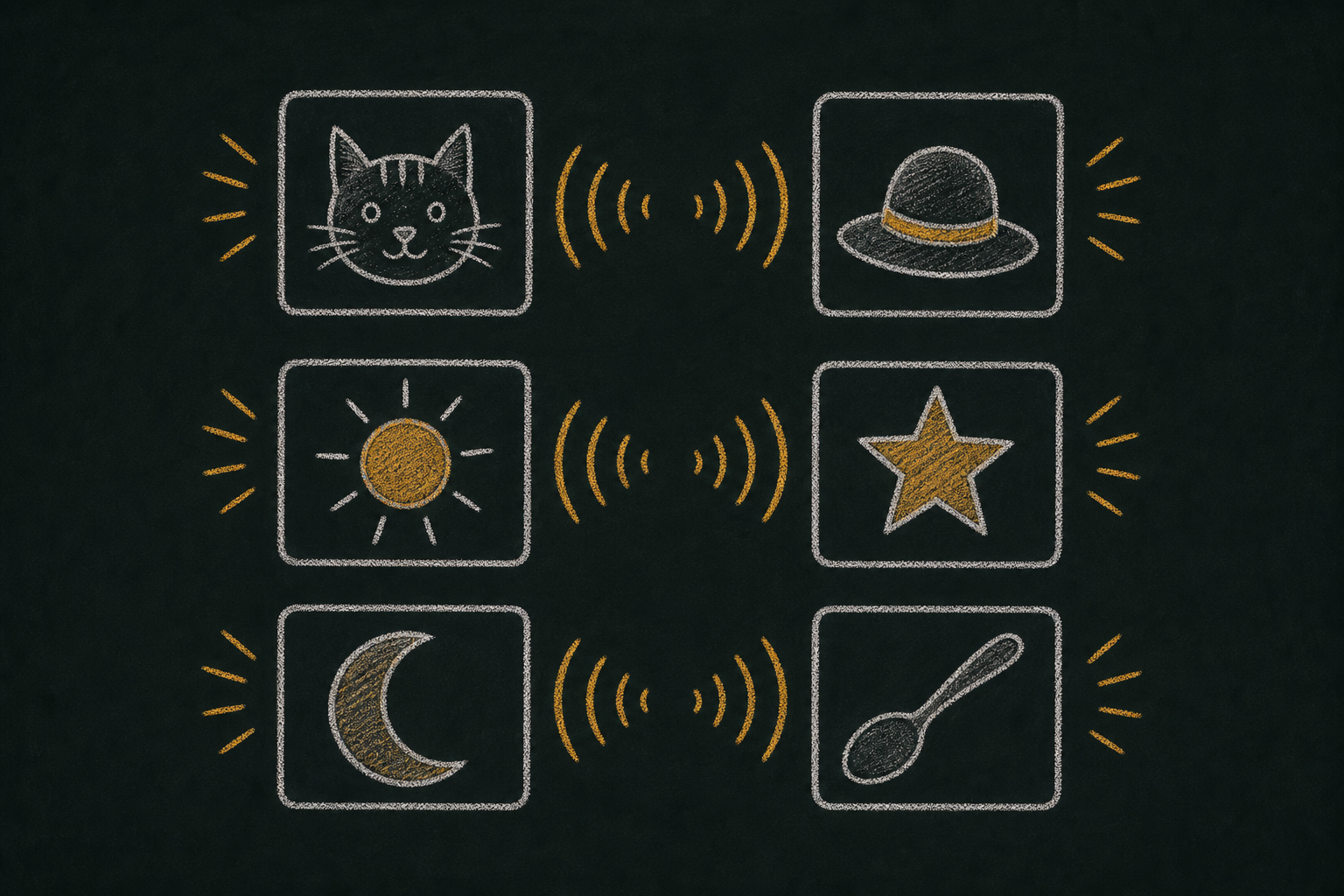
Before letters, there is listening
Long before a child reads a single word, they need to hear that spoken language is made of smaller pieces: words are made of syllables, and syllables are made of sounds. This listening skill is called phonological awareness, and it is the single strongest early predictor of how easily a child learns to read.
This unit teaches two of the most accessible phonological awareness skills: hearing that two words rhyme (cat and hat), and identifying the very first sound in a spoken word (dog starts with /d/). Both are entirely oral, said and heard, no letters involved yet.
- cat, hat, batthese all rhyme, they end with the same sound
- listen for the first sound'sun' starts with the /s/ sound, said by itself: sss
- clap for yesa simple physical response lets every child answer without needing to write
- sound out loud, not spelled outphonological awareness is 100% about spoken sound, letters come later
What students will be able to do
Students will recognise when two spoken words rhyme, will generate a word that rhymes with a given word, will identify the first sound in a spoken word, and will sort or match spoken words by their beginning sound, all without needing to read or write any letters.
- I can tell if two words rhyme by listening to how they end.
- I can think of a word that rhymes with a word I am given.
- I can say the first sound I hear in a spoken word.
- I can find other words that start with the same sound.
Standards this unit teaches
- CCSS.ELA-LITERACY.RF.K.2Common Core (US)Phonological awareness
Demonstrate understanding of spoken words, syllables, and sounds (phonemes): recognize and produce rhyming words, and count, pronounce, blend, and segment syllables in spoken words.
- AC9EFLY09Australian Curriculum v9 (ACARA)Phonological awareness
Recognise and generate rhyming words, alliteration patterns, syllables and phonemes in spoken words.
Prior knowledge
This unit builds on skills students should already have met. Revisit any that are shaky first.
Words to teach and display
- Rhyme
- two words that end in the same sound, like cat and hat
- Syllable
- a beat in a spoken word; 'dog' has one beat, 'ele-phant' has three
- Beginning sound
- the very first sound heard in a spoken word, said on its own
- Phoneme
- the smallest single sound in spoken language, such as the /m/ in 'mat'
Teach it: listen, say, play
This is entirely a listening and speaking unit: no reading or writing is required, since phonological awareness works on the sounds of spoken words, not on letters. Say every word aloud, exaggerate the sounds, and let students respond out loud or with a physical action (clap, thumbs up) rather than writing.
1. Hearing that two words rhyme
ConcreteStart entirely with listening: say two words aloud and ask if they rhyme, using a physical yes/no response. Only after students can identify rhymes reliably do you move to generating their own.
Say word pairs aloud, clearly and slowly: cat/hat (rhymes), cat/dog (does not rhyme). Ask students to clap or give a thumbs up for 'rhymes' and stay still for 'does not rhyme.'
Use real objects or pictures where possible (a real hat, a toy cat) so the activity stays playful and concrete, matching how young children learn best before any print is involved.
Say 'sun' and 'fun' aloud. Do they rhyme?
- Say both words slowly: sun... fun.
- Listen to the ending sound of each: both end in the '-un' sound.
- Since the ending sounds match, they rhyme.
Answer: Yes, sun and fun rhyme, they both end with the same '-un' sound.
- What does it mean for two words to rhyme?
- Do cat and dog rhyme? Why not?
- How do we show 'yes, it rhymes' without saying a word?
2. Thinking of a rhyming word
ConcreteMove from recognising rhymes to generating them, a harder skill since it requires actively searching memory for a matching sound, not just comparing two given words.
Give one word and ask students to think of a word that rhymes with it. Accept real words and playful made-up words that still follow the rhyme pattern, the goal is hearing the sound pattern, not vocabulary.
If a student struggles, offer a choice of two or three words and ask which one rhymes, turning generation back into the easier recognition task temporarily.
Think of a word that rhymes with 'bug'.
- Say the word slowly: bug.
- Listen for its ending sound: '-ug'.
- Think of another word ending the same way: rug, hug, mug or tug all work.
Answer: Any of rug, hug, mug or tug rhymes with bug, they all share the '-ug' ending sound.
- Why is thinking of a rhyme harder than just hearing if two words rhyme?
- Is a made-up word allowed if it still rhymes?
- Can you think of a word that rhymes with 'top'?
3. Finding the beginning sound
ConcreteShift to a different phonological skill: isolating the very first sound in a spoken word. Model stretching out the start of a word so the first sound stands alone.
Say a word slowly and stretch the first sound: 'mmm-at' for mat, so the /m/ is clearly heard on its own before the rest of the word.
Ask 'what is the first sound you hear?' and accept the sound itself (said aloud, like 'mmm'), not the letter name, since this is still entirely about spoken sound.
Say 'dog' slowly and identify its beginning sound.
- Stretch the word: d-d-d-og.
- Isolate the very first sound: /d/.
- Say the sound on its own, separate from the rest of the word.
Answer: The beginning sound in 'dog' is /d/, the sound said on its own before the rest of the word.
- What is the beginning sound in 'sun'?
- Why do we stretch out the word first?
- Is the beginning sound the same as the letter name?
4. Sorting words by their beginning sound
PictorialBring beginning sounds together with a sorting activity: given a set of pictures or spoken words, group the ones that start with the same sound. This is the bridge toward the beginning-sounds worksheets.
Show or say a set of words: cat, cup, dog, cake, duck. Ask students to group the ones that start with the same sound as each other.
Keep this oral and visual (pictures) rather than written, matching how the ChalkBee beginning-sounds worksheet presents pictures to match by sound, not spelling.
Sort 'cat', 'cup' and 'dog' into groups by beginning sound.
- Say each word and isolate its first sound: cat -> /c/, cup -> /c/, dog -> /d/.
- Group the matching sounds together: cat and cup share /c/.
- Dog stands alone since its beginning sound /d/ does not match the others.
Answer: Cat and cup go together (both start with /c/), and dog is in its own group (starts with /d/).
- Which two of cat, cup and dog start with the same sound?
- How do you check if two words start with the same sound?
- Can a group have just one word in it?
Common misconceptions and how to address them
MisconceptionTwo words rhyme if they look similar in spelling.
Why it happens: Some children have already started noticing print and judge by letters rather than sound, missing that this is an oral skill.
How to address it: Keep every example purely spoken at this stage, with no print in sight. Say word pairs aloud and remind students they are listening, not looking.
MisconceptionThe beginning sound is the name of the letter.
Why it happens: Children who already know some letter names say 'the first sound in dog is dee' (the letter name) instead of the sound /d/.
How to address it: Model the difference explicitly: the letter is called 'dee,' but the sound it makes is /d/, said with the mouth in the same shape as the start of 'dog.' Practise saying sounds, not letter names.
MisconceptionAny two words that share a sound anywhere rhyme.
Why it happens: Children sometimes match words that share a sound in the middle or start, not the ending, and call them rhymes.
How to address it: Anchor rhyme specifically to the ending sound. Say pairs and touch your ear at the END of each word to cue where to listen.
Guided practice (with answers)
1. Do 'pig' and 'wig' rhyme?
Answer: Yes, pig and wig rhyme, they both end with the '-ig' sound.
2. Think of a word that rhymes with 'bee'.
Answer: Any of tree, see, key or free rhymes with bee, they share the ending '-ee' sound.
3. What is the beginning sound in 'fish'?
Answer: The beginning sound in fish is /f/, said by stretching the start of the word: fff-ish.
4. Do 'ball' and 'bike' start with the same sound?
Answer: Yes, both ball and bike start with the /b/ sound, even though the rest of each word is different.
Independent practice worksheets
Set the matching ChalkBee phonological awareness worksheets, read aloud with the class or in small groups since students are not yet expected to read independently. Students respond by circling, drawing a line, or saying the answer aloud for a teacher to record.
Differentiation
- Use real objects or clear pictures rather than words alone, so meaning is never a barrier to the sound task.
- Slow every word down further, stretching sounds even more than usual, and allow extra thinking time before expecting a response.
- Start with only two choices when generating rhymes (is it more like 'cat' or 'dog'?) before asking for a fully open-ended rhyme.
- Pair a stronger and a developing student for the sorting activity so the developing student hears a model response first.
- Introduce syllable counting (clapping the beats in a word) as a related but separate phonological skill.
- Challenge students to generate three or four rhymes for one word, not just one.
- Introduce simple alliteration (several words starting with the same sound in a row) as a playful extension of beginning sounds.
- Begin connecting a spoken sound to its most common letter for students who are ready (e.g. /s/ is usually spelled with the letter s).
Assessment: exit ticket
A short one-on-one or small-group oral check rather than a written test, since this unit is entirely phonological. Ask each question aloud and note the response.
1. Do 'hat' and 'cat' rhyme?
Answer: Yes, they rhyme, they both end with the '-at' sound.
2. Tell me a word that rhymes with 'pen'.
Answer: Any of ten, hen or den is acceptable, they share the ending '-en' sound.
3. What sound does 'mouse' start with?
Answer: The beginning sound in mouse is /m/.
Teacher notes and timings
- Rough timing across three short lessons: Lesson 1 hearing and generating rhyme (sections 1 and 2), Lesson 2 finding beginning sounds (section 3), Lesson 3 sorting by beginning sound plus the oral assessment (section 4 and assessment).
- This entire unit should be delivered orally: say words aloud, respond aloud or with an action, and keep print out of sight until phonological awareness is secure. Reading it off a worksheet defeats the purpose of a listening skill.
- Language to keep saying: listen to the ending, listen to the beginning, say it slowly. These phrases cue the exact listening behaviour each activity needs.
- Curriculum note: the US names rhyme production and syllable/phoneme work together in one Kindergarten foundational-skills standard (RF.K.2). ACARA v9 groups rhyme, alliteration, syllables and phonemes together in one Foundation Year descriptor (AC9EFLY09). Both frameworks treat phonological awareness as a single connected skill area, which is why this unit teaches rhyme and beginning sounds side by side rather than as separate topics.
- Present mode works well here as a shared listening activity (say the words aloud to the whole class from the screen), though this unit leans more on spoken delivery than the screen itself.